Store Signage: The Guide to Designing a Clear, On-Brand Retail Space
- LED neon sign power consumption runs 8 to 15 W per meter. A one-meter sign used 8 hours daily costs about $6 to $8 per year at the 2026 US average near 17 cents per kWh.
- This guide covers watts per meter, yearly kWh and cost tables, gas neon comparison, standby draw, and bill-cutting tips.
Updated October 5, 2026, by Guillaume Schlupp, founder of Helioneon.
Store signage covers every support that guides shoppers, shares information, and carries a retail space’s identity: exterior signs, aisle wayfinding, price displays, checkout signage, and branded light elements. Done well, it shortens search time and structures the path through the store. At Helioneon we build custom neon signs into these projects, and this guide is for store planners, commercial architects, and retailers who want coherent store signage.
In a retail space, shoppers decide fast: a few seconds is enough to know whether they found the right section or should walk out. That is why signage is not a décor line item. It is a sales and brand tool. With more than 500 neon signs delivered, a growing share for boutiques, concept stores, and franchise networks, we see the same mistakes return on fit-out plans. Here is a method to avoid them, from the brief through installation.
What is store signage and what is it for?
It has three jobs: orient the shopper in the space, inform them about the offer and prices, and assert the brand identity. One piece can fill more than one role, but none of the three should be missing from the plan. When orientation is weak, shoppers stop staff or leave. When identity is weak, the store looks like every other store.
So we separate directional signage (aisles, fitting rooms, checkout), informational signage (prices, promotions, required notices), and ambient brand signage. Neon belongs in that last family: a logo, slogan, or collection name in light, readable from a distance, acting as both landmark and signature.
- Directional: guide to aisles, fitting rooms, checkout, and exits
- Informational: prices, promotions, hours, required notices
- Identity: logo, slogan, brand world, often in a lit version
- Regulatory: safety, egress, accessibility, required in spaces open to the public
For a store planner or commercial architect, these families are designed together from the layout plan. Signage added after opening often stacks supports and muddies the message. That is why the signage plan is drawn with furniture and lighting, not once the store is live.
What are the different types of in-store signage?
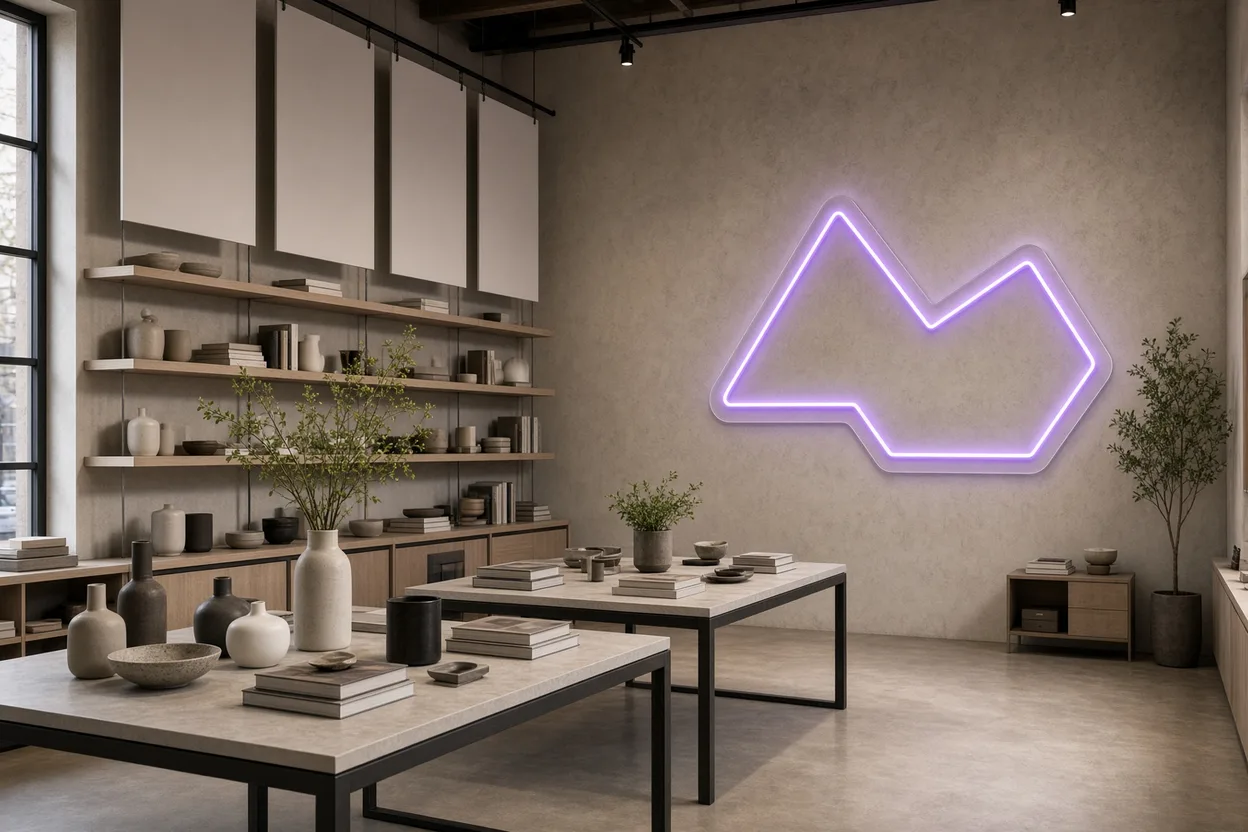
In-store signage supports range from simple vinyl to illuminated signs, and the right choice depends on reading distance, expected lifespan, and budget. A promo sticker lasts a few weeks, while a brand element must hold up for years without degrading. The table below compares the supports used most often on retail fit-out jobs. To go further, our guide to sensory marketing shows how to combine light, music and scent.
| Support | Best use | Typical lifespan |
|---|---|---|
| Custom LED neon | Logo, slogan, zone landmark readable from afar | 100,000 hours, 3-year warranty |
| Cut letters | Brand name on a wall or fascia | Several years |
| Aisle hanging signs | Wayfinding in larger floor plates | Several years |
| Totem or banner stand | Promotion, entrance, event | A few months |
| Vinyl and window graphics | Promos, hours, window décor | A few weeks to months |
| Digital screens | Content that changes often | Depends on the hardware |
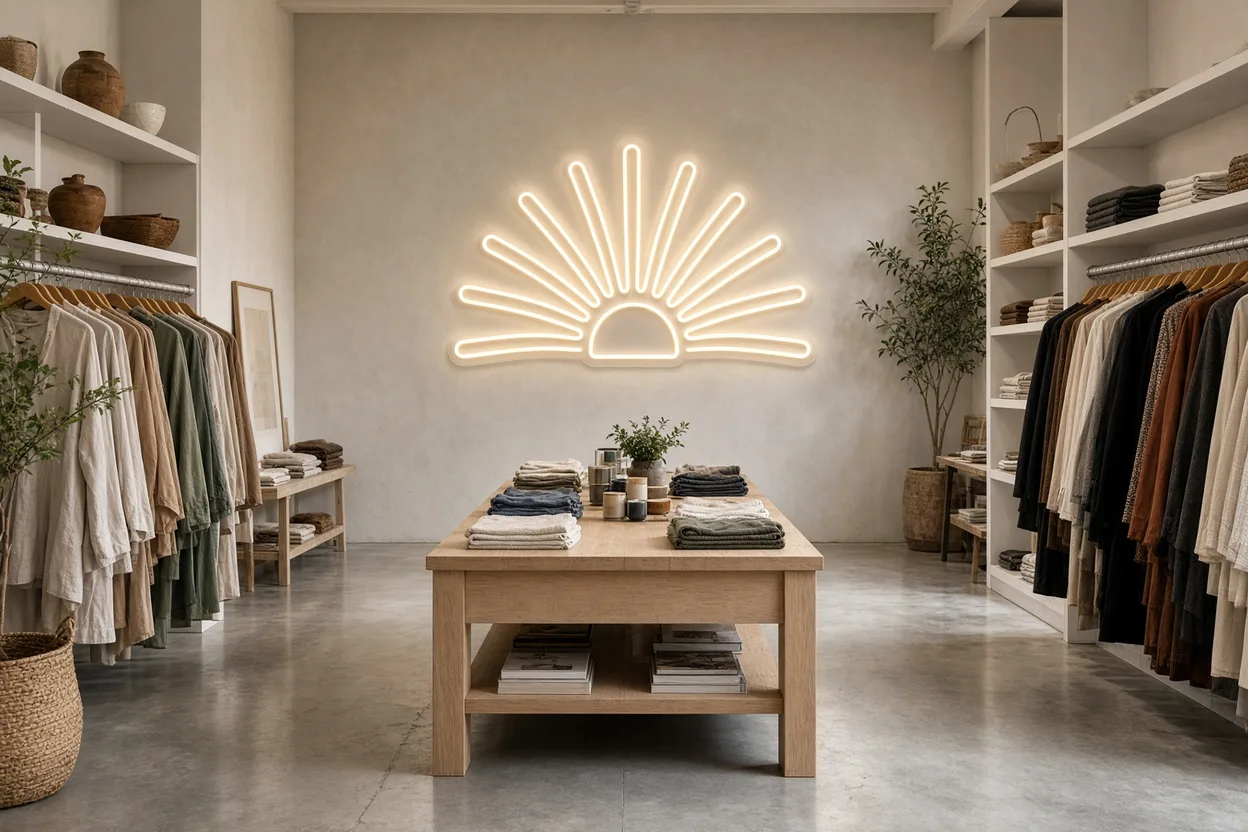
Neon has a particular advantage on a signage plan: it works as a visual landmark even when the rest of the lighting is even. And because it is made to order, it matches the brand’s type and color exactly, which makes it an identity support more than a décor object.
In one store you usually combine two or three of these supports. Durable pieces carry identity and orientation, while temporary supports carry promotions and events. That split keeps a stable, readable base and still gives teams room to keep the floor fresh.
How do you design effective store signage?
Effective store signage is designed from the customer journey, not from the supports on hand. Start with the floor plan, mark decision points (entrance, aisle junctions, fitting rooms, checkout), and place a landmark at each one. Only then pick the support that fits the distance and the message.

Hierarchy matters as much as placement. If everything is highlighted, nothing stands out: reserve the most visible pieces, often lit ones, for two or three core messages, and keep the rest quiet. For example, a neon at the back of the store pulls the eye and draws shoppers into quieter zones, while aisle signage stays sober and consistent.
- Start from the plan: map decision points on the customer journey
- Rank the messages: three reading levels max, from distant landmark to detail
- Follow the brand system: one type family, one palette, consistent icons
- Test distances: a message must read from the spot where it is useful
- Plan maintenance: swapping a promo should not mean rebuilding everything
Before fabrication, a plan test or mockup validates that path. Stand in for a first-time shopper and check that every zone is findable without help. When a landmark is missing or lost in the décor, fix it then, because every change after install costs more.
What rules apply to illuminated store signage?
Illuminated store signage is framed by rules in many countries and municipalities. Nighttime curfews often require exterior lit signs to be turned off after hours, flashing is frequently restricted or banned outside limited uses, and a facade sign may need a local permit or approval before install.
Inside the store, other rules protect the shopper: price display for goods offered for sale is generally required, and safety and egress signage must stay fully visible. A decorative neon must never cover an exit mark or hurt its readability, a point to check on the plan from day one.
- Night shutoff: many cities require lit signs off overnight when the business is closed
- Flashing: often restricted or banned outside limited emergency-type uses
- Price display: required for products offered for sale
- Public access: never block safety and egress signage
- Permit: a facade or window-facing sign may need local approval
Rules also vary by city and by zoning. A local sign code can add limits on size, brightness, color, or hours for signs visible from the street. Before placing a lit piece in a window or on the facade, check with your municipality so you avoid a costly retrofit later.
How do you integrate LED neon into store signage?
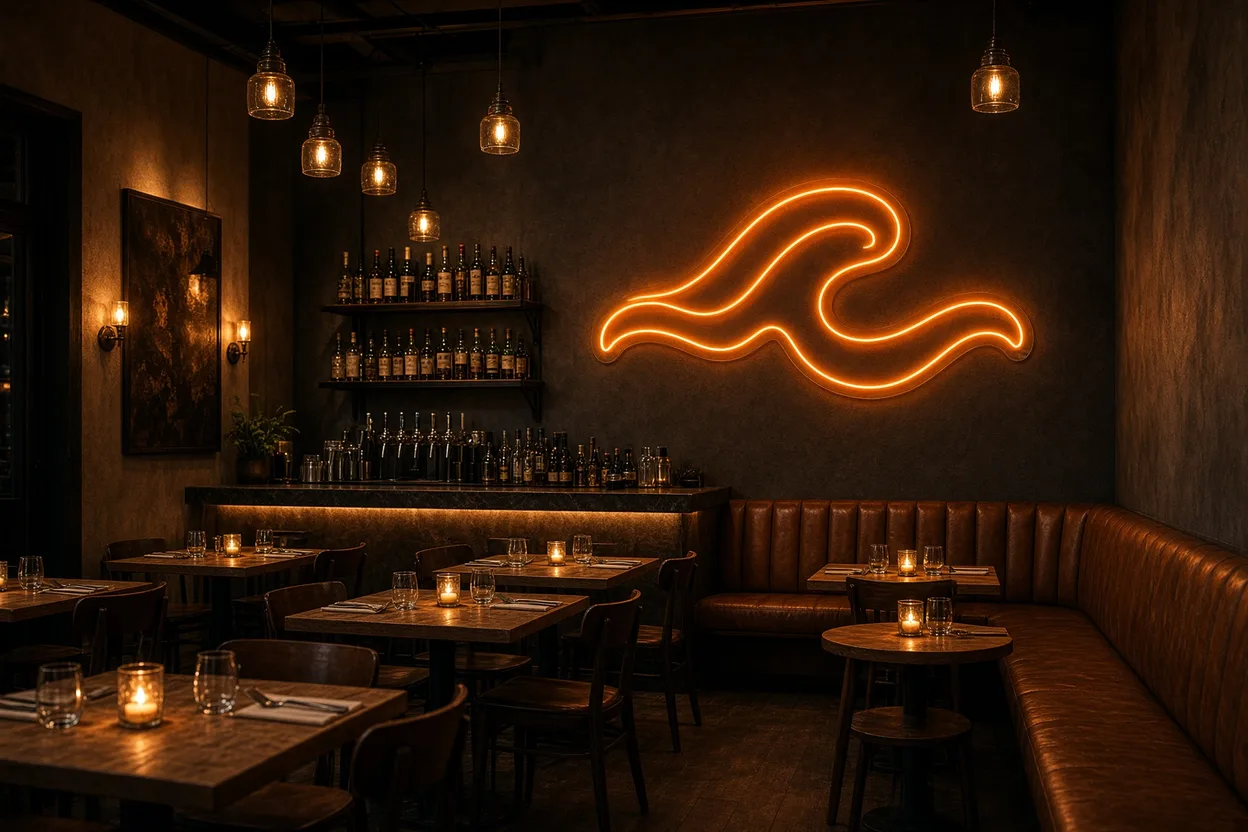
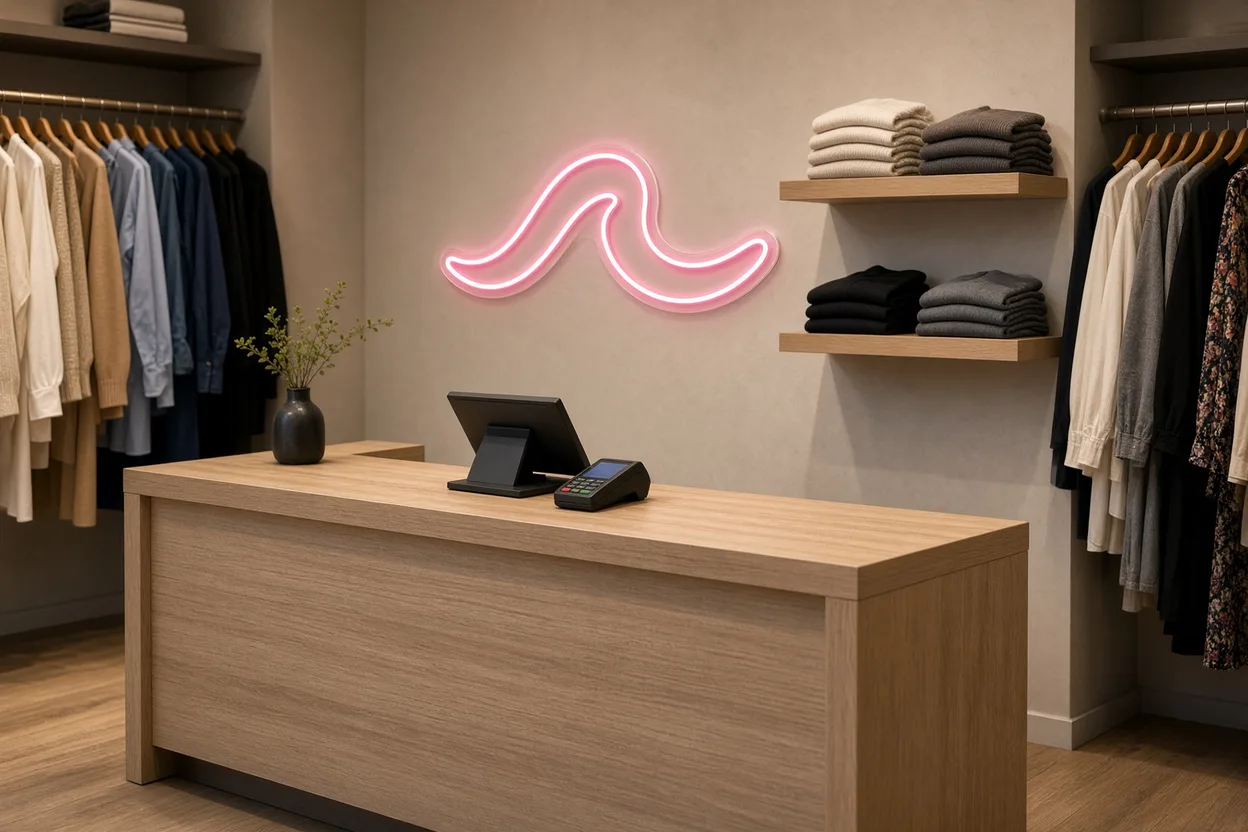
LED neon fits store signage as an identity element: logo behind checkout, collection name over a bay, slogan on the back wall, or zone landmark in a large floor plate. Its soft glow draws the eye without glare, and it matches brand type and colors exactly.
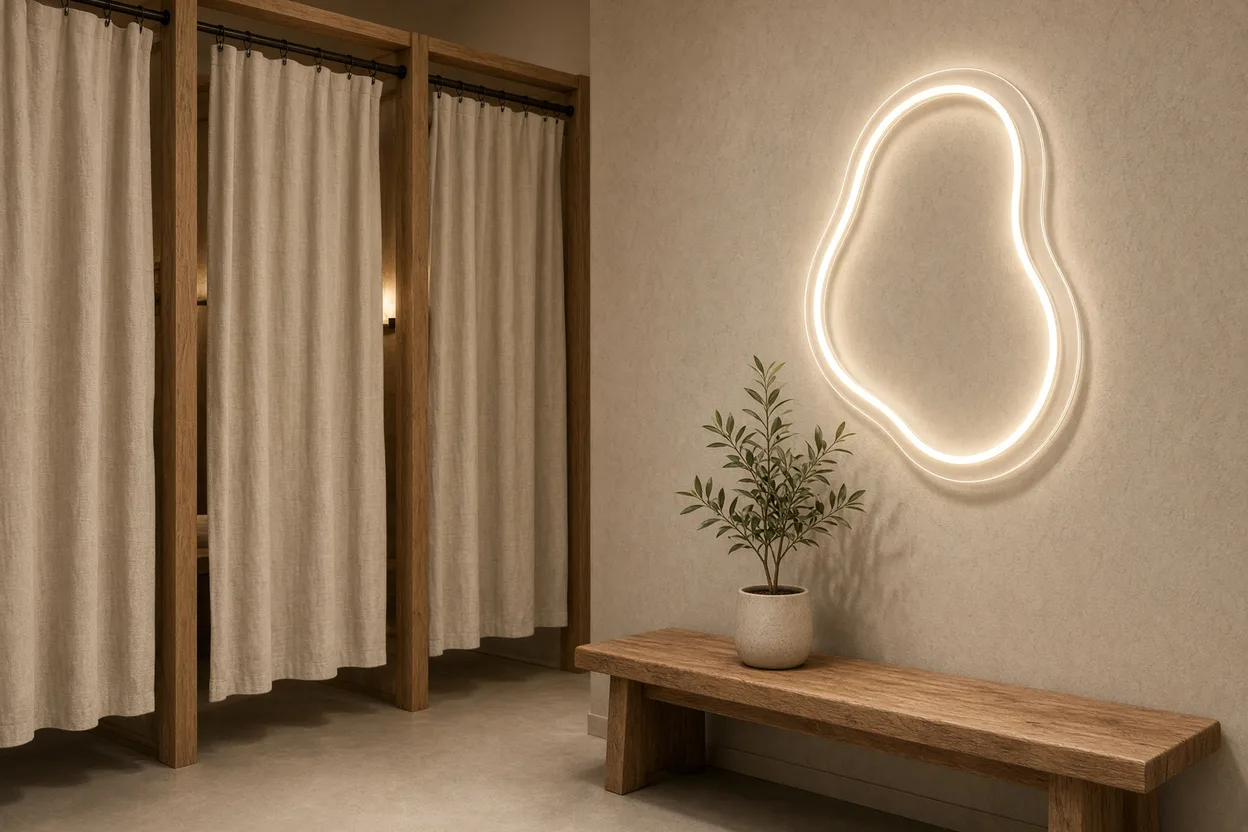
On the technical side, it fits commercial job constraints well. It runs on 12V, stays cool to the touch, uses only a few watts, and lasts 100,000 hours, which limits maintenance on long opening hours. For a version visible from the street or installed outdoors, use a weather-sealed IP65 model. We cover that case in our guide to neon signs for store windows.
- Behind checkout: the logo that signs every transaction
- Back wall: a slogan that pulls shoppers into quieter zones
- Over a bay: a collection or world name
- Fitting rooms: a light landmark and a brand touch
- Facade or window: IP65 version for street visibility
Neon also has to coordinate with the rest of the lighting plan. Its color should sit well with the general lighting temperature, and its size should match the distance from which shoppers first see it. When those two points are set, it becomes a landmark customers quickly tie to the brand, often enough to photograph and share it.
What brief should you give a signage fabricator?
A solid brief cuts back-and-forth and gaps between the look you imagined and the piece delivered. For custom lit signage it should lock the artwork in vector form, dimensions, colors, exact placement, mounting method, and available power. The more precise it is, the more accurate the quote.
This is also when you lock site constraints: reading distance, mounting height, sun or moisture exposure, and on hours. On our side, every project gets a free 3D mockup within 24 hours, approved before production, so the planner can present it to the client. Our guide on how bright LED neon signs are helps you set size and impact together.
- Vector artwork: logo or text as AI, SVG, or PDF
- Dimensions: width and height, plus target reading distance
- Colors: brand references, and warm or cool white
- Install: substrate (drywall, brick, glass, hanging), height, power
- Environment: indoor or outdoor, exposure, on hours
For a franchise network, that brief becomes a reusable template. You lock dimensions, colors, and install rules once, then adapt per store by floor area and ceiling height. Locations keep the same lit identity even when their plans differ.
What mistakes should you avoid in store signage?
The most common store signage mistake is overload: too many messages, too many supports, too many colors. Shoppers stop reading, and brand identity thins out. Other classic errors are missing hierarchy, messages placed at the wrong point on the path, and signage that ages poorly because maintenance was never planned.
On the lit side, we often see signs that are too bright and cause glare, colors that clash with general lighting, and pieces sized wrong for the reading distance. Think about base lighting too: IES recommendations commonly point to roughly 300 lux on the sales floor and about 500 lux at checkout. A neon complements that lighting. It does not replace it.
- Overload: limit the number of messages and supports
- No hierarchy: highlighting everything highlights nothing
- Wrong placement: a message belongs where the decision is made
- Glare: light that is too harsh tires shoppers and drives them off
- Forgotten maintenance: damaged signage hurts the brand
To avoid these traps, a regular signage audit helps. A walkthrough with fresh eyes, ideally at different times of day, is enough to spot outdated messages, worn supports, and landmarks that have gone invisible. And it is often a chance to remove pieces rather than add more.
Frequently asked questions about store signage
What is store signage?
Store signage is the full set of supports that orient shoppers, share information, and assert a retail space’s identity. It includes directional signage (aisles, fitting rooms, checkout), informational signage (prices, promotions, required notices), regulatory signage (safety, egress, accessibility), and identity signage, such as a lit logo or slogan. Designed from the customer journey, it shortens search time, reduces staff interruptions, and strengthens brand image.
What are the rules for an illuminated store sign?
Many countries and municipalities regulate illuminated signs: nighttime shutoff when the business is closed, limits or bans on flashing, and often a local permit for facade or street-facing signs. Price display for goods offered for sale is generally required, and safety and egress signage must never be blocked. Rules vary by city, so check with your municipality before install.
Can LED neon work as in-store signage?
Yes. LED neon is a strong identity signage support in retail. It shows a logo, slogan, or zone name with a soft glow readable from a distance, while matching brand type and colors exactly. It runs on 12V, stays cool, uses only a few watts, and lasts 100,000 hours, which suits long opening hours. For a street-facing or outdoor install, choose a weather-sealed IP65 model.
Where should you place signage in a store?
Place signage at decision points on the customer journey: the entrance, aisle junctions, fitting room access, and checkout. The most visible landmarks, often lit ones, go at the back of the store to pull shoppers into quieter zones, or behind checkout to sign the brand. Aisle signage stays sober and consistent. Finally, check that nothing blocks safety and egress marking required in spaces open to the public.
What information should you give a lit signage fabricator?
Provide vector artwork (AI, SVG, or PDF), target dimensions and reading distance, brand color references, exact placement with substrate type, mounting height, and available power. Also state indoor or outdoor install and on hours. At Helioneon, every project includes a free 3D mockup within 24 hours, approved before production.
Strong store signage starts from the customer journey, ranks messages, respects local rules, and reserves light for the landmarks that matter. For a fit-out or a multi-store network, see our custom neon signs for retail stores, or send your plan through our contact page: you get a free 3D mockup within 24 hours.
Your custom neon, designed for free in 24 h
- Describe your ideaA text, a logo or a simple sketch. It takes one minute.
- Get your mockup and priceWithin 24 h by email, no commitment.
- Approve, we make itFree express delivery in 7 to 10 days, set up in 3 minutes.
- Mockup and price within 24 h, no commitment
- Free express delivery, received in 7 to 10 days
- 3-year warranty, set up in 3 minutes
Get your free mockup

Guillaume Schlupp
Founder of Helioneon
Over 10 years of entrepreneurship in premium interior design. 500+ LED neons delivered across 13 countries under Helioneon and Light Genius. Leads product strategy, design and professional accounts.