LED neon sign power consumption: how much does it cost in 2026?

⚡ The essentials in 30 seconds
- LED neon sign power consumption 2026: 8-15 W/m, $6 to $8 per year at the US average electricity rate.
- Compare with gas neon and Helioneon saving tips.
LED neon sign power consumption sits between 8 and 15 watts per meter, five to eight times less than a traditional gas neon. With 8 hours daily use, a one-meter LED neon sign costs roughly $6 to $8 per year at the 2026 US residential average of about 17 cents per kWh, a rate that runs from roughly 11 cents in Utah to more than 40 cents in Hawaii.
At Helioneon, we manufacture custom LED neon signs and our US customers ask us almost every week: how much will it really cost on my electricity bill? This guide answers the question precisely with verified figures, and details the technical factors that influence LED neon sign power consumption for your home or business.
How many watts does a LED neon sign use per meter?
A modern LED neon sign uses between 8 and 15 watts per meter, depending on LED density, color and driver quality. At Helioneon, our standard average is 12 W/m for our flexible silicone neon signs powered by 12 V low voltage. This range stays well below the 65-80 W/m of an equivalent gas neon, hence the dramatic difference in annual consumption.
This range is explained by three main technical variables. First, LED density per meter, which varies between 60 and 120 diodes depending on the desired effect. Second, the chosen color: white and blue consume slightly more than red or orange at equal brightness. Third, the driver, whose efficiency directly impacts the wattage drawn from the wall.
- Helioneon standard density: 96 LEDs/m for a continuous halo effect without visible bright spots.
- Cool white consumption: around 14 W/m at full power.
- Pink and orange consumption: around 10 W/m for equivalent visual output.
- Certified 12 V driver: over 92 % efficiency throughout its lifespan.
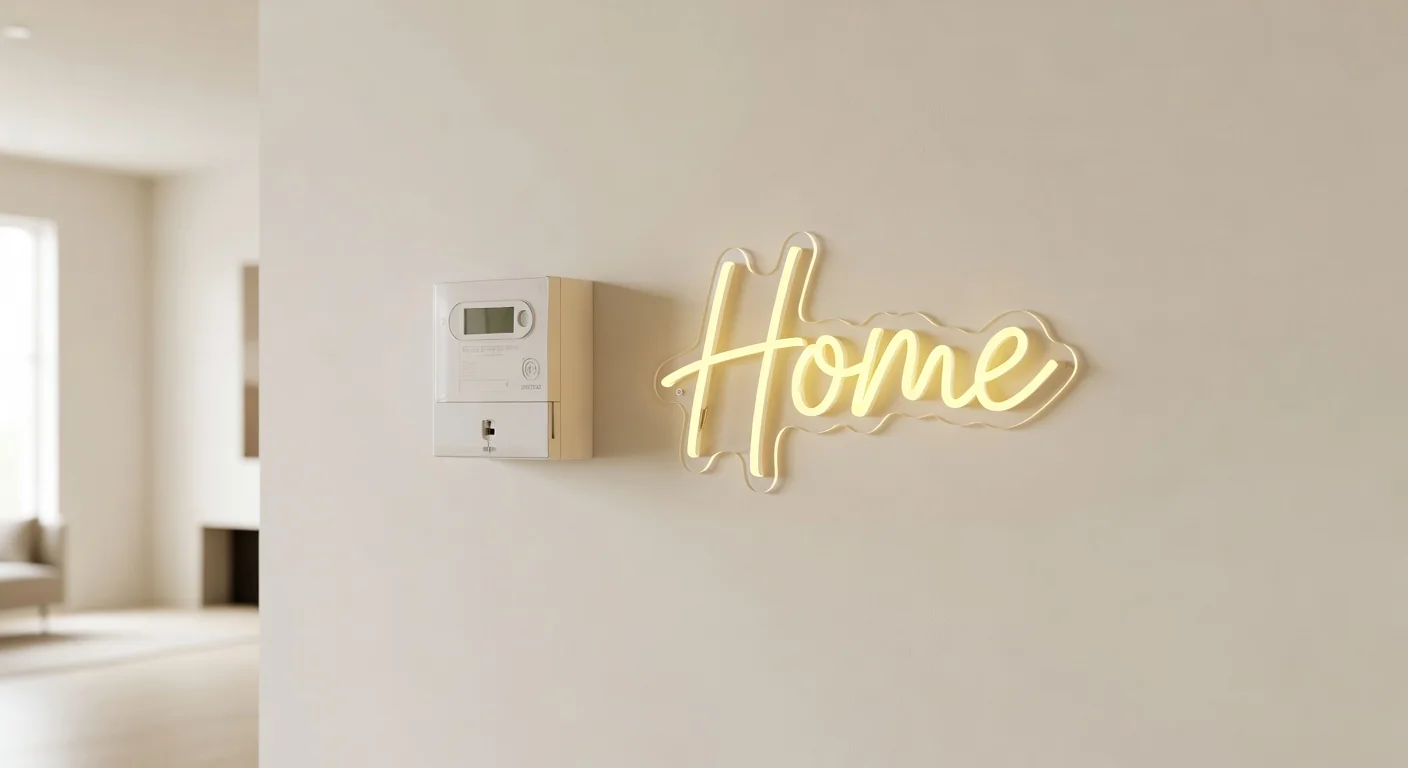
Annual LED neon sign consumption in kWh
For a one-meter LED neon sign running 8 hours daily, annual consumption averages 35 to 44 kWh. That equates to around $6 to $8 per year at the 2026 US residential average of about 17 cents per kWh, before the fixed monthly service charge your utility adds and before local sales tax.
The calculation is simple: watts × hours × days ÷ 1 000 = kWh per year. Concretely, a 12 W neon running 8 h/day for 365 days uses 12 × 8 × 365 ÷ 1 000 = 35 kWh annually. For a shop window running 12 h/day, consumption rises to roughly 53 kWh annually, equivalent to about $9 on the electricity bill.
| LED neon sign size | Power | Annual use (8h/day) | Annual cost (17 cents/kWh) |
|---|---|---|---|
| Name 16 in (40 cm) | 5 W | 15 kWh | $2.55 |
| Phrase 24 in (60 cm) | 8 W | 23 kWh | $3.90 |
| Business logo 31 in (80 cm) | 10 W | 29 kWh | $4.95 |
| Sign 1 m | 12 W | 35 kWh | $5.95 |
| Sign 1.5 m | 18 W | 53 kWh | $9.00 |
| Large 2 m | 24 W | 70 kWh | $11.90 |
These figures reflect full-power operation. In practice, LED neon sign power consumption can be reduced further with a dimmer that modulates light intensity. A neon set to 50 % brightness consumes about 55 % of its rated wattage while remaining perfectly visible.

LED vs gas neon: how does consumption compare?
Compared to a traditional gas neon, a LED neon sign saves on average 80 % of energy consumption. Concretely, a 65-80 W/m gas neon uses roughly 240 kWh per meter annually, while an equivalent LED neon sign only needs 35-44 kWh. Beyond the bill, the LED holds stable performance throughout its 100,000-hour lifespan, while gas tubes lose 30-50 % of their efficiency after a few thousand hours.
For more on US pricing and gas vs LED comparison, see our existing guide Custom neon sign cost US, which breaks down the full ownership cost over 5 years.
Which factors influence LED neon sign consumption?
Six main factors shape LED neon sign power consumption: total length, LED density, color, brightness, driver quality and runtime. A Helioneon neon configured in eco mode consumes up to 40 % less than an equivalent standard model.
- Lit LED length: each extra meter adds 8 to 15 W.
- LED color: 20-30 % gap between cool white and warm amber.
- Brightness (dimmer): 50 % brightness ≈ 55 % consumption.
- Driver quality: 10-15 % gap between premium and entry-level driver.
- RGB animation: 5-10 % overhead vs fixed color.
- Ambient temperature: below 0 °C, LEDs need slightly more power.
Does a LED neon sign use much in standby?
No, a switched-off LED neon sign uses practically nothing. Unlike a TV, our Helioneon LED neons have no active standby mode. The driver shuts down completely when the switch is set to OFF, with residual consumption below 0.01 W, basically zero on the meter.
For premium versions with Wi-Fi or radio remote, a 0.1 to 0.5 W standby may remain to keep the sign reachable. Over a year of use, this standby represents less than $1 of additional cost, an insignificant amount on any electricity bill.

How to reduce LED neon sign consumption further
Four levers help reduce LED neon sign power consumption on an already installed sign: dimmer, automatic timer, motion sensor and choosing a more energy-efficient color at order time. Combined, they can cut the annual bill by 30 to 50 %.
The dimmer remains the most immediate solution. Set to 70 % brightness, you keep a very pleasant lighting result while shaving 25 % off consumption. For business signs, time-scheduling automatically turns off the neon during closing hours, removing 30 to 50 % of annual kWh depending on opening hours. For more on the underlying technology, the Wikipedia article on LEDs provides a comprehensive academic reference.
Frequently asked questions about LED neon power consumption
How much will a LED neon sign cost on my US electricity bill?
A one-meter LED neon sign at 8 hours daily costs roughly $6 to $8 per year at the 2026 US residential average of about 17 cents per kWh. That is comparable to a modern LED bulb and far less than a traditional gas neon, which would cost $30 to $40 annually for the same length. For larger commercial signs (2 m+), expect $12 to $18 yearly at the same usage pattern, more in a high-rate state, less in a low-rate one.
Does the RGB version use more energy than fixed color?
Yes, a programmable RGB LED neon uses 5-10 % more than an equivalent fixed-color model, mainly because of the active Wi-Fi controller and dynamic effect modes. For a one-meter sign, that translates to about $0.30 to $0.60 of extra annual cost, marginal compared to the flexibility you gain.
Does consumption stay stable over the years?
Yes, LED neon consumption stays virtually stable over the entire useful lifespan. Unlike a fluorescent or gas tube, the LED does not suffer significant efficiency degradation before 50 000 to 70 000 operating hours. See the dedicated install guide for cabling and longevity tips.
Which driver saves the most energy?
A certified 12 V driver, UL listed as a Class 2 power supply under UL 1310, with efficiency above 92 %, is the most efficient choice. Avoid no-name drivers under $11 whose efficiency rarely exceeds 80 % and which usually fail within a year, leading to wasted energy and premature replacement.
For a free quote on your LED neon sign with a precise consumption estimate, visit the Helioneon US page. We answer within 24 hours with a 3D preview and detailed annual cost breakdown.