Architectural Lighting: Principles, Techniques and Criteria for a Successful Project
- LED neon sign power consumption runs 8 to 15 W per meter. A one-meter sign used 8 hours daily costs about $6 to $8 per year at the 2026 US average near 17 cents per kWh.
- This guide covers watts per meter, yearly kWh and cost tables, gas neon comparison, standby draw, and bill-cutting tips.
Updated October 5, 2026, by Guillaume Schlupp, founder of Helioneon.
Architectural lighting is the discipline that uses light to reveal a building or space: its volumes, materials, lines and use. It does not only aim to illuminate; it composes with light as with a material. At Helioneon, we make custom neon signs and made-to-measure light lines for these projects, and this guide gives architects and interior designers the principles, technical criteria and mistakes to avoid.
The same space can feel monumental, intimate or cold depending on how it is lit, even when nothing else has changed. That is why light should be planned from the first sketch, not after the walls are up. With more than 500 neons delivered, including a growing share for retail, hotels and offices, we join projects earlier and earlier alongside the design team. Here are the fundamentals to master so you get the most from it.
What is architectural lighting?
This discipline means designing light around the architecture, not the other way around. It has three goals: support safe seeing and circulation, reveal volumes and materials, and create an atmosphere that fits the identity of the place. It applies indoors as well as to facades, gardens and public spaces.
It differs from functional lighting, which mainly targets a sufficient light level, and from decorative lighting, which puts the fixture itself on display. Here, the source often disappears in favor of its effect: a wall that glows, a vault that is outlined, a light line that guides. LED neon sits at the boundary of both: a light line when it follows the architecture, a signature when it carries a word or a shape.
- Functional: see, move and work safely
- Revealing: highlight volumes, textures and details
- Narrative: build an ambiance that tells the identity of the place
- Responsible: control consumption, maintenance and light pollution
For an architect, this approach changes how a project is drawn. Light becomes a material in its own right, on the same footing as wood or concrete, and it is planned from the sketch stage. That is why recesses, cable runs and power supply locations are decided together with the plans.
What are the main architectural lighting techniques?
Lighting techniques are grouped by how light hits the surface. Each one produces a different effect, so a strong project usually combines several to hierarchy the space. The choice depends on what you want to show: a texture, a volume, a detail or a line. For a more ambitious event, our guide to event scenography walks through the method, from brief to teardown.
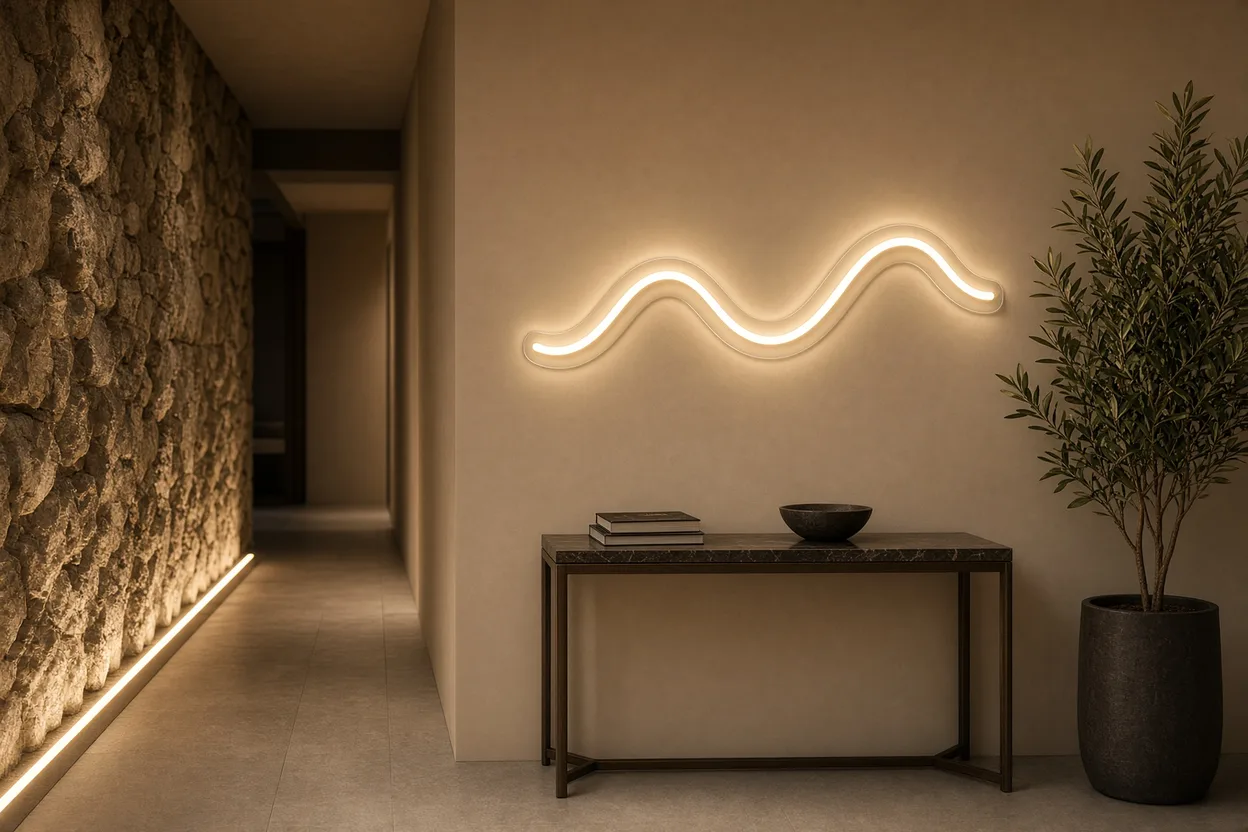
| Technique | Intended effect | Example application |
|---|---|---|
| Light line (LED neon) | Outline a line, guide, sign a place | Ceiling edge, brand name, wayfinding cue |
| Grazing light | Reveal the texture of a material | Stone, brick or raw concrete wall |
| Wall washing | Light a surface evenly | Reception wall, picture rail, facade |
| Accent lighting | Highlight an object or detail | Artwork, product, architectural feature |
| Backlight and silhouette | Detach a form against a lit background | Sculpture, planting, furniture |
| Indirect lighting | Diffuse light with no visible source | Cornice, ceiling, light cove |
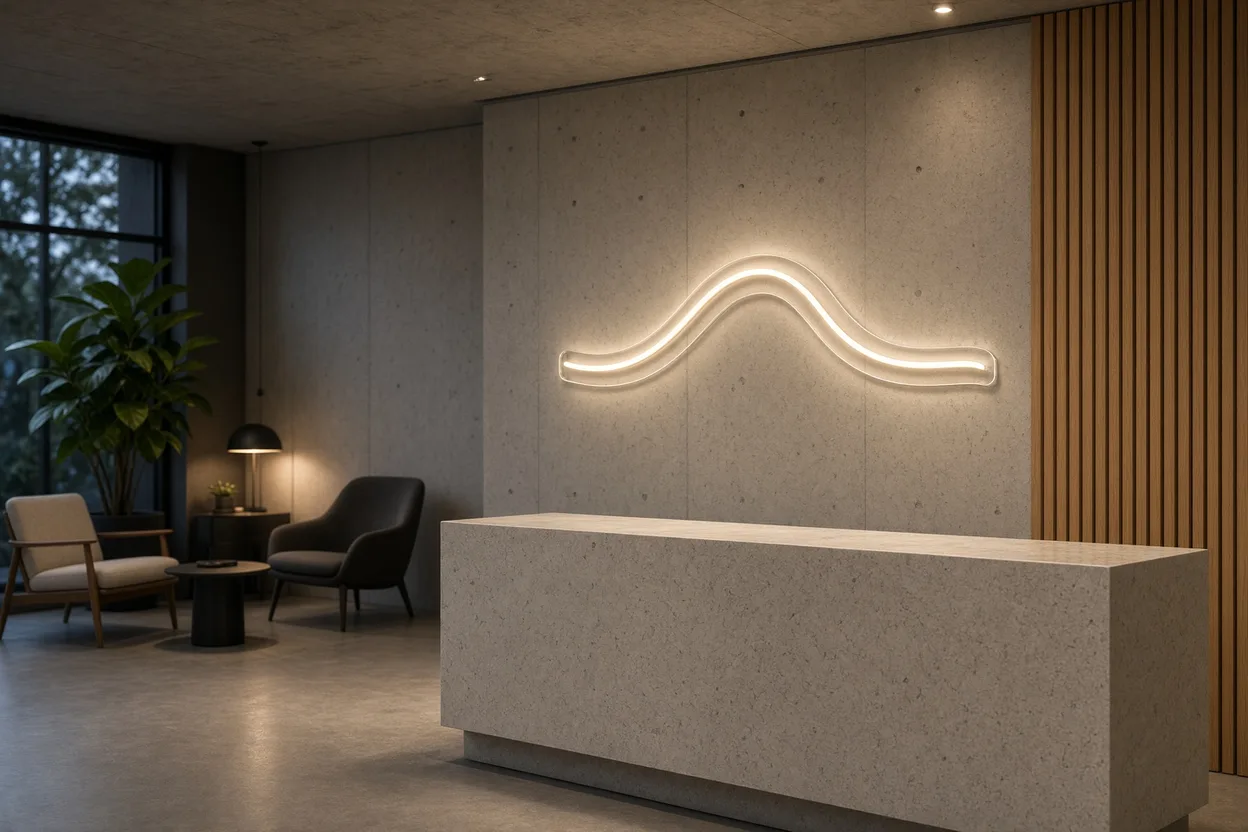
Silicone-tube LED neon is especially well suited to a light line: it bends, follows a contour and delivers continuous light with no visible dots. To understand how it differs from a classic LED strip, see our comparison of LED neon vs LED strip lights.
In practice, two or three techniques per space are enough. A lobby might combine wall washing for overall light, accent lighting on an artwork and a light line that guides toward reception. Beyond that, the effect blurs because the eye no longer knows where to rest.
Which technical criteria matter for a lighting scheme?
When you design architectural lighting, five technical criteria separate a controlled result from a disappointing one: color temperature, color rendering index, visual comfort, dimming and moisture protection. That is why they belong in the specifications, alongside power and dimensions.
Color temperature, expressed in kelvins, sets the mood: warm around 2,700 to 3,000 K, neutral near 4,000 K. The color rendering index (CRI) measures how faithfully lit colors appear, on a scale from 0 to 100: IES recommendations call for at least 80 in most workplaces, and high-end projects often target 90 and above. Comfort is measured with the unified glare rating (UGR): the lower it is, the less the light bothers the eye.
- Color temperature: 2,700 to 3,000 K for reception, 4,000 K for work
- CRI: 80 minimum, 90 and above for fine materials and products
- UGR: control glare, especially in work zones
- Dimming: adjust intensity by time of day and use
- IP rating: IP65 minimum outdoors or in wet areas
These values should be checked on manufacturer data sheets, not only on marketing visuals. When a figure is missing, such as CRI or the dimming range, ask for it in writing before you approve the product. On site, that detail often separates a controlled lighting scheme from an approximate one.
How to integrate LED neon in an architectural lighting project?
LED neon fits a lighting scheme in two ways: as a light line that follows the architecture, or as a signature piece that carries a word, logo or shape. In both cases it delivers continuous, diffuse light that bare spots or strips cannot match.
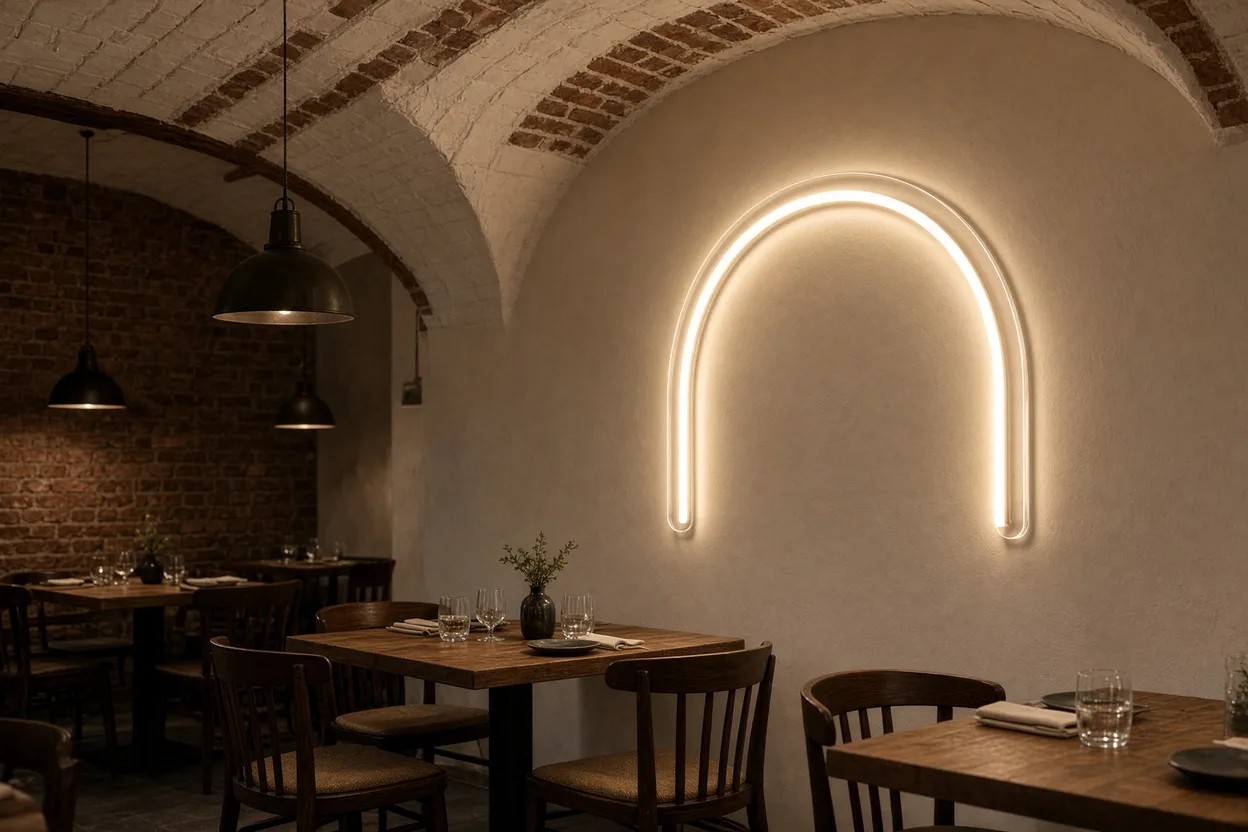
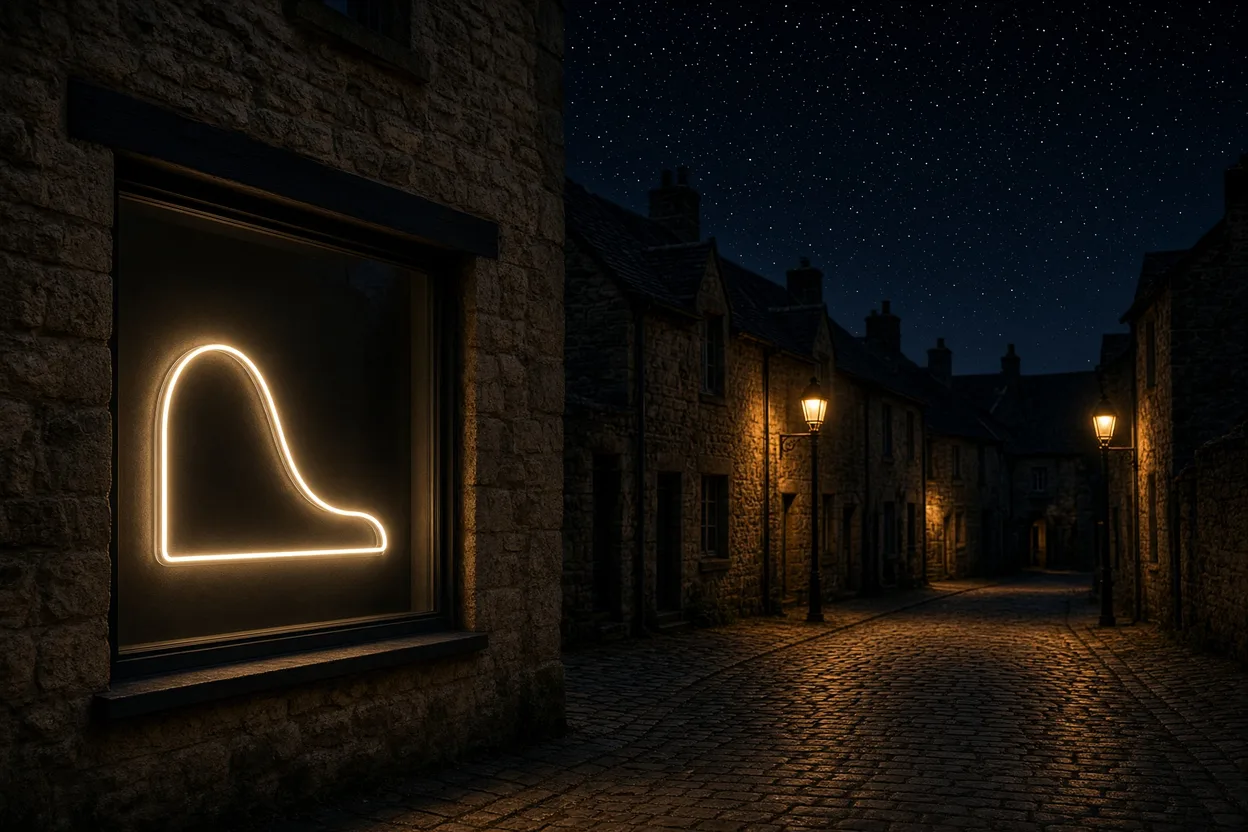
Its ease of integration is a real asset on site. It runs on 12V, stays cool to the touch, uses only a few watts and lasts 100,000 hours, which limits maintenance in hard-to-reach spaces. It mounts on an acrylic backing cut to the path of the design, fixed flat on the wall or suspended. For tube technology details, see our page on flexible LED neon.
- Ceiling line: outline a beam, vault or edge
- Wayfinding: draw a path through a lobby or corridor
- Signature: brand name or keyword of the place, at reception
- Art piece: custom graphic form as a focal point
- Outdoor: IP65 version for facade, terrace or patio
Neon also coordinates with the other sources in the project. Match its color temperature to the general lighting, and plan a dimmer when the space shifts mood between day and evening. That way the light line supports the architecture instead of competing with it, even in a space that is already well lit.
Indoor vs outdoor architectural lighting: what changes?
Indoors, light aims for comfort and ambiance, while outdoors it must also deal with weather, night conditions and regulation. Indoors you mainly work color temperature, CRI and glare. Outdoors, weather sealing, UV resistance and light pollution move to the front.
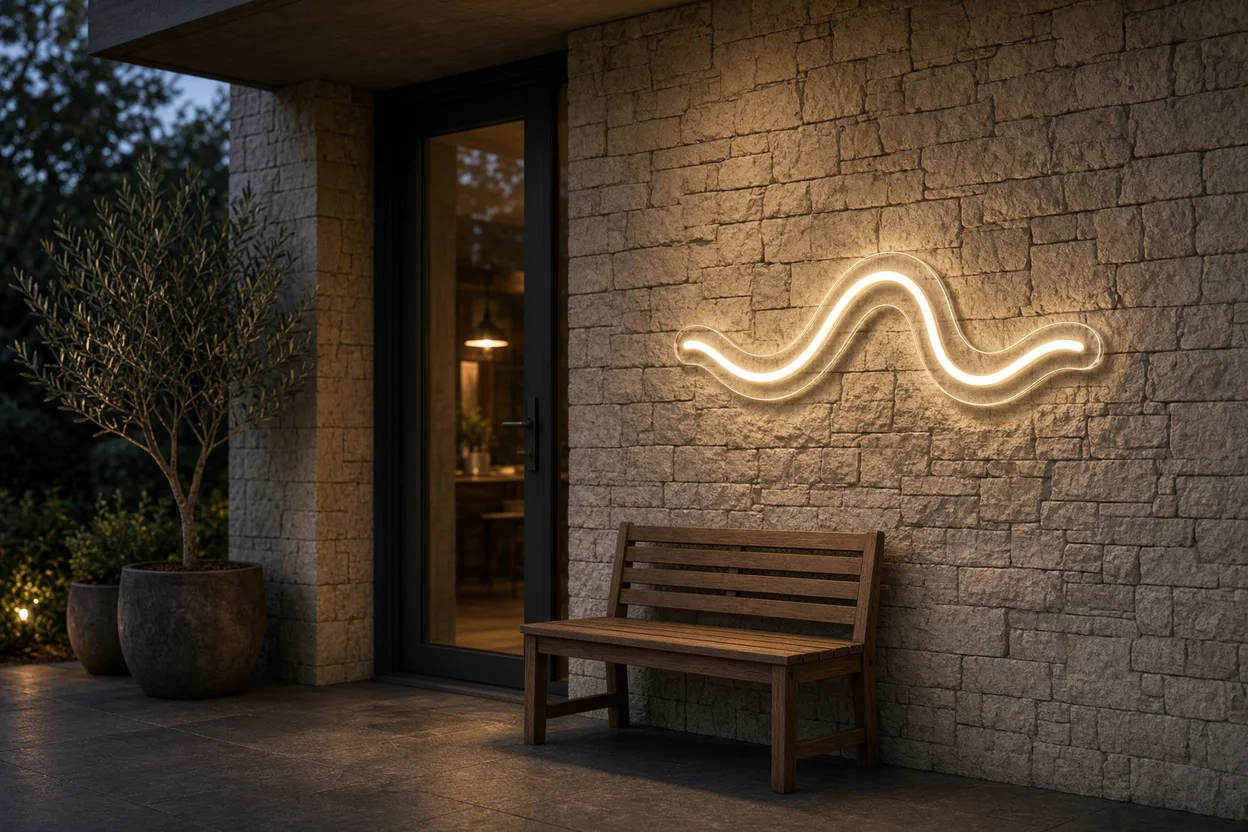
In many countries and municipalities, outdoor lighting is regulated: warm color temperatures are often preferred, and curfew or shutoff hours may apply, especially for facade and landscape lighting. For a neon line on a facade, choose an IP65 model in warm white. Our guide to patio lighting ideas with three light layers covers outdoor layering in more detail. Always check local rules before you install.
- Indoor: visual comfort, CRI, dimming, discreet integration
- Outdoor: IP65 minimum, UV resistance, freeze performance
- Regulation: warm color temperature preferred and timed shutoff outdoors
- Biodiversity: limit light toward the sky and natural areas
Moving from indoor to outdoor still calls for real project continuity. When a facade announces a light line that continues into the lobby, the same color temperature and the same path keep the scheme coherent. Visitors sense it without naming it, and that detail strengthens the identity of the place.
How to prepare a lighting specification?
A lighting specification starts from use and intent, then moves down to technique. First describe what light should do in each zone (welcome, guide, highlight), then the constraints of the place, and finally measurable technical requirements. This method keeps you from picking products before the desired effect is defined.
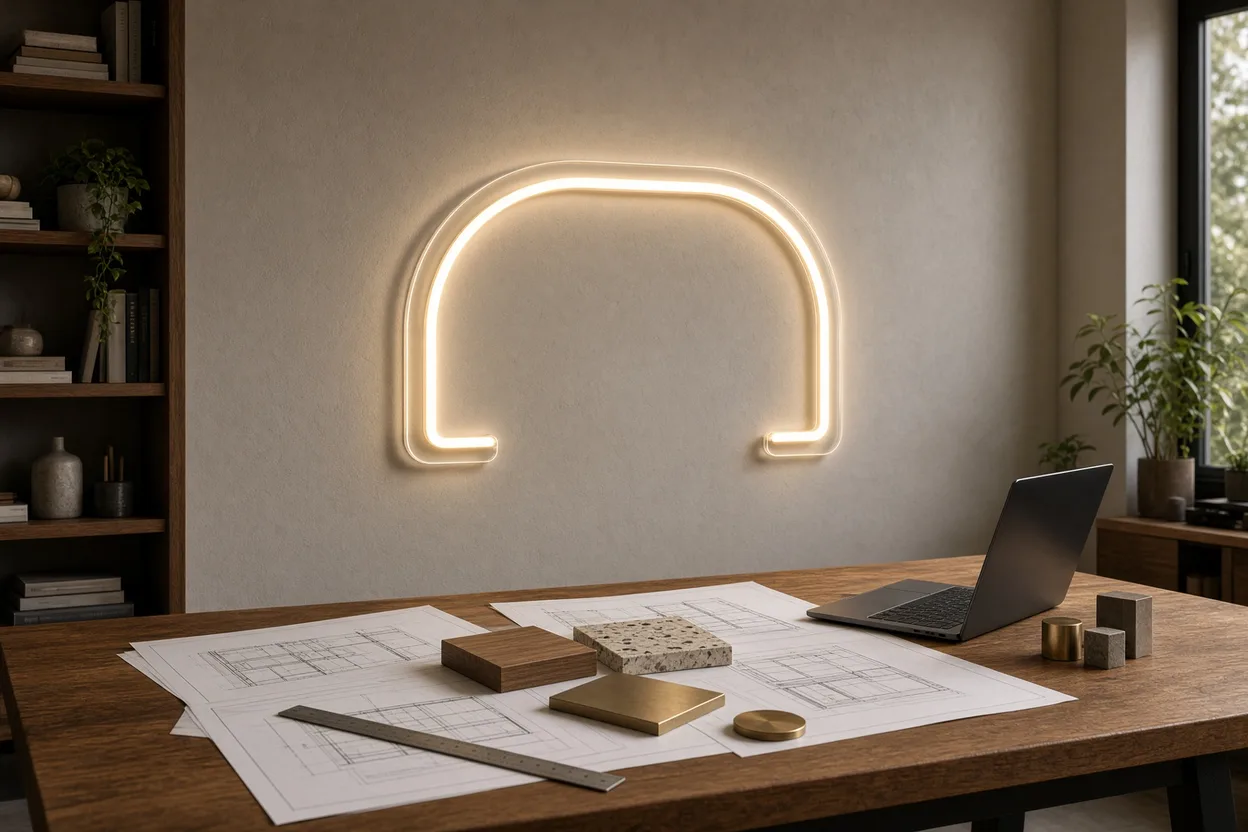
For a custom light piece, the maker needs precise inputs: a dimensioned plan or elevation of the location, a path or vector artwork, color and temperature, mounting method and available power. At Helioneon, every project goes through a free 3D mockup within 24 hours, approved before production, that the architect can fold into the client presentation. Our neon sign projects show examples of integrated pieces.
- Intent by zone: welcome, guide, highlight, sign
- Constraints: heights, supports, maintenance access, moisture
- Measurable requirements: kelvins, CRI, UGR, IP, dimming
- Deliverables provided: dimensioned plan, vector artwork, planned power
- Validation: mockup or prototype before production
The specification also serves as the reference during construction. When a trade package changes, for example a lowered ceiling or a moved wall, you return to the document to confirm the lighting intent still holds. At handover, it lets you check zone by zone that each area delivers the planned effect.
Which mistakes to avoid in architectural lighting?
The most common mistake is thinking about light too late, once ceilings are closed and power feeds are locked. Other classic errors are uniformity that flattens the space, mixed color temperatures, and glare from sources that are poorly aimed or too powerful.
Maintenance is often overlooked too: a hard-to-reach source that fails can stay dark for months. That is why very long-life technologies and accessible power supplies matter as much as the look. Finally, light should stay in service of the architecture: a light piece that is too dominant competes with the place instead of revealing it.
- Thinking too late: plan power and recesses from the first sketch
- Making everything uniform: hierarchy light to give depth
- Mixing temperatures: one kelvin value per ambiance
- Creating glare: aim sources and hide bright points
- Ignoring maintenance: durable sources and accessible power supplies
To limit these risks, a site trial remains the best safeguard. A sample placed where it will live, switched on in the evening under real conditions, quickly shows whether temperature, intensity and aim are right. The step is short, but it avoids costly corrections once the job is finished.
Frequently asked questions about architectural lighting
What is architectural lighting?
Architectural lighting is the discipline that designs light around the architecture of a place. It aims both to support safe seeing and circulation, to reveal volumes and materials, and to create an ambiance that fits the identity of the space. It applies indoors and outdoors, and the light source often disappears in favor of its effect: a wall that glows, a light line, a detail brought forward.
What is the difference between architectural and decorative lighting?
Architectural lighting highlights the space itself: the source stays discreet and what matters is the effect on walls, ceilings or volumes. Decorative lighting puts the fixture forward as a visible object. LED neon sits between the two: it becomes architectural when it draws a line that follows the place, and decorative when it carries a word, logo or shape designed as a focal point.
Which CRI should you choose for an architectural lighting project?
Aim for a color rendering index of at least 80, the minimum commonly referenced in IES guidance for most workplaces. For spaces where color truly matters, such as a shop, gallery, restaurant or fine materials, designers often choose a CRI of 90 and above. A high CRI makes hues more faithful and richer, which elevates both materials and displayed products.
Can you use LED neon in architectural lighting?
Yes. Silicone-tube LED neon is widely used by lighting designers to create continuous light lines: outline a ceiling, vault or edge, draw a path, or sign a place with a name or shape. It bends, produces diffuse light with no visible dots, runs on 12V and lasts 100,000 hours. Outdoors or in wet areas, choose a sealed IP65 version.
What rules apply to outdoor architectural lighting?
Many countries and municipalities regulate outdoor lighting to limit light pollution. Warm color temperatures are often preferred, and timed shutoff or curfew hours may apply, especially for heritage, park and non-residential facade lighting. Stricter rules can apply in protected areas. Always verify local regulations before any facade project.
Successful architectural lighting is planned from the sketch, hierarchies light and chooses durable sources in service of the place. To add a light line or signature piece to your next project, explore our office neon signs for business, or send your plan through our contact page: you receive a free 3D mockup within 24 hours. To go further, the architectural lighting definition on Light ZOOM Lumière (French-language resource) remains a useful reference.
Your custom neon, designed for free in 24 h
- Describe your ideaA text, a logo or a simple sketch. It takes one minute.
- Get your mockup and priceWithin 24 h by email, no commitment.
- Approve, we make itFree express delivery in 7 to 10 days, set up in 3 minutes.
- Mockup and price within 24 h, no commitment
- Free express delivery, received in 7 to 10 days
- 3-year warranty, set up in 3 minutes
Get your free mockup

Guillaume Schlupp
Founder of Helioneon
Over 10 years of entrepreneurship in premium interior design. 500+ LED neons delivered across 13 countries under Helioneon and Light Genius. Leads product strategy, design and professional accounts.