How to Change a Neon Light? Steps, Safety, and Switching to LED
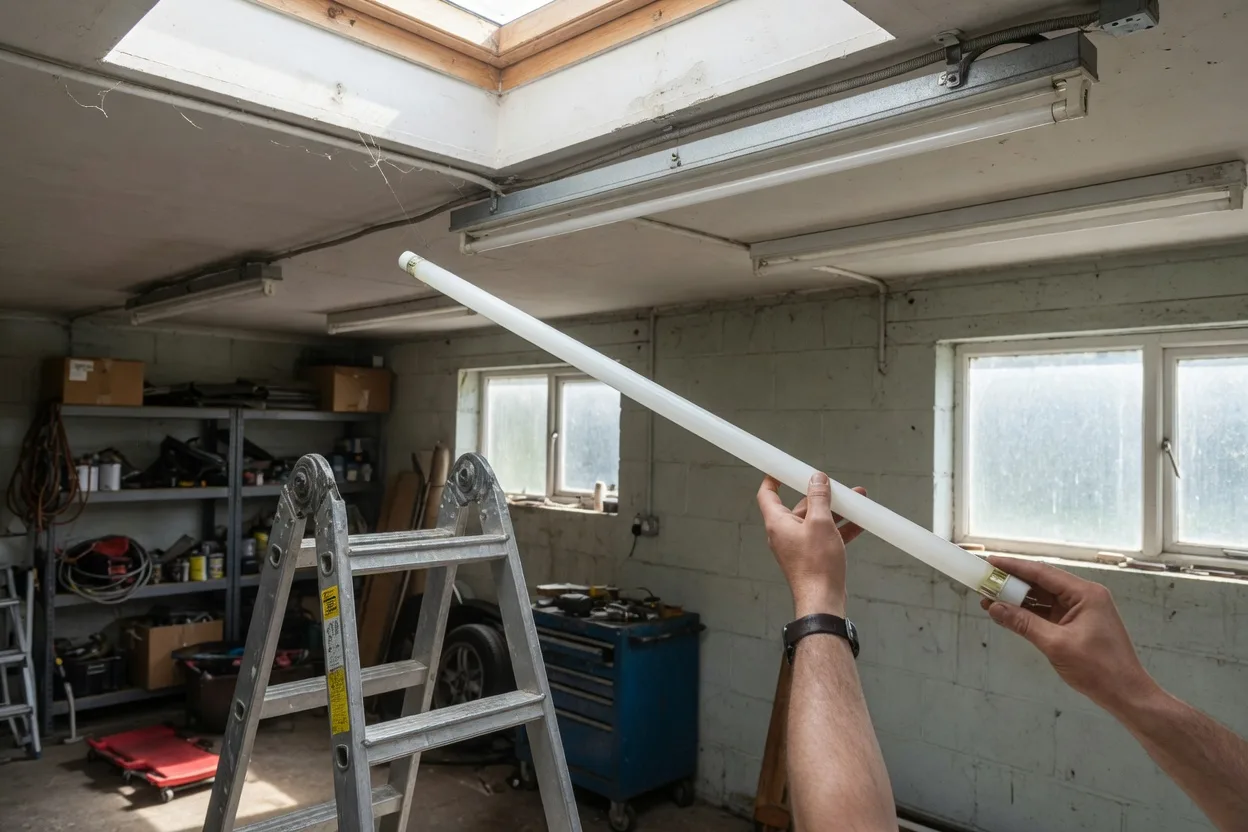
- To change a neon light, cut power at the breaker, unlock the tube with a quarter turn, slide it out, insert the new one, and lock it. The job takes five minutes with no tools.
- You will also find safety rules, recycling tips, LED tube swaps, and why decorative LED neon never needs replacing.
To change a neon tube, the process is simple: cut power at the circuit breaker, remove the old tube with a quarter turn, insert the new one into the sockets, and lock it by twisting. The job takes five minutes and needs no tools. At Helioneon, our made-to-order LED creations never need replacing: they last 100,000 hours. This guide still covers how to change a neon fluorescent tube safely, and when it makes more sense to switch to LED.
Fluorescent tubes still light millions of garages, kitchens, and basements, and end of life always comes: dim light, flickering, blackened ends. Replacing the tube yourself is within reach for anyone, as long as you follow a few safety rules. With more than 500 LED neon signs delivered and deep knowledge of both technologies, here is the clean method, step by step.
When should you replace a neon tube?
You should change a neon tube when the ends blacken, when the light dims or turns pink, or when it flickers even with a new starter. Those three signs point to worn electrodes and exhausted fluorescent powders. In short, the tube is reaching the end of its 8,000 to 15,000 hour lifespan.
Watch out for a false diagnosis, though. A neon that flickers without fully lighting often has a simple starter problem, a part that costs a few dollars and swaps in a minute. Check the starter before you condemn the tube. Blackened ends remain the most reliable sign that the tube itself is finished.
- Blackened ends: electrode wear, tube at end of life
- Dim or pink light: fluorescent powders exhausted
- Persistent flickering: check the starter first, then the tube
- Hard starting: starter and tube age together
What precautions before changing a neon?
Before you change a neon tube, one absolute rule: cut power at the circuit breaker, not only at the wall switch, because the fixture can stay live at 120V. A tube handled under power can deliver a serious shock. Add the fragility of the glass, which holds traces of mercury: keep every move gentle.

Gear stays minimal. A stable stepladder, thin gloves for grip if you want them, and a replacement tube with the right dimensions. Let a tube that was just on cool down, and never force the glass. Basic electrical safety is the same as for any light fixture work.
- Breaker off: never work on a live circuit
- Tube cooled: wait a few minutes after shutoff
- Stable stepladder: both hands free to handle the tube
- Gentle moves: glass is fragile and contains mercury
- Matching specs: same length, diameter, and wattage
How to change a neon step by step?
Changing a neon tube follows a precise but easy motion: unlock the tube with a quarter turn, slide it out of the sockets, then insert the new one and lock it the same way. No tools are required; everything is done by hand. It is one of the simplest electrical jobs in the house.

The delicate point is pin alignment. The two pins at each end must enter the socket slots vertically before the locking twist. Use the moment to fit a new starter so the whole setup starts a full new cycle. Here is the sequence.
- Step 1: cut power at the breaker and let the tube cool
- Step 2: turn the old tube a quarter turn to unlock it
- Step 3: slide it out of the sockets without forcing
- Step 4: insert the new tube, pins aligned in the slots
- Step 5: lock with a quarter turn and replace the starter
- Step 6: restore power and check for a clean, steady start
What to do with the old neon tube?
A used neon tube never goes in household trash: it contains mercury and fluorescent powders classed as hazardous waste, and it belongs at a municipal e-waste drop-off or household hazardous waste (HHW) facility. A broken tube in regular garbage can release toxic vapors. Proper disposal is both a safety step and a responsible one.

Logistics stay simple. There is no federal e-waste recycling law in the United States; about twenty-five states run their own rules, and fluorescent tubes are banned from regular trash in several of them. Store take-back is voluntary (some retailers accept small lamps), so plan on an HHW drop-off. Carry the tube intact, packed in the new tube’s carton for example. Earth911 finds the nearest collection point by ZIP code.
- Never in household trash: mercury and toxic powders
- HHW or municipal e-waste drop-off: proper free disposal
- Transport intact: packed flat, no impacts
- Voluntary store take-back: some retailers accept small lamps
Replacing a neon with an LED tube: the right moment?
Replacement day is ideal for switching to an LED tube: at equal brightness it uses about half the power, lasts three to five times longer, and lights instantly with no starter. Standard-format LED tubes fit existing fixtures, often with a dummy fuse in place of the starter depending on the model. The higher upfront cost typically pays back in a few years of electricity savings.

The table below sums up the tradeoff. For the deeper technology gap, our comparison of glass neon vs LED neon covers every criterion, and our guide to LED neon sign power consumption puts numbers on the savings.
| Criterion | Fluorescent tube | LED tube |
|---|---|---|
| Lifespan | 8,000 to 15,000 hours | 30,000 to 50,000 hours |
| Power use | 36 to 58 W by length | 15 to 25 W equivalent |
| Startup | Ignition with starter | Instant, no starter |
| Contents | Mercury, dedicated recycling | Mercury-free |
| Replacements | Regular starter and tube swaps | Almost no maintenance |
And for decor: why you never need to change neon again
If your neon is decorative, a sign or a light-up text piece, the replacement question disappears with silicone-tube LED neon: 100,000 hours of life, decades of use, with no starter, no ballast, and no glass tube. Low-voltage LED technology removed every wear part of traditional neon. You no longer “change” an LED neon; you enjoy it.
That is the core of our work. Our custom silicone neon signs carry a 3-year warranty, run on safe 12V, and keep their original glow for years, as explained in our LED neon sign lifespan guide. If something looks off on a decorative LED neon, start with the power supply, covered in our article on how to clean a LED neon sign.
- 100,000 hours: the end of regular replacements
- Zero wear parts: no starter, no ballast, no glass
- 12V instead of 120V: no high-voltage handling
- 3-year warranty: peace of mind on top of the look
Frequently asked questions about changing a neon
How do you remove a neon from its fixture?
First cut power at the circuit breaker, then let the tube cool if it was just on. Hold the tube with both hands, one at each end, and turn it a quarter turn on its axis: the pins unlock from the sockets. Then gently slide the tube downward out of the slots, without forcing the glass. If it resists, check the rotation direction and pin alignment instead of pushing harder. On some fixtures with a cover, you must first unclip the plastic diffuser to reach the tube.
Do you need to cut power to change a neon?
Yes, without exception, and at the circuit breaker, not only at the wall switch. A fluorescent fixture runs on 120V, and its sockets can stay live even with the switch off depending on the wiring. Killing the circuit at the panel removes any shock risk while you work. It is the same basic rule as for any light fixture job. Add two simple precautions: let the tube cool before you touch it, and work from a stable stepladder with both hands free. Five minutes of care for a job with no danger.
Should you replace the starter at the same time as the neon?
Strongly recommended. The starter is a wear part with a shorter life than the tube: fitting a new tube on a tired starter invites rapid flickering and wears out the new tube early. At a few dollars for the part, swapping both at once resets the whole setup for a full cycle. Choose a starter matched to the tube wattage printed on the ends. Electricians do this by habit, and it keeps you from opening the fixture again a few weeks later.
Where do you dispose of an old neon tube?
Never in household trash: a fluorescent tube contains mercury and powders classed as hazardous waste. Drop it off intact at a municipal e-waste drop-off or household hazardous waste (HHW) facility, or check whether a local retailer voluntarily accepts lamps. There is no federal one-for-one take-back rule in the United States; store programs are optional. Carry the tube packed and flat to avoid breakage, because a broken tube can release toxic vapors. Earth911 locates the nearest collection point by ZIP code.
Can you replace a neon with an LED tube directly?
Yes, in most cases. LED tubes come in standard formats and mount in existing fixtures. On a classic magnetic-ballast fixture, you usually replace the starter with the dummy fuse supplied with the LED tube. On an electronic ballast, simple rewiring may be needed depending on the model. The gain is immediate: about half the power use, instant start, and a lifespan three to five times longer. Check the compatibility stated by the LED tube maker before you buy, or have an electrician confirm it.
Changing a neon tube stays a simple job: breaker, quarter turn, new tube, new starter. Every swap still raises the real question: why not move to light you never replace? Our custom LED neon signs last 100,000 hours, with a 3-year warranty. Start your project on our contact page and get a free 3D mockup within 24 hours.
Your custom neon, designed for free in 24 h
- Describe your ideaA text, a logo or a simple sketch. It takes one minute.
- Get your mockup and priceWithin 24 h by email, no commitment.
- Approve, we make itFree express delivery in 7 to 10 days, set up in 3 minutes.
- Mockup and price within 24 h, no commitment
- Free express delivery, received in 7 to 10 days
- 3-year warranty, set up in 3 minutes
Get your free mockup

Guillaume Schlupp
Founder of Helioneon
Over 10 years of entrepreneurship in premium interior design. 500+ LED neons delivered across 13 countries under Helioneon and Light Genius. Leads product strategy, design and professional accounts.