Dan Flavin: The Artist Who Transformed the Fluorescent Tube into Art
- Dan Flavin transformed the fluorescent tube into art by using commercial tubes as his sole material starting in 1963, creating installations where colored light itself reshapes space and architecture.
- Discover his biography, famous works, places to see them, minimal art context, and practical ways to adapt the ideas with LED neon.
Dan Flavin (1933-1996) is an American minimal artist, famous for installations composed only of commercial fluorescent tubes. Starting in 1963, he made light itself the material of his works, playing with color, space and architecture. At Helioneon, we often cite him as one of the fathers of light art that inspires today's custom neon sign maker.
His works are shown in the world's major museums and in several French collections. They interest art lovers as much as architects, scenographers and decorators, because they show how a few lines of light can transform a place. With more than 500 neon signs delivered, we regularly see clients cite his work as a reference. Here is his life, his key works, where to see them and what he changed.
Who was Dan Flavin?
Flavin was born on April 1, 1933 in New York, in the Jamaica neighborhood, and died on November 29, 1996 in Riverhead, New York State. He is one of the major figures of American minimal art, alongside Donald Judd, Sol LeWitt or Carl Andre.
Nothing destined him for art. He first studied at the seminary to become a priest, from 1947 to 1952, then served in the United States Air Force, where he trained in meteorology. Back in New York in 1956, he took classes in art history and painting, notably at Columbia University.
- 1933 : birth in New York, with a twin brother, David
- 1959 : guard at the Guggenheim Museum, where he met Sol LeWitt
- 1961 : first "icons", paintings bordered with electric bulbs
- 1963 : first work made of a single fluorescent tube
- 1996 : death at 63, two days after completing his last project
His time in museums as a guard mattered. There he met young artists and critics who shared his desire to break with the expressive painting of the 1950s, and sought simpler, more direct forms, made with industrial materials.
Why did Dan Flavin choose the fluorescent tube?
Flavin chose the fluorescent tube because it was a banal industrial object, available everywhere, with standardized dimensions and colors. By hanging it as is on the wall, he made light itself a work, without painter's gesture or material effect.
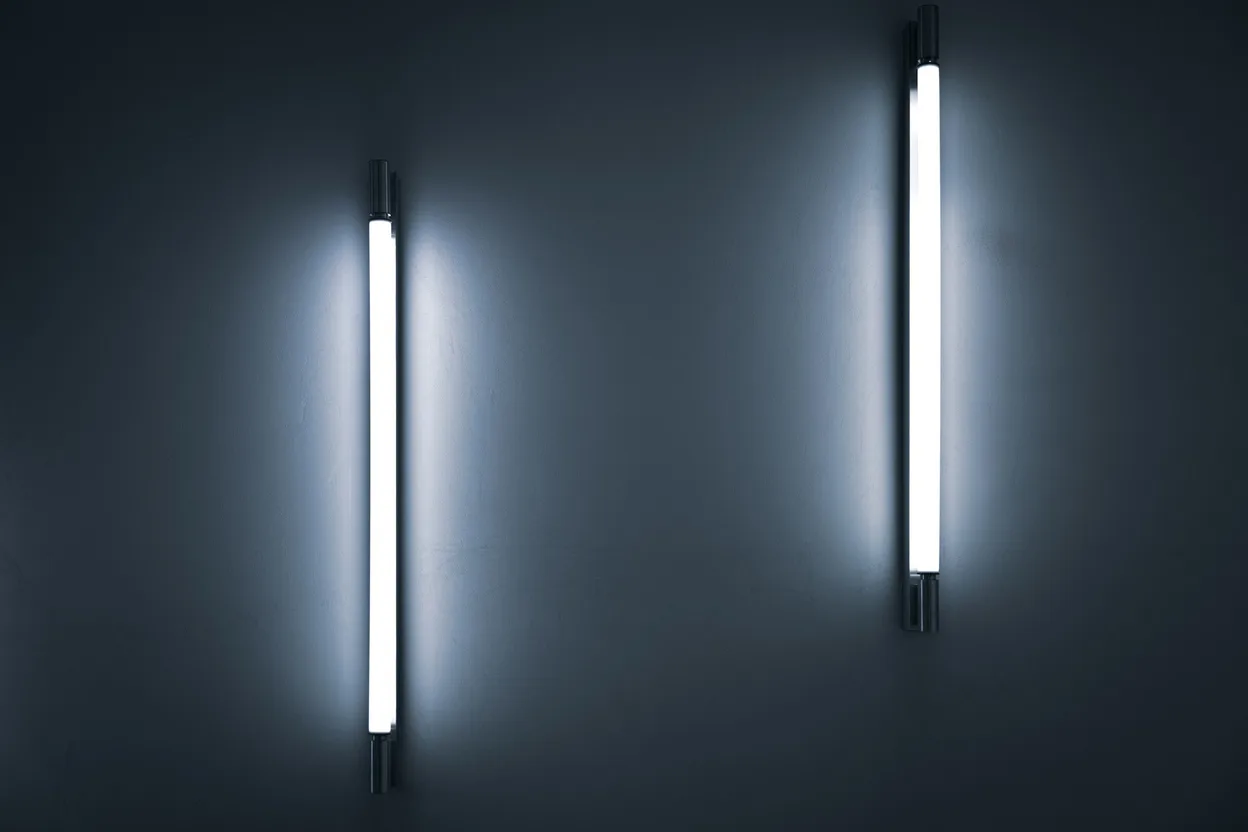
His first entirely luminous piece, "the diagonal of May 25, 1963", is a simple yellow tube fixed at 45 degrees on a wall, dedicated to the sculptor Constantin Brancusi. The work consists of a hardware object, but it changes the entire perception of the wall and the room. Donald Judd then wrote that light is a new means for art.
- Standard material : tubes sold commercially, without modification
- Fixed lengths : market formats, from 2 to 8 feet, about 60 to 240 cm
- Limited palette : red, blue, green, pink, yellow, ultraviolet and four whites
- Titles : often "untitled", followed by a dedication in parentheses
This voluntary constraint is at the heart of his approach. By limiting himself to about ten colors and a few lengths, Flavin shows that a very reduced vocabulary is enough to create an infinity of luminous situations, depending on how the tubes are assembled and placed in space.
What are Dan Flavin's most famous works?
Flavin's most famous works are "the diagonal of May 25, 1963", the series of "monuments" for V. Tatlin, "greens crossing greens (to Piet Mondrian who lacked green)", his corridors barred with light and his large permanent installations, such as those in Marfa, Texas or Milan.
- the diagonal of May 25, 1963 : a yellow tube on the diagonal, starting point of his entire work
- "monuments" for V. Tatlin (1964-1982) : a series of compositions in white tubes evoking Tatlin's utopian tower
- greens crossing greens (1966) : first installation occupying an entire space, created in the Netherlands
- Corridors (from 1973) : light barriers that block or guide the visitor's passage
In 1968, he immersed an entire room in ultraviolet light at documenta 4 in Kassel. In 1992, for the reopening of the New York Guggenheim Museum, he filled Frank Lloyd Wright's famous rotunda with colored light, based on a project imagined as early as 1971.
His last work is an installation for the church Santa Maria Annunciata in Chiesa Rossa, in Milan, built in the 1930s. He finished the design two days before his death; it was realized in 1997 with the support of the Dia Art Foundation and the Prada Foundation, and remains visible today.
In practice, his compositions often rely on simple lengths: a 2.4 m tube placed alone, two 1.2 m tubes side by side, or a grid of 60 cm tubes. Because light diffuses over several meters around the source, a work of a few tubes can tint an entire wall, even an entire room. Compared to a bulb, a 120 cm fluorescent tube diffuses its light along its entire length, which explains this effect of colored plane rather than light point. This is also why his installations change so much depending on ceiling height, wall color and visitor distance, who sees the hue modify with each step.
Dan Flavin and minimal art: what should we understand?
Flavin belongs to minimal art, an American movement of the 1960s that uses simple forms, industrial materials and repetition to make the spectator experience space directly. With him, the work is not the tube, but the light that spreads on the walls.
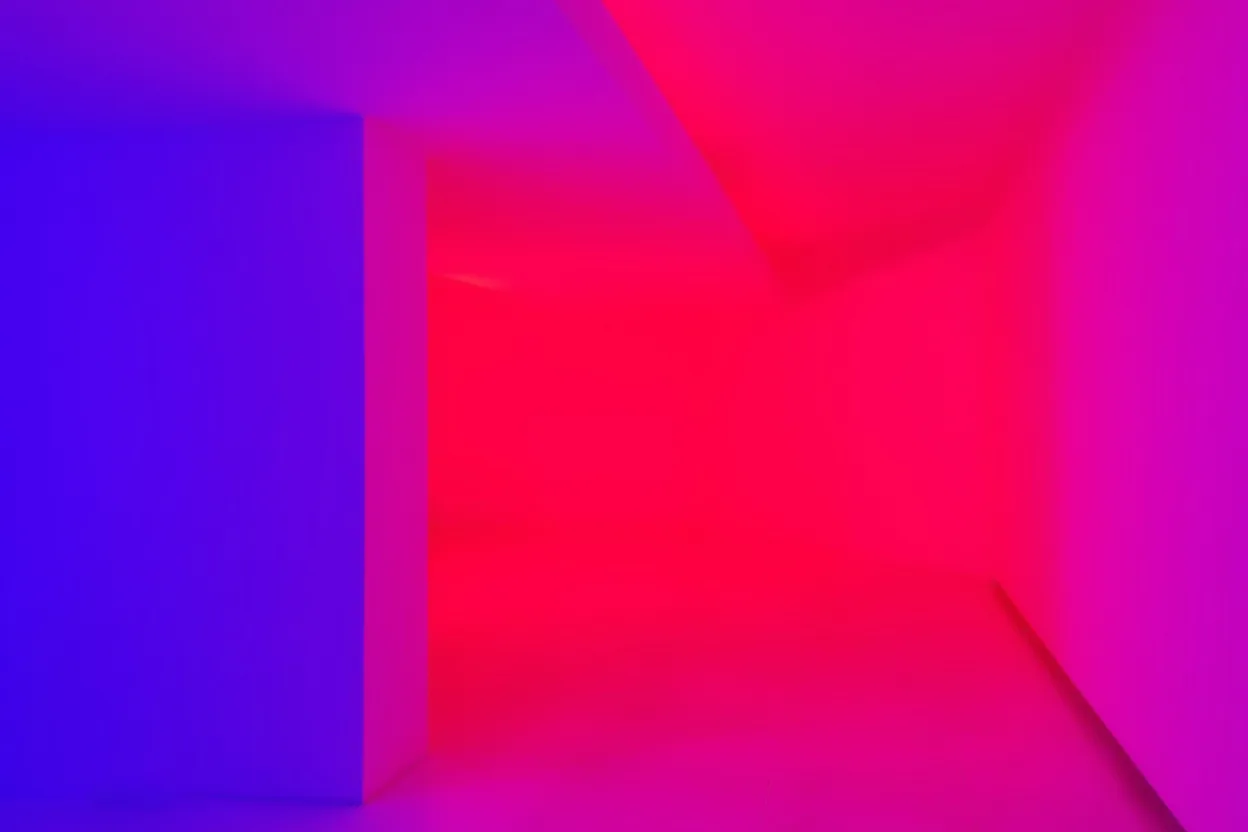
His pieces always overflow their support. The color tints the wall, the floor and the ceiling, mixes with that of neighboring tubes and changes according to the visitor's place. Architecture is therefore part of the work: the same composition does not produce the same effect in a small white room and in a large hall.
- Simplicity : one or a few tubes, without ornament
- Situation : the work is defined by its relation to space
- Experience : the visitor moves and sees the color evolve
- Impalpable : light cannot be touched, it is felt
Some critics have noted the almost spiritual side of these color baths, which recall the large canvases of Mark Rothko. Flavin preferred to speak of "propositions" rather than sculptures, and refused overly symbolic interpretations of his work.
Where to see Dan Flavin's works?
Flavin's works can be seen in major museums and in several permanent installations in Europe and the United States. Some are designed for a specific place and can only be seen on site, making them true destinations for lovers of art and light.
| Light source | Used by | What it allows |
|---|---|---|
| Helioneon LED neon | Decoration, shops, hotels | Custom lines and texts in 12V |
| Commercial fluorescent tube | Flavin, minimal art | Straight lines in standard lengths |
| Blown glass neon | Signs, neon artists | Free forms, high voltage |
| Ultraviolet light | Flavin, scenography | Light baths, fluorescent effects |
- Milan : church Santa Maria Annunciata in Chiesa Rossa, permanent installation
- Marfa, Texas : six buildings of the Chinati Foundation lit by his tubes
- Houston : Richmond Hall, at the Menil Collection, 1996 installation
- Otterlo, Netherlands : Kröller-Müller Museum, permanent work since 1977
In France, several public and private collections hold works by Flavin, such as the Fondation Louis Vuitton, the Pinault Collection or the Frac Grand Large in Dunkerque. They are not always on display: check the exhibition program before traveling. The major retrospective organized between 2004 and 2007 passed through the Museum of Modern Art in Paris.
What legacy did Dan Flavin leave to light art and decoration?
Flavin showed that a simple line of colored light could be enough to transform a space. This idea has influenced generations of artists, architects and scenographers, and it is found today in the lighting of museums, hotels, shops and even apartments.
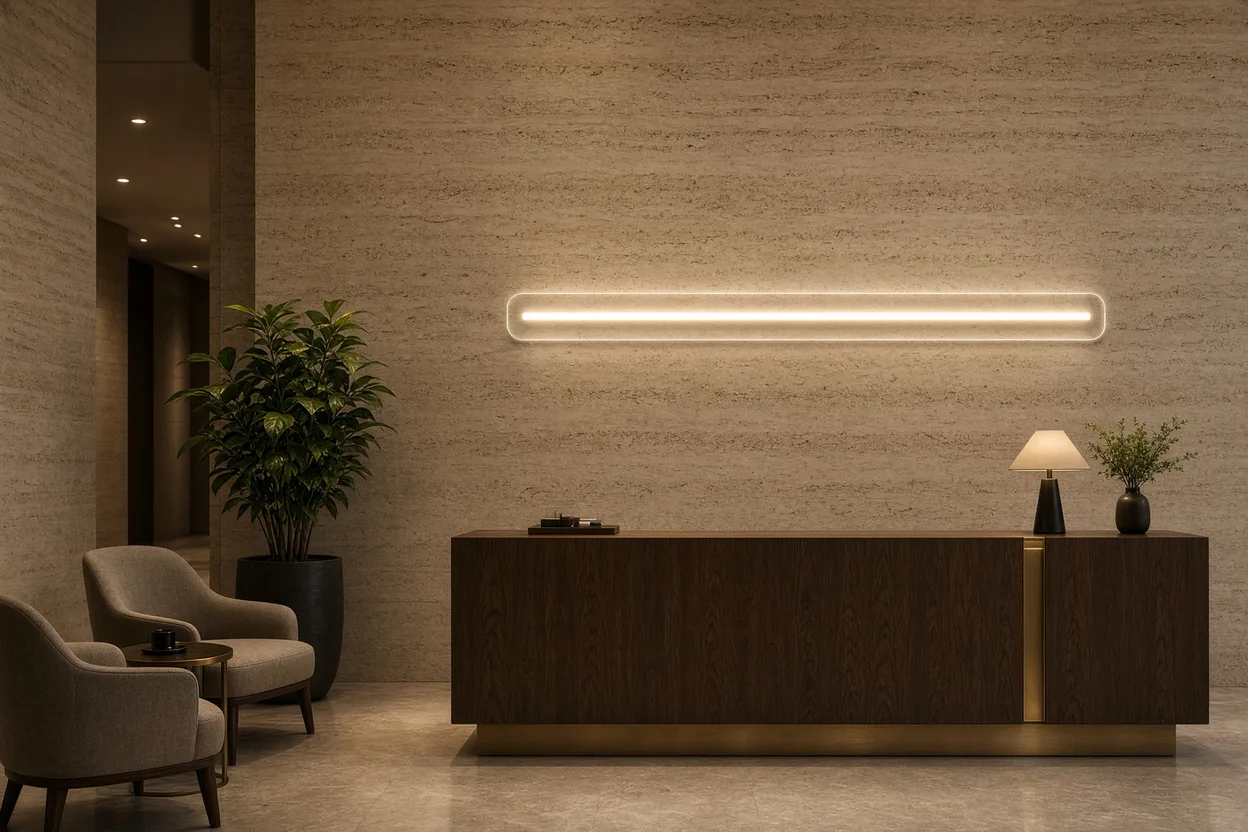
Other artists have continued the adventure of neon and light: Bruce Nauman and his word neons, François Morellet with his geometric compositions in tubes, or Tracey Emin with her luminous handwritten phrases. Our article on the history of neon signs traces how this material went from commercial sign to gallery.
- Architecture : linear light as a structural element, on a facade or in a hall
- Scenography : color baths for exhibitions, fashion shows or events
- Commerce : luminous lines that guide the gaze and the customer path
- Habitat : a stroke of colored light that sculpts a wall or a room corner
In architectural lighting as in event scenography, designers take up his principles: few elements, frank colors, thoughtful placement relative to walls and corners. The fluorescent tubes he used are now on the way out, replaced by LEDs, but the idea remains intact.
Being inspired by Dan Flavin at home or in a professional space
To be inspired by Flavin, the idea is not to copy his works, protected by copyright, but to take up his logic: one or a few lines of colored light, placed according to the architecture, that tint the wall rather than illuminating it uniformly.
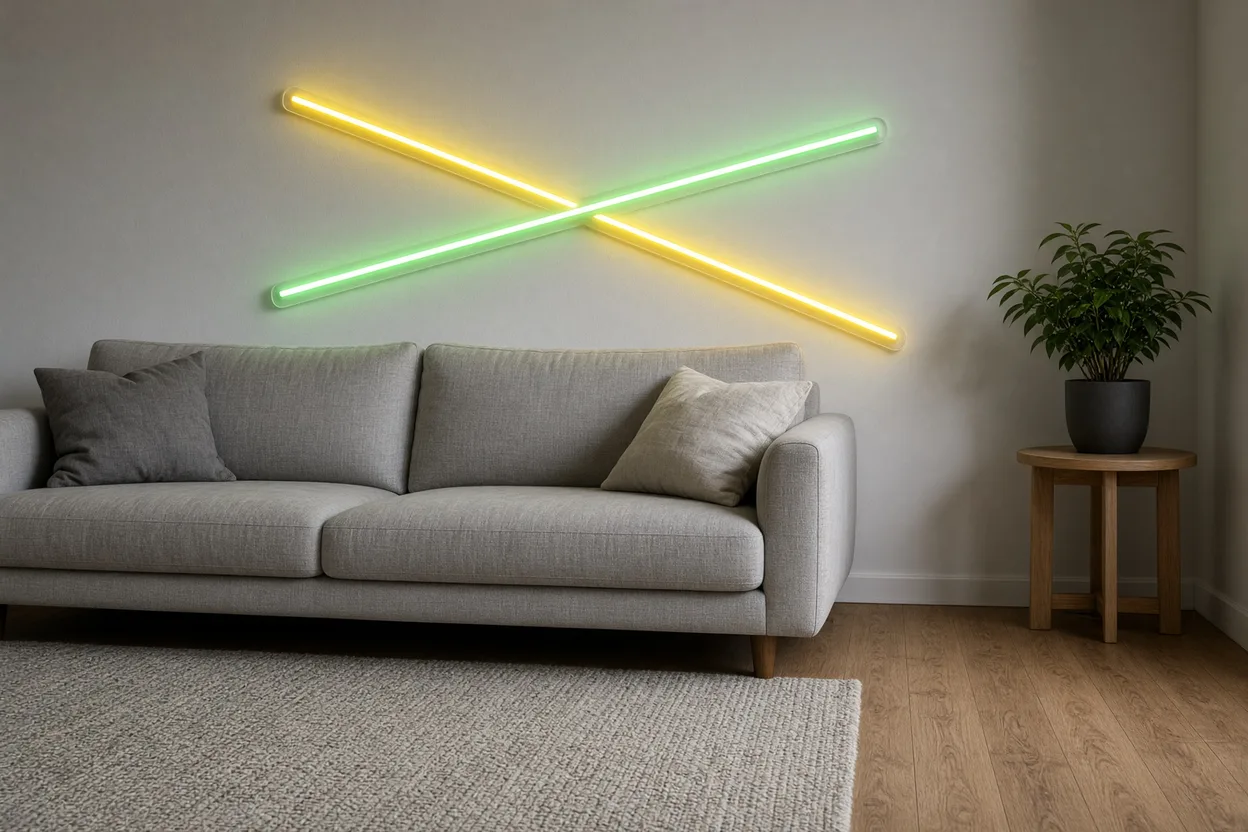
An LED neon allows playing with these principles in complete safety. Unlike the fluorescent tubes the artist used, it works in 12V, consumes 8 to 15 W per meter, stays cold to the touch and can follow a straight line, an angle or a curve. Its lifespan reaches about 100,000 hours, and it is guaranteed 3 years at Helioneon, which avoids the regular replacements required by the original tubes. Our comparison between glass neon vs LED neon explains what distinguishes these technologies.
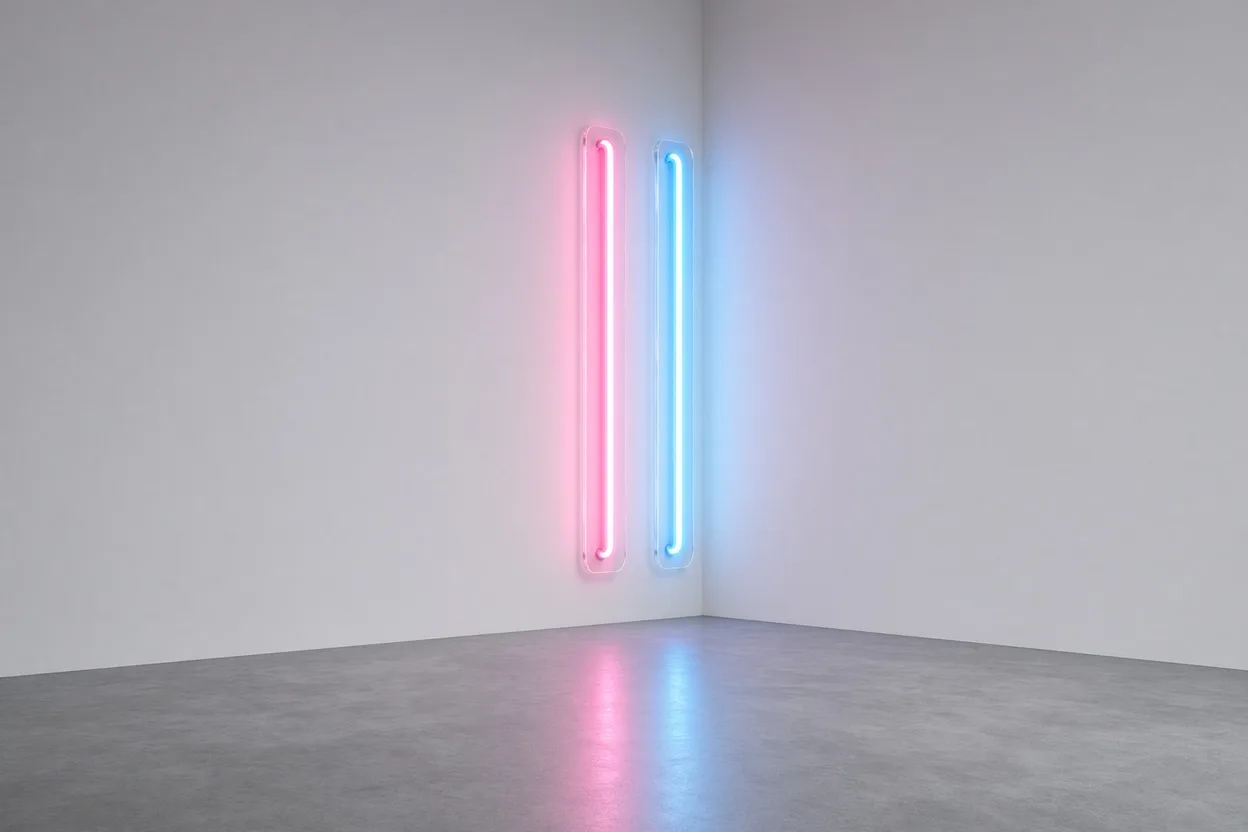
- Vertical line in a corner : a stroke of color that tints two walls at once
- Horizontal line above a sofa : a soft light bath on the wall
- Two colors that cross : pink and blue, or green and yellow, for mixtures on the wall
- Corridor or entrance : a line on the floor or ceiling that guides the gaze
In a hotel lobby, a gallery, a showroom or an office, this type of luminous line creates a strong signature with few means. Before drawing, take photos of the place by day and by night: as with Flavin, it is the relation between the light and the walls that makes the effect, more than the luminous object itself.
Frequently asked questions about Dan Flavin
Who is Dan Flavin?
Flavin (1933-1996) is an American artist, a major figure of minimal art. He is known for his works composed solely of commercial fluorescent tubes, which he used from 1963 to create installations of colored light. His pieces, often titled "untitled" with a dedication, transform space through color and are exhibited in major museums in Europe and the United States.
What is Dan Flavin's most famous work?
His founding work is "the diagonal of May 25, 1963", a yellow fluorescent tube fixed diagonally on a wall and dedicated to Constantin Brancusi. The series of "monuments" for V. Tatlin, made between 1964 and 1982, is also very well known. Among his large installations are those of the Chinati Foundation in Marfa, Texas, and of the church Santa Maria Annunciata in Chiesa Rossa, in Milan.
Did Dan Flavin use neons?
No, in the strict sense. Flavin used industrial fluorescent tubes, in the standard lengths and colors of commerce, and not blown glass neons filled with gas. The visual result is close, which explains why people often speak of his "neons". Both techniques are today largely replaced by LEDs in current and decorative lighting.
Where to see Dan Flavin works in France?
Several French collections hold works by Flavin, notably the Fondation Louis Vuitton, the Pinault Collection and the Frac Grand Large in Dunkerque. They are not exhibited permanently, so check the exhibition programs. In Europe, the permanent installation of the church Santa Maria Annunciata in Milan and that of the Kröller-Müller Museum in the Netherlands are visible all year.
How to be inspired by Dan Flavin in decoration?
Take up his logic rather than his works: one or two lines of colored light, placed in a corner or above a piece of furniture, that tint the wall. Choose frank colors like pink, blue or green, and observe how they mix on the surfaces. An LED neon in 12V allows realizing this type of line in complete safety, straight as well as curved.
Dan Flavin proved that an object as banal as a light tube could become a work, provided it is placed with precision in space. His legacy lives today in architecture, scenography and decoration. To create your own luminous line, colored or custom, launch your project via our contact page and receive a free 3D mockup within 24 hours. To deepen his biography, the Wikipedia page on Dan Flavin details his exhibitions and installations.
Your custom neon, designed for free in 24 h
- Describe your ideaA text, a logo or a simple sketch. It takes one minute.
- Get your mockup and priceWithin 24 h by email, no commitment.
- Approve, we make itFree express delivery in 7 to 10 days, set up in 3 minutes.
- Mockup and price within 24 h, no commitment
- Free express delivery, received in 7 to 10 days
- 3-year warranty, set up in 3 minutes
Get your free mockup

Guillaume Schlupp
Founder of Helioneon
Over 10 years of entrepreneurship in premium interior design. 500+ LED neons delivered across 13 countries under Helioneon and Light Genius. Leads product strategy, design and professional accounts.