Memphis Style: History, Codes and Tips to Adopt the Boldest 80s Design
- The Memphis style is a bold 1981 Milan design movement known for geometric shapes, bright primary and pastel colors, graphic patterns and playful humor, now returning in more restrained neo-Memphis versions for homes and commercial spaces.
- Discover its origins in 1981 Milan, key visual codes, iconic pieces and tips to use the style at home or in shops.
The Memphis style is a design and interior decor movement born in Milan in 1981 around Ettore Sottsass. It is recognized by its geometric shapes, bright colors, graphic patterns and sense of humor. Created as a reaction against minimalism, it is returning to interiors today. At Helioneon, we often design a personalized neon sign for these highly colorful settings.
This guide is for both private individuals and decorators, interior designers and business owners who want a space that gets noticed. With more than 500 neon signs delivered, we see this style coming back in cafes, shops and teen bedrooms, often in a more restrained version than the original. Here is where the style comes from, how to recognize it and how to adopt it without turning the room into a playroom.
What is the Memphis style?
The Memphis style is a postmodern design movement that mixes geometric shapes, primary and pastel colors, graphic patterns and industrial materials to create joyful, provocative and deliberately offbeat objects. It does not seek classical harmony, but emotion and surprise.
In the early 1980s, the dominant design followed the rule "form follows function". The members of the Memphis group did the opposite: a piece of furniture could be funny, appear unstable or almost unusable, as long as it told a story. That is why it is often called anti-design or anti-minimalism.
- Shapes: circles, triangles, zigzags, checkers and wavy lines
- Colors: bright primaries, acid pastels and black and white contrasts
- Materials: printed laminate, plastic, lacquered metal, terrazzo
- Spirit: humor, freedom and rejection of the rules of good taste
The movement was criticized from the start: some found it kitsch, others loud. Yet it deeply marked the graphic design, fashion and decor of the 1980s, and it remains one of the most recognizable styles in the history of design.
Where does the Memphis style come from?
This movement comes from a collective of designers and architects gathered in Milan by Ettore Sottsass in December 1980. Sottsass was then 63 years old and had a long career behind him, notably at Olivetti, where he designed the famous Valentine typewriter in 1969.
The name of the group comes from a Bob Dylan song, "Stuck Inside of Mobile with the Memphis Blues Again", which played on loop during the first meeting. It evoked both Memphis, the capital of ancient Egypt, and Memphis, the city of rock and roll and Elvis Presley. This double meaning summed up the group's ambition well: to mix high culture and popular culture.
- 1980: birth of the collective in Sottsass's Milan apartment
- 1981: first exhibition in Milan, during the Furniture Fair
- 1985: Sottsass leaves the group, which continues without him
- 1988: dissolution of the collective, about 7 years after its first exhibition
Around Sottsass, we find in particular Michele De Lucchi, Martine Bedin, Nathalie Du Pasquier, George Sowden, Matteo Thun, Aldo Cibic and Marco Zanini, joined by international guests such as Shiro Kuramata, Michael Graves or Peter Shire. The laminate manufacturer Abet Laminati played a key role, as its printed surfaces became the signature of the movement.
What are the visual codes of the Memphis style?
The codes of the Memphis style come down to four elements: simple geometric volumes stacked together, a palette of bright contrasting colors, repeated graphic patterns and industrial materials treated as noble materials. When three of these elements are combined, the style is recognizable at first glance.
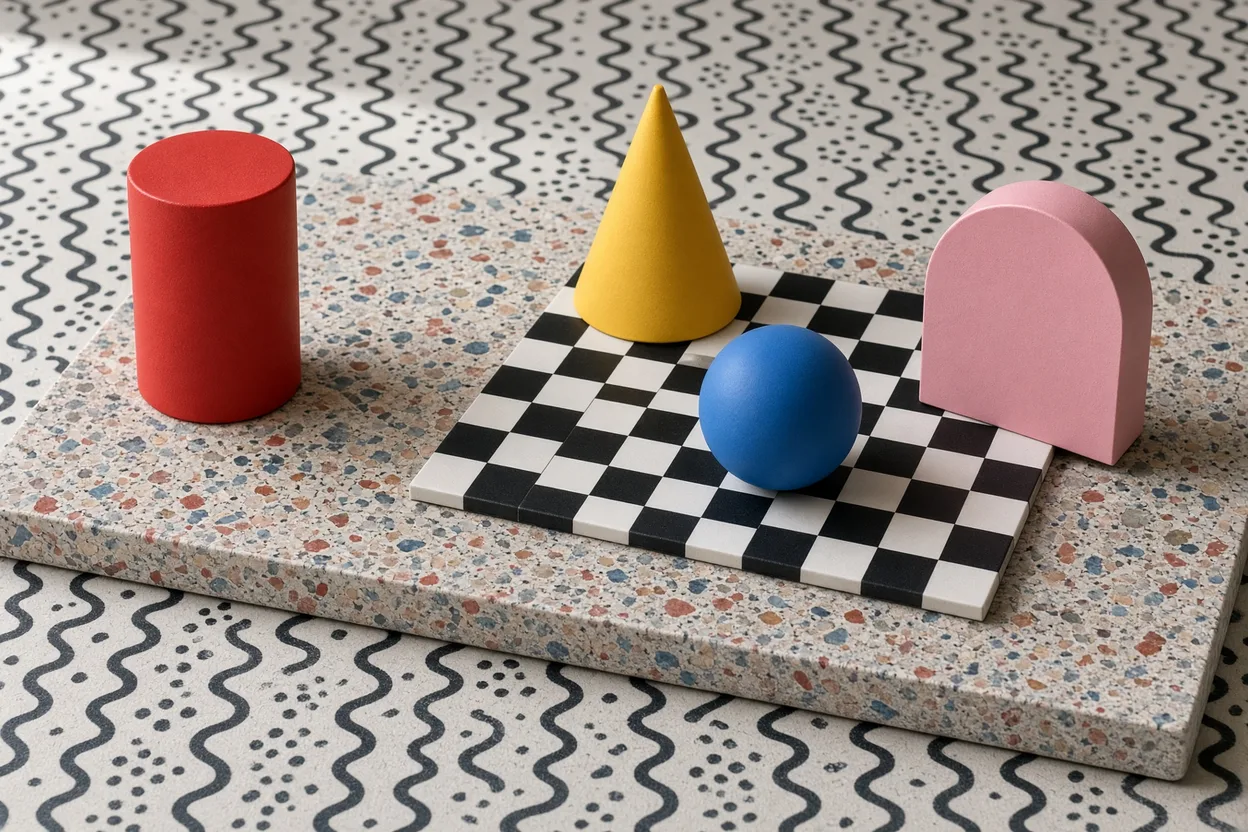
Colors are the most visible point. The group associates red, yellow and blue with more acid tones like pink, turquoise, mint green or lilac, often close to neon hues. Black and white serve as a binder, especially in checkerboard or dotted patterns.
| Memphis Element | Distinctive Sign | Contemporary Version |
|---|---|---|
| Custom LED neon | Bright color line, graphic shape | Zigzag, lightning bolt or word in pink and blue |
| Printed laminate | Bacterio patterns, dots, lines | Table top or graphic backsplash |
| Geometric shapes | Cylinders, cubes, arches | Colored console or shelf |
| Black and white checkerboard | Strong contrast on floor or wall | Checkerboard tile or rug |
| Terrazzo | Colored chips on light background | Countertop or small table |
Patterns count as much as colors. The "Bacterio" pattern, designed by Sottsass for Abet Laminati, imitates microorganisms, while Nathalie Du Pasquier created textiles saturated with shapes and lines. To choose colors that match the desired effect, our guide on neon color meaning and psychology provides useful benchmarks.
Volumes also play a central role. A Memphis piece of furniture often looks like an assembly of toys: a cylinder placed on a cube, a sphere at the end of a rod, an arch stuck between two blocks. This stacking logic creates immediately identifiable silhouettes, even in a small photo. In a current interior, a single piece of this type is enough to set the tone, especially if it stands out against a light wall.
What are the iconic pieces of Memphis design?
A few objects are enough to summarize the movement: the Carlton bookcase and the Tahiti lamp by Ettore Sottsass, the Super lamp by Martine Bedin and the First armchair by Michele De Lucchi. They are now exhibited in major museums and highly sought after at auction.
- Carlton bookcase (1981): a multicolored totem nearly 2 m high, with diagonal shelves
- Tahiti lamp (1981): a desk lamp in the shape of a bird, with a yellow beak and pink neck
- Super lamp (1981): a semicircle on wheels, adorned with colored bulbs
- First armchair (1983): a metal structure, a ball and discs as armrests
The movement also seduced famous collectors. Karl Lagerfeld furnished his Monte Carlo apartment entirely in Memphis in the early 1980s, before selling his collection at auction in 1991. David Bowie's collection, sold at Sotheby's in 2016, also contained many pieces from the group.
In France, the Musée des Arts Décoratifs in Paris holds several Memphis pieces and presents them in its design circuit. It is a good visit to see the colors and volumes in real life, because photos tend to flatten them.
Why is the Memphis style coming back in decor in 2026?
This style is coming back because it responds to a weariness with all-beige and all-minimalist interiors. Since the late 2010s, "neo-Memphis" takes up its shapes and colors, but applies them with more restraint, on a neutral base.
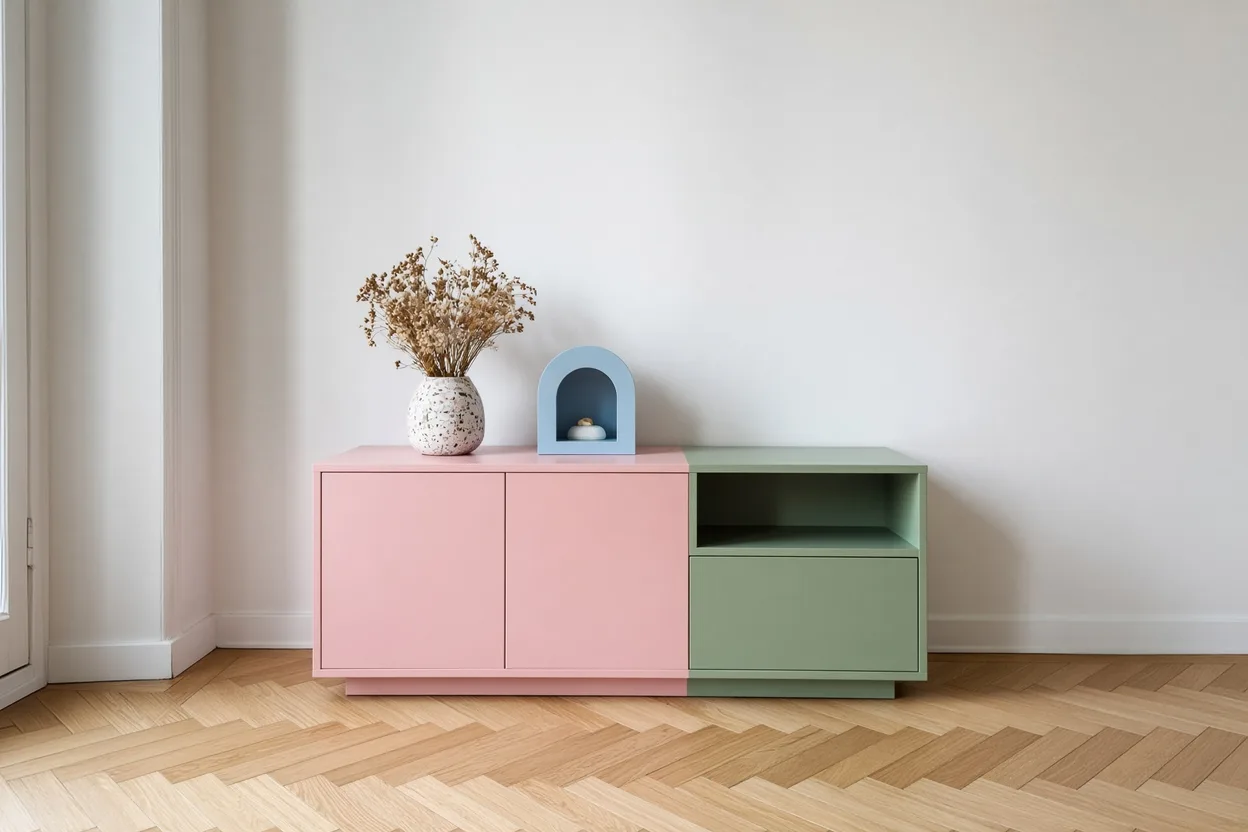
Social media have accelerated this return, because Memphis decors are very photogenic. A furniture brand, a coffee shop or a fashion boutique finds a simple way to stand out in images. Several publishers are also reissuing original pieces, and young designers openly draw inspiration from the movement.
- Neutral base: white walls, polished concrete or light wood rather than a wall painted in color
- Targeted touches: one piece of furniture, one rug or one strong light per room
- Pastels: softer tones than in 1981, often powder pink and aqua green
- Mix of styles: Memphis combines with vintage, Scandinavian or Art Deco
Neo-Memphis is part of a broader movement back to color and maximalism. If you like more geometric and older styles, our Art Deco style guide shows another way to use line and light as decor.
How to adopt the Memphis style at home without overwhelming the room?
To adopt it without tiring the eye, start from a neutral base and add color touches on about 30% of the room, keeping only one strong piece. The 60-30-10 rule works well: 60% dominant neutral color, 30% secondary color and 10% bright accents.
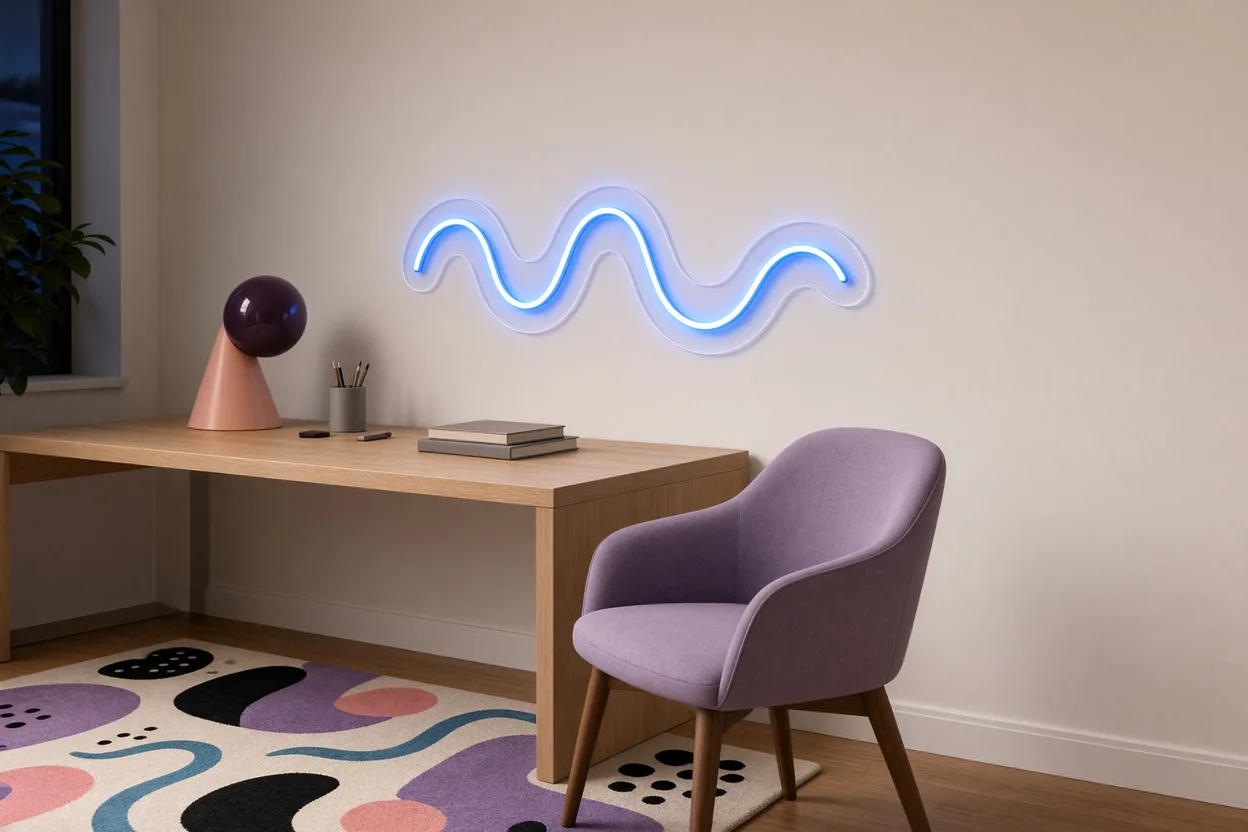
The simplest is to start with an object that sets the tone, such as a graphic rug, a colored console or a light. Then build around it, by taking up two or three colors from that object in the cushions, the tableware or the frames.
- Living room: a patterned rug, a terrazzo side table and a colored light line
- Bedroom: a plain headboard and a graphic touch on the wall, no more
- Kitchen: a backsplash or colored chairs on a light background
- Office: a sculptural lamp and a few objects with simple shapes
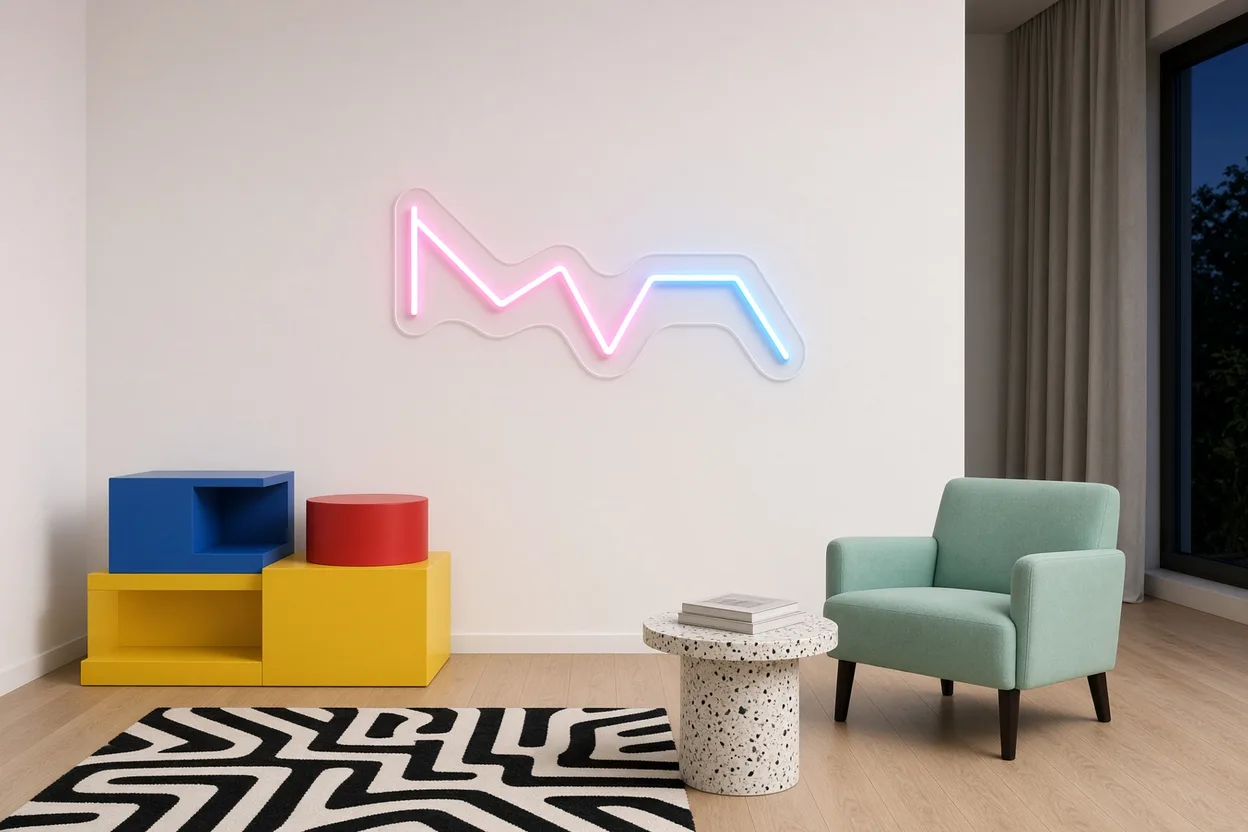
Light is an excellent entry point, because it adds color without cluttering. A neon in the shape of a zigzag, a lightning bolt, a wave or a short word, in pink, blue or yellow, is enough to give a Memphis identity to a white wall. For ideas on neon placement throughout the home, check our complete neon decor room-by-room guide.
On the practical side, a Helioneon LED neon runs on 12V and consumes 8 to 15 W per meter, which allows you to leave it on in the evening without thinking about it. It does not heat up and can therefore be placed above a sofa or a desk. Its lifespan reaches about 100,000 hours and it comes with a 3-year warranty.
The most common mistakes are easy to avoid. Multiplying different patterns in the same room, choosing colors that do not respond to each other, or mixing cheap objects that imitate the style without its quality. Better one well-designed piece and two or three coherent accessories than ten graphic objects with no link. If you hesitate, keep the walls white: they let the shapes and colors breathe, as in the group's presentations in 1981.
The Memphis style in a cafe, a shop or an office
In a place open to the public, this style mainly serves to create a memorable and photographed decor. It works well in coffee shops, concept stores, hair salons, youth spaces and startup offices, when the brand wants to display a joyful personality.
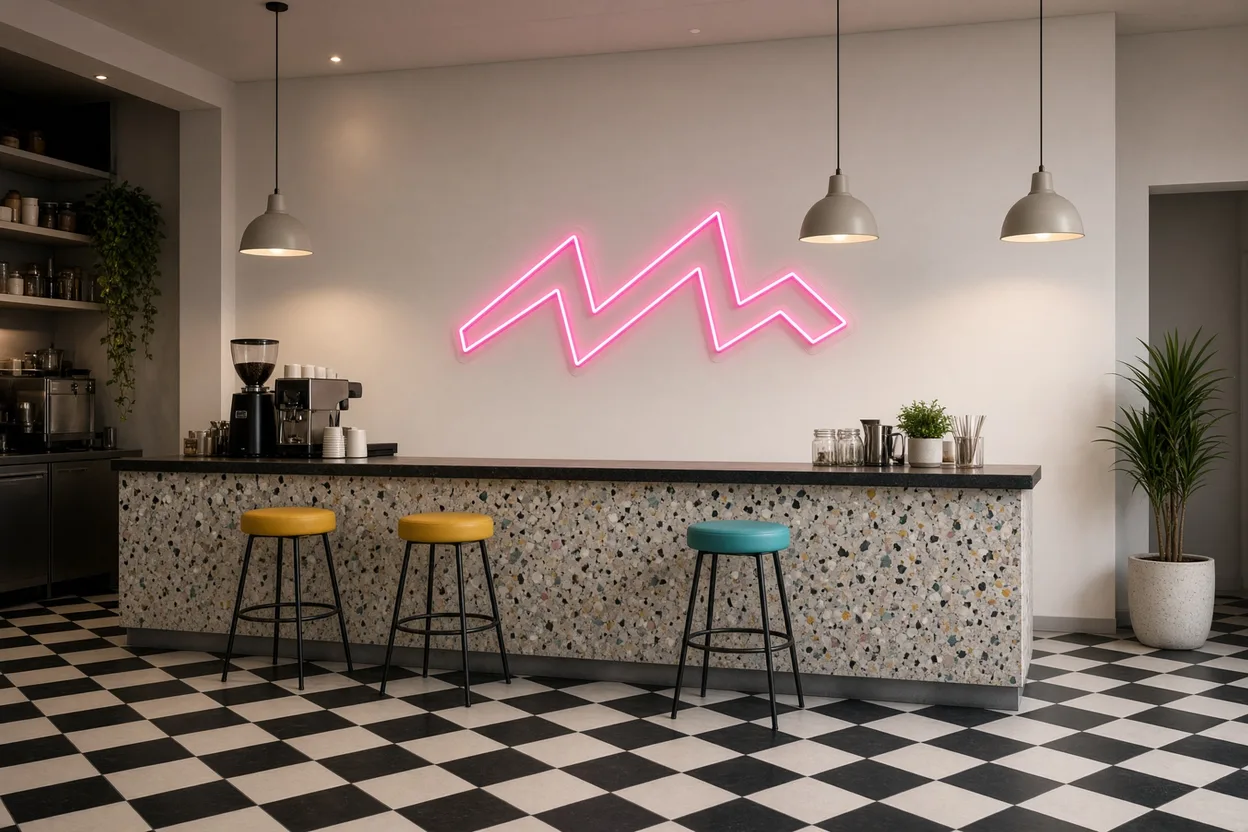
The trap is to do too much. A place entirely decorated this way quickly becomes exhausting for customers as well as for the team. It is better to concentrate the style on one or two strong points: the counter, the wall behind the cash register or the photo corner.
- Signature wall: a graphic pattern and a neon with the logo or the brand phrase, often between 60 cm and 1.2 m wide
- Counter: facade in colored laminate or terrazzo
- Seating: a few colored chairs in the middle of more neutral furniture
- Signage: arrows, pictograms and geometric typographies
For a professional, consistency with the visual identity remains a priority. We start from the logo or the brand guidelines to choose among our 13 colors and our 20 fonts, then we send a 3D mockup within 24 hours. Our neon aesthetic styles guide presents other universes if Memphis seems too marked for your clientele.
Frequently asked questions about the Memphis style
Who created the Memphis style?
It was created by the Italian designer and architect Ettore Sottsass, surrounded by a collective of young designers gathered in Milan in December 1980. Among them were Michele De Lucchi, Martine Bedin, Nathalie Du Pasquier, George Sowden, Matteo Thun, Aldo Cibic and Marco Zanini. The group presented its first collection in 1981 in Milan, then dissolved in 1988, after Sottsass's departure in 1985.
Why is it called the Memphis style?
The name comes from a Bob Dylan song, "Stuck Inside of Mobile with the Memphis Blues Again", which played on loop during the first meeting of the group at Sottsass's. The word also appealed for its double meaning: Memphis is both the ancient capital of Egypt and the American city of rock and roll. This mix of ancient culture and pop culture perfectly matched the spirit of the collective.
What colors to use for a Memphis style?
It associates bright primary colors, red, yellow and blue, with acid tones like pink, turquoise, mint green or lilac. Black and white serve as contrast, especially in checkerboard or dots. For a current version, keep a neutral base and limit yourself to three bright colors per room, distributed on the objects, the textiles and the light.
Is the Memphis style still in fashion?
Yes, it has returned since the late 2010s under the name of neo-Memphis. It is now used with more restraint: a light base, a few graphic pieces of furniture or objects and colors often more pastel than in 1981. It is seen a lot in cafes, shops and interiors of young professionals, and original pieces are reissued by design publishers.
Can a neon fit into a Memphis decor?
Yes, neon is one of the simplest ways to bring a Memphis touch, because it combines bright color and graphic line. A zigzag, a lightning bolt, a wave or a short word in pink, blue or yellow is enough on a white wall. Choose one or two colors taken up elsewhere in the room, and avoid long texts that would blur the desired graphic effect.
The Memphis style remains a joyful way to break the monotony of an interior or a business, provided it is dosed: a neutral base, a few strong shapes and well-chosen colors. To design a light line in this spirit, start your project via our contact page for a free neon sign quote and receive a free 3D mockup within 24 hours. To go further on the history of the collective, the Wikipedia page on the Memphis Group is a good starting point.
Your custom neon, designed for free in 24 h
- Describe your ideaA text, a logo or a simple sketch. It takes one minute.
- Get your mockup and priceWithin 24 h by email, no commitment.
- Approve, we make itFree express delivery in 7 to 10 days, set up in 3 minutes.
- Mockup and price within 24 h, no commitment
- Free express delivery, received in 7 to 10 days
- 3-year warranty, set up in 3 minutes
Get your free mockup

Guillaume Schlupp
Founder of Helioneon
Over 10 years of entrepreneurship in premium interior design. 500+ LED neons delivered across 13 countries under Helioneon and Light Genius. Leads product strategy, design and professional accounts.