Art Deco Style: Origins, Characteristics and How to Use It Today
- Art deco style emerged in the 1910s and peaked between 1920 and 1940. You can recognize it by its geometric shapes, symmetry, luxurious materials such as brass and marble, and bold black and gold contrast.
- You will find its origins, how to spot it, how it differs from Art Nouveau, iconic places and tips for using it today.
Art deco style is a decorative and architectural movement that emerged in the 1910s and peaked between 1920 and 1940. You can spot it by its geometric shapes, its symmetry, its luxurious materials such as brass, lacquer and marble, and its bold contrast between black and gold. At Helioneon, we often design neon signs inspired by its lettering, and this guide explains how to recognize art deco and bring it into a space, with or without a custom neon sign.
A century after the exhibition that gave it its name, the style is back everywhere: in hotels, cocktail bars, restaurants and homes that want some character. It also has a direct link to what we do, because the first neon signs appeared in the same era and spread its look far and wide. With more than 500 neon signs delivered, we regularly see requests for geometric letters and fan motifs. Here is what you need to know.
What is art deco style?
Art deco style is an artistic movement that shaped architecture, furniture, interiors, fashion and graphic arts from the 1910s to the 1940s. It combines geometric rigor, the elegance of fine materials and a fascination with modernity, speed and the machine.
Its name comes from the International Exhibition of Modern Decorative and Industrial Arts, held in Paris in 1925. Yet the term "art deco" only caught on in the 1960s, when historians rediscovered the style. At the time, people talked about the "modern" style or the "1925" style.
- Period: from the 1910s to the late 1930s, peaking around 1925
- Fields: architecture, furniture, objects, posters, jewelry, fashion
- Spirit: luxury, modernity, geometric order and fine craftsmanship
- Reach: Europe, the United States, Latin America, North Africa, Asia
Art deco, which dominated the decorative arts for nearly 20 years, is both a way of living and a visual language. It dressed luxury ocean liners as well as movie theaters, train stations, apartment buildings and department stores. That ability to suit very different places explains why it is returning to interior architecture projects today.
For an interior designer or architect, knowing these reference points is not just a matter of culture. When a client asks for an art deco mood, they often have a specific film or hotel in mind, so you need to translate that image into concrete choices. A 1925 bar, for example, does not follow the same codes as a 1935 ocean liner, even though both belong to the same movement. That is why the best projects start from a clear reference rather than a list of motifs.
Where does art deco style come from?
Art deco grew out of a break with Art Nouveau, which by the early 20th century was seen as too ornate and too floral. Designers looked for simpler, more structured lines, drawing on cubism, Egyptian art, African art and industrial aesthetics.
Several events fed this vocabulary. The discovery of Tutankhamun's tomb in 1922 sparked a craze for Egyptian motifs, while the Ballets Russes popularized vivid colors and daring sets. After World War I, society also longed for modernity, speed and celebration, which the Roaring Twenties came to embody.
- Cubism: geometric breakdown of forms
- Ancient Egypt: stepped pyramids, friezes, sunburst motifs
- Industry: machines, ocean liners, automobiles, streamlining
- Non-European arts: African masks, Asian lacquerware
Among the great names of the style, people often cite Jacques-Émile Ruhlmann for furniture, Jean Dunand for lacquer, René Lalique for glass, Eileen Gray for design and Sonia Delaunay for patterns. Their work set the codes we still recognize today.
Art deco also went mainstream faster than you might think, because manufacturers adopted its forms for everyday objects. While Ruhlmann's pieces remained the preserve of wealthy clients, radios, clocks, perfume bottles and posters brought this language into every home. That is also why you can still find plenty of affordable art deco objects at antique dealers today.
How to recognize art deco style
The characteristics of art deco style come down to five signs: geometric shapes (chevrons, fans, zigzags, circles), strong symmetry, luxurious materials, contrasting colors and tall, graphic lettering. Once several of these signs come together, there is no doubt left.
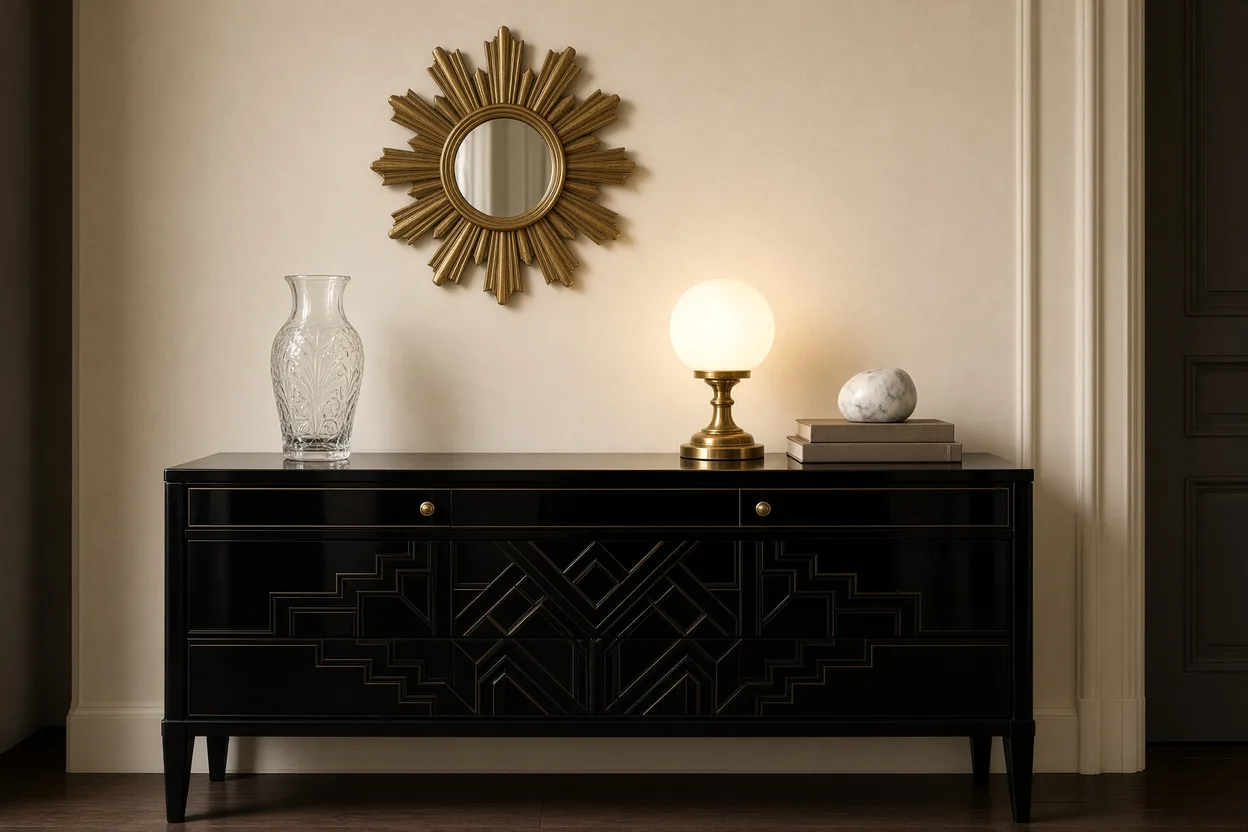
Materials are a decisive clue. Art deco furniture uses varnished exotic woods, lacquer, ivory, shagreen, brass, chrome, marble and etched glass. As for colors, black and gold dominate, often paired with emerald green, midnight blue, burgundy or cream.
- Geometry: fans, sunbursts, chevrons, stepped forms
- Symmetry: centered, balanced compositions
- Materials: lacquer, brass, marble, glass, precious woods
- Colors: black and gold, emerald, midnight blue, burgundy
- Lettering: tall, narrow letters with contrasting thick and thin strokes
Lettering deserves special attention, because it defined the posters, facades and signs of the era. These vertical, geometric letters are a natural fit for neon. Once you have picked the lettering style, our list of neon sign quote ideas can help you decide what to write.
Art Nouveau vs. art deco style: what is the difference?
Art Nouveau, which came before art deco, roughly from 1890 to 1910, draws on nature with plant-like curves, flowers and flowing lines. Art deco takes the opposite approach with geometry, symmetry and industrial inspiration. Both movements still share a love of fine craftsmanship and noble materials.
For a decorating project, this distinction helps you stay consistent. The table below lists the typical elements of art deco decor, their distinctive sign and how to reinterpret them today, starting with the illuminated sign, the emblem of the era.
| Art deco element | Distinctive sign | Contemporary version |
|---|---|---|
| Illuminated sign (neon) | Tall letters, light as decor | Custom LED neon, geometric lettering |
| Sunburst or fan mirror | Symmetrical rays | Brass mirror above a console |
| Lacquered furniture | Clean lines, glossy finish | Black lacquered sideboard, gold handles |
| Glass light fixture | Globes, stepped forms, opaline glass | Globe and brass wall sconce |
| Geometric tile | Black and white patterns | Herringbone floor or mosaic |
- Art Nouveau: curves, floral motifs, asymmetry, plant inspiration
- Art deco: geometry, symmetry, industrial and ancient inspiration
- Common ground: a high level of craftsmanship and detail
Where to see art deco style in France and around the world
Art deco left masterpieces on every continent. In France, highlights include the Palais de Tokyo and the Palais de Chaillot, built for the 1937 Exposition, the Roubaix swimming pool that became the La Piscine museum, and the cities rebuilt after World War I such as Reims and Saint-Quentin.
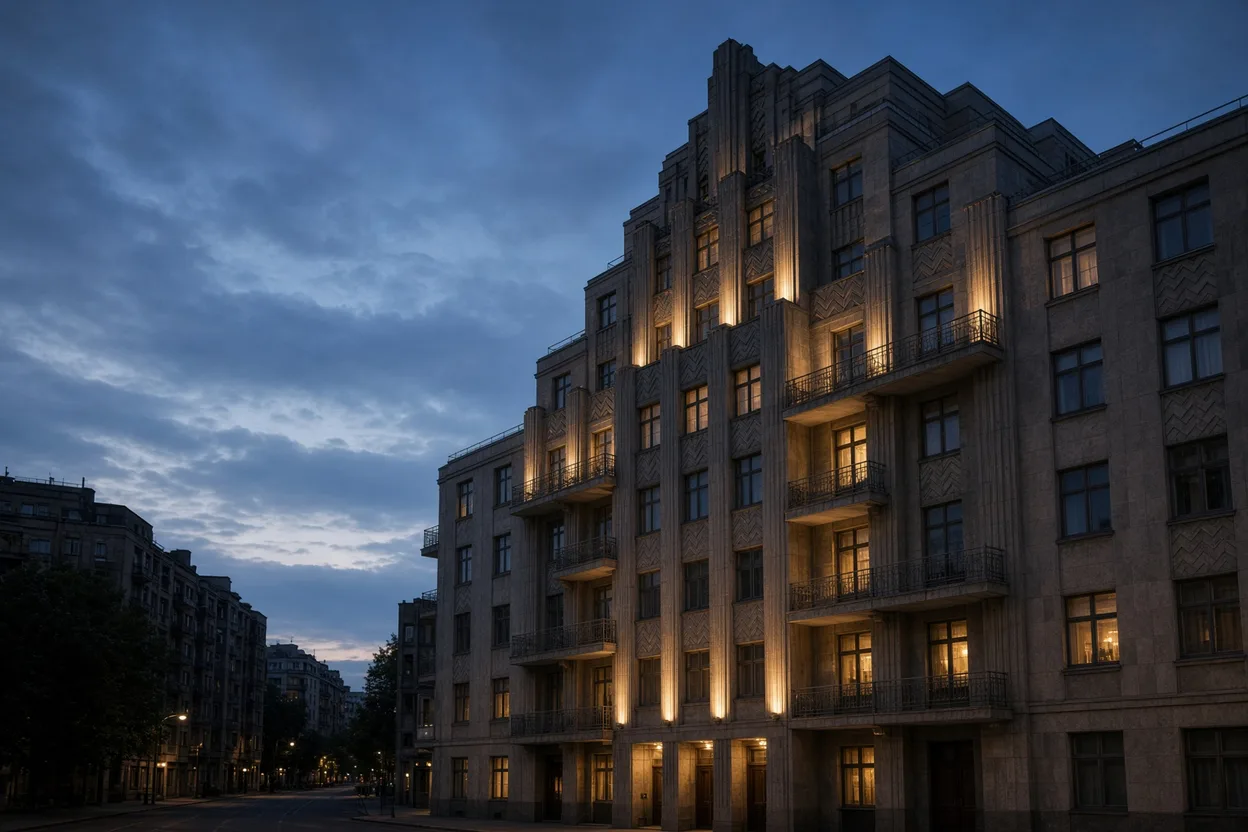
Elsewhere, the New York skyscrapers are its most famous symbols: the Chrysler Building, completed in 1930 and 1,046 feet (319 m) tall, and the Empire State Building in 1931, which rises to 1,250 feet (381 m) without its antenna. The Art Deco Historic District in Miami Beach, with its pastel facades and neon signs, shows a seaside version of the style, while Casablanca, Napier in New Zealand and Mumbai offer other interpretations.
- Paris: Palais de Tokyo, Palais de Chaillot, many apartment buildings and movie theaters
- Northern and eastern France: Roubaix, Reims, Saint-Quentin, the rebuilt cities
- United States: Chrysler Building, Empire State Building, Miami Beach
- Elsewhere: Casablanca, Napier, Mumbai, Shanghai
These places are a valuable source of inspiration for architects and designers. They also show the role light plays in art deco: facades highlighted at night, illuminated signs, lobbies lit by glass sconces. The principles behind this kind of lighting are covered in our guide to architectural lighting principles.
How to bring art deco style into a home today
To bring art deco interior design into a home without turning it into a period set, choose a few statement pieces and a tight palette, then pair them with a simple contemporary base. A sunburst mirror 30 to 40 inches across, emerald velvet, a brass globe sconce and a geometric floor are often enough to set the mood.
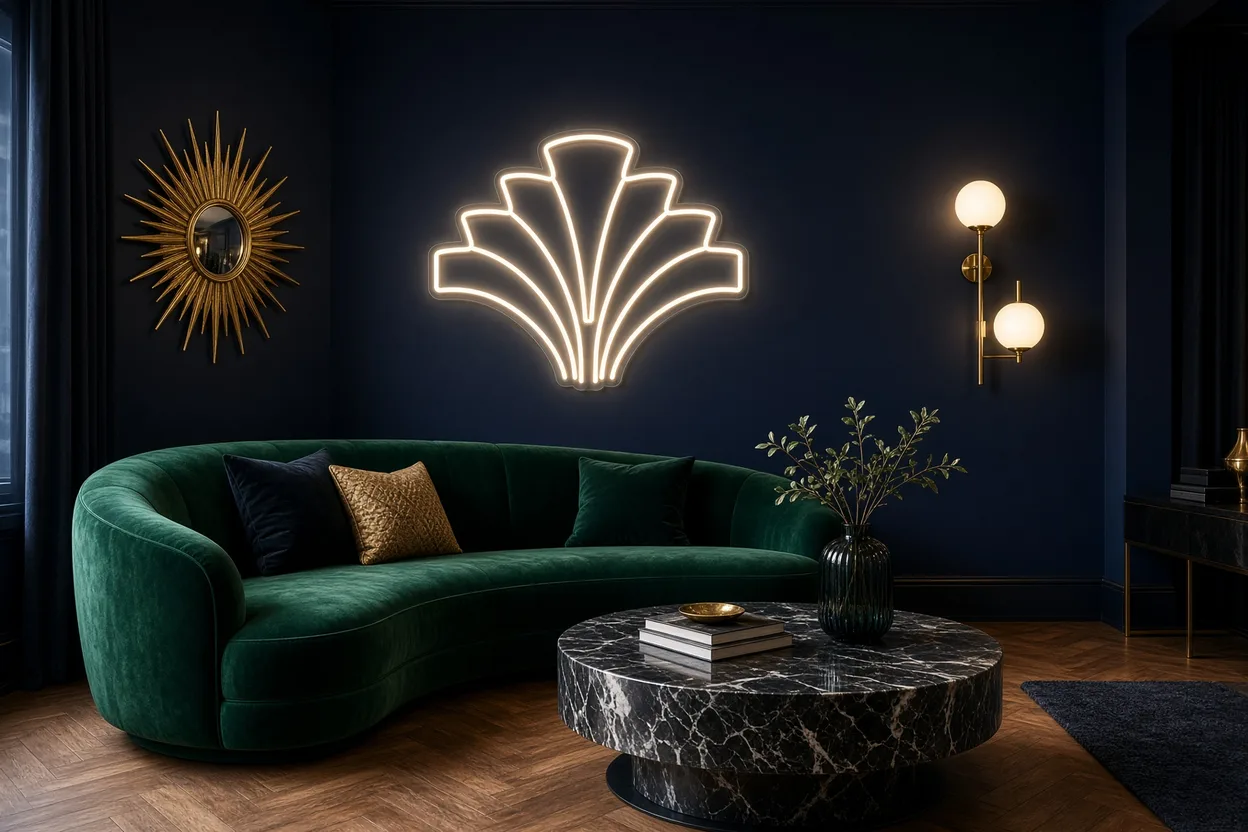
The living room is a good fit for a curved velvet sofa, a marble coffee table and brass light fixtures. In the bedroom, a tufted or fan-shaped headboard and lacquered nightstands do the job. The bathroom loves black and white tile, gold faucets and a geometric mirror.
- Palette: one deep color, black, a touch of gold
- Statement pieces: sunburst mirror, lacquered sideboard, velvet armchair
- Patterns: fans, chevrons and stepped forms, in moderation
- Lighting: glass globes, brass and one graphic light accent
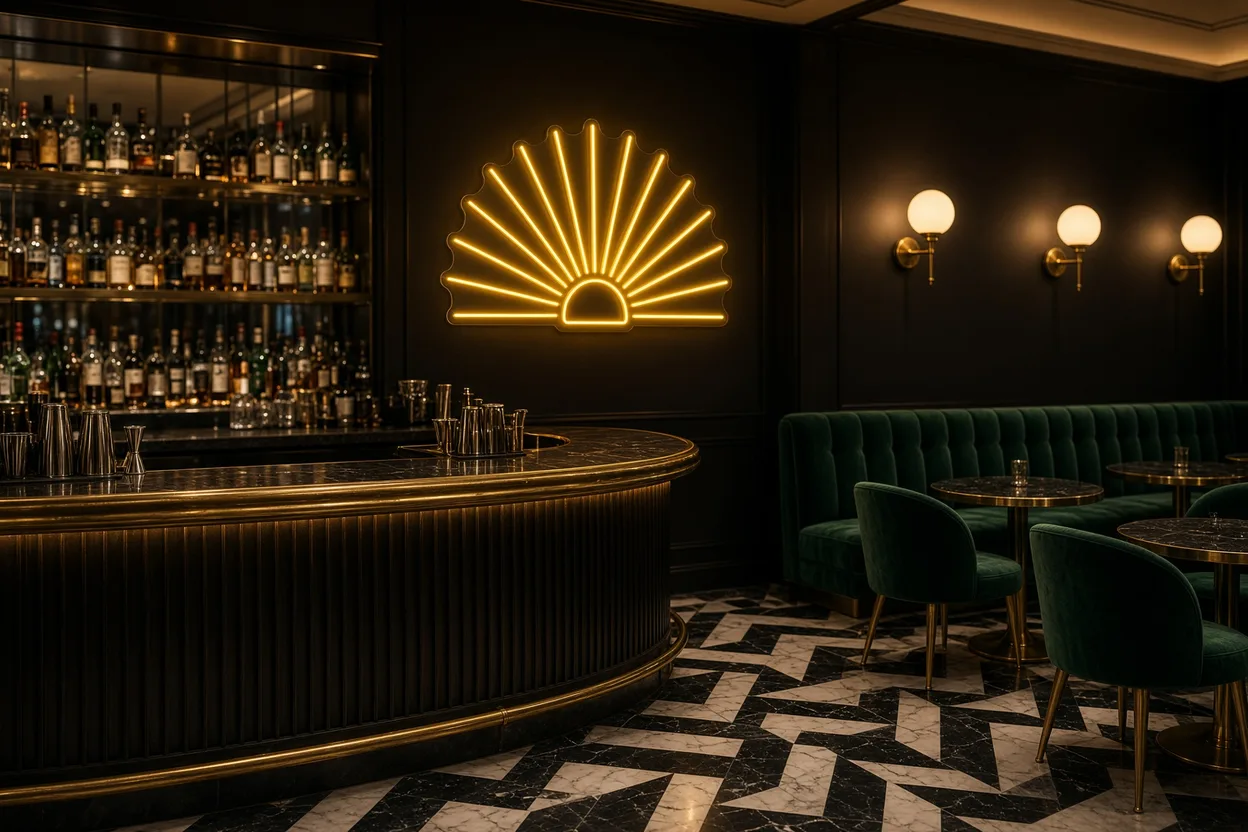
The common mistake is overdoing it. Art deco is rich by nature, so a few well-chosen elements are enough, while a pile of gilding and patterns quickly looks like a pastiche. A neon sign with art deco lettering, in warm white or gold, can become the only graphic element on a wall and set the tone for the whole room.
Finally, lighting deserves extra care in an art deco interior, because it makes brass, glass and lacquer shine. With a warm white around 2,700 K, never above 3,000 K, gilded finishes take on a soft glow, while a cool white makes them look dull. You are better off adding several sconces and table lamps than installing a single powerful ceiling light.
Why art deco style appeals to hotels, bars and restaurants
Art deco appeals to hotels and restaurants because it instantly evokes the luxury, celebration and refinement of the Roaring Twenties. It creates a strong, photogenic atmosphere, ideal for a cocktail bar, an upscale restaurant or a hotel lobby that wants to make an impression.
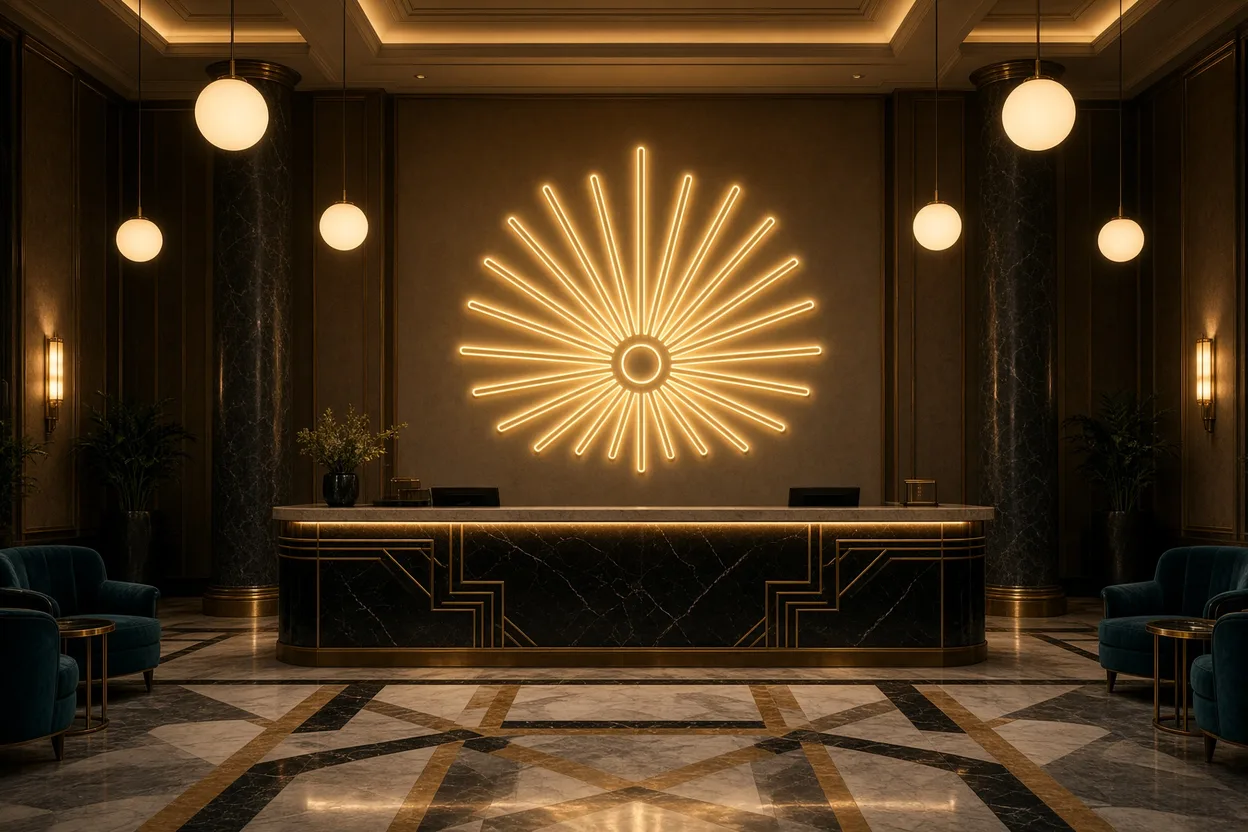
The link with light is historical. Frenchman Georges Claude unveiled the first neon sign in Paris in 1912, and in the 1920s these signs took over the boulevards before reaching the United States in 1923, 11 years later, right in the art deco years. Facades of movie theaters, dance halls and hotels tied this style to glowing letters for good, as we tell in our article on the history of neon signs.
- Cocktail bar: brass counter, velvet, a sign with the venue's name
- Restaurant: banquettes, mirrors, globe fixtures, dim lighting
- Hotel: symmetrical lobby, marble, glass sconces, a signature light piece
- Store: brass-framed window, geometric letters
Today, LED neon brings back this look without the constraints of glass and gas: it runs on 12V, stays cool to the touch and lasts 100,000 hours. It reproduces the tall letters and fan motifs typical of the style, in a contemporary version. Our article on neon aesthetic styles shows how to pair it with other looks.
Art deco style FAQ
What are the characteristics of art deco style?
Art deco is defined by geometric shapes (chevrons, fans, zigzags, stepped forms), strong symmetry, luxurious materials such as lacquer, brass, marble, glass and exotic woods, and contrasting colors dominated by black and gold. Its lettering, made of tall, graphic letters, is also very recognizable. The style draws on cubism, Egyptian art and industrial aesthetics, breaking with the plant-like curves of Art Nouveau.
When did art deco style begin?
Art deco appeared in the 1910s and reached its peak in the 1920s and 1930s. It takes its name from the International Exhibition of Modern Decorative and Industrial Arts held in Paris in 1925, although the term "art deco" only caught on in the 1960s. The style faded in the late 1930s, then kept coming back into fashion, especially since the exhibition's centennial in 2025.
What colors work for art deco decor?
The typical colors of art deco decor are black and gold, often paired with a deep shade such as emerald green, midnight blue, burgundy or teal. Cream and off-white act as a base to balance these contrasts. For a modern interior, choose one dominant color, add black for structure and touches of brass or gold for shine, without piling on bright hues.
How do you bring art deco into a modern interior?
Start from a simple contemporary base, then add a few statement pieces with art deco character: a sunburst mirror, a curved velvet armchair, a marble table, a brass globe sconce or geometric tile. Limit the palette to one deep color, black and a touch of gold. A graphic light piece, such as a neon sign with geometric letters, can also set the tone without overloading the room.
Does neon work with art deco style?
Yes, neon is historically tied to art deco. The first neon signs appeared in Paris in 1912 and spread through the 1920s and 1930s on the movie theaters, hotels and dance halls of the time. Today, an LED neon sign picks up those tall letters and fan motifs, in warm white or gold, with low power consumption and a lifespan of 100,000 hours. It is a perfect match for an art deco bar, restaurant or living room.
Art deco style remains one of the most elegant of the 20th century: geometry, noble materials, contrast and light make it a language you can reinterpret today with real accuracy. To create a sign or a light piece with art deco lettering, start your project through our contact page and get a free 3D mockup within 24 hours. To learn more about the history of the movement, the Wikipedia article on Art Deco is a good place to start.
Your custom neon, designed for free in 24 h
- Describe your ideaA text, a logo or a simple sketch. It takes one minute.
- Get your mockup and priceWithin 24 h by email, no commitment.
- Approve, we make itFree express delivery in 7 to 10 days, set up in 3 minutes.
- Mockup and price within 24 h, no commitment
- Free express delivery, received in 7 to 10 days
- 3-year warranty, set up in 3 minutes
Get your free mockup

Guillaume Schlupp
Founder of Helioneon
Over 10 years of entrepreneurship in premium interior design. 500+ LED neons delivered across 13 countries under Helioneon and Light Genius. Leads product strategy, design and professional accounts.