When were neon signs invented? The history of neon signs, from 1898 to LED
- Neon signs were invented between 1910 and 1912 in Paris by Georges Claude. He demonstrated glowing neon tubes at the Paris Motor Show in December 1910 and sold the first advertising sign in 1912 after the gas was discovered in 1898.
- This article traces the complete history of neon signs from early experiments and the golden age through decline and the modern LED comeback.
Neon signs were invented in France between 1910 and 1912. Engineer Georges Claude first showed glowing neon tubes at the Paris Motor Show in December 1910, and his company sold the first neon advertising sign to a Paris barbershop in 1912. The gas itself had been discovered in London in 1898. That is the core of the history of neon signs.
The rest of the story is just as interesting: a glowing barometer in the 17th century, two chemists distilling air, a Los Angeles car dealer who stopped traffic, the golden age of Times Square, a long decline and a comeback powered by LEDs. At Helioneon we make the latest chapter, flexible LED neon, with more than 500 signs delivered, so here is the whole timeline, told with the dates that matter.
When were neon signs invented? The key dates
Neon signs were invented in 1910 to 1912: Georges Claude demonstrated neon lighting in Paris in December 1910 and sold the first commercial neon sign in 1912. The timeline below covers the full history of neon signs, from the first glowing tube to modern LED neon.
- 1675: French astronomer Jean Picard sees a faint glow in his shaken mercury barometer
- 1857: German glassblower Heinrich Geissler makes sealed gas tubes that glow with electricity
- June 1898: William Ramsay and Morris Travers discover neon at University College London
- 1902: Georges Claude co-founds L'Air Liquide and produces neon as a by-product of liquefied air
- December 1910: Claude shows two red neon tubes, each about 12 m long, at the Paris Motor Show
- 1912: the first neon advertising sign lights a barbershop on the Boulevard Montmartre in Paris
- 1913: a large rooftop Cinzano sign glows over Paris
- 1915: Claude receives a US patent for his neon lighting system
- 1923: Earle C. Anthony brings two Packard neon signs to Los Angeles
- 1950s and 1960s: cheaper backlit plastic signs start to replace glass neon
- 1996: the Neon Museum is founded in Las Vegas to save historic signs
- 2010s: flexible LED neon in silicone tubing takes over decorative signs
If you are asking "when were neon signs invented?" for a school project or a quiz, two details help. First, dates in older books sometimes differ by a year or two, because early Paris signs were rarely photographed and dated. Second, a quick note on the word "invented": nobody invented neon gas, it was discovered. What Claude invented was a practical neon tube, with electrodes that kept it glowing for long periods, and a business model to sell it as signage.
Before neon: glowing barometers and Geissler tubes
The history of neon signs starts long before neon was known: in 1675, Jean Picard noticed light inside a shaken barometer, and in 1857 Heinrich Geissler built sealed glass tubes that glowed when electricity passed through low-pressure gas.
Picard's "barometric light" puzzled scientists for decades. It came from mercury vapor being excited by static electricity, the same basic principle as every neon tube that followed. Geissler's tubes, often blown into spirals and decorative shapes, became popular scientific curiosities in the second half of the 19th century. They proved that gas plus voltage equals light, but they were fragile, short-lived and far too dim for a street.
- Principle: an electric current excites gas atoms, which release light
- Limit: early tubes darkened quickly as electrodes degraded
- Missing piece: a bright gas, available in quantity
Inventors kept trying. In the 1890s and 1900s, American Daniel McFarlan Moore sold long tubes filled with nitrogen or carbon dioxide, known as Moore lamps. They glowed, but they leaked and were expensive to run. The right gas was about to appear.
Who discovered neon gas, and when?
Neon was discovered in June 1898 by Scottish chemist William Ramsay and English chemist Morris Travers at University College London. They isolated it from liquefied air and named it after the Greek word neos, meaning new.
The two scientists were hunting for the missing noble gases. After finding krypton, they distilled more air and found a gas that, under an electric current, gave off what Travers called a "blaze of crimson light". Ramsay won the 1904 Nobel Prize in Chemistry for his work on the noble gases. Neon is common in the universe but rare on Earth: it makes up only about 0.0018% of the air we breathe, which explains why it went unnoticed for so long.
- Discovered: June 1898, London
- By: William Ramsay and Morris Travers
- Source: fractional distillation of liquefied air
- Share of air: about 0.0018%
- Natural color in a tube: red-orange
For a few years, neon remained a laboratory sample, far too scarce and costly for lighting. Turning it into a commercial product needed someone who produced liquefied air on an industrial scale.
Who made the first neon sign?
French engineer Georges Claude made the first neon lighting: he showed neon tubes at the Paris Motor Show in December 1910, and in 1912 his company sold the first neon advertising sign to a barbershop on the Boulevard Montmartre, widely recorded as the Palais Coiffeur.
Claude had co-founded L'Air Liquide in 1902 to liquefy air for industry, which left him with a steady supply of neon as a by-product. He improved the Moore tube, replaced its gas with neon and solved the electrode problem that made earlier tubes go dark. According to the American Physical Society, he eventually built tubes about 6 m (20 ft) long that could glow for around 1,200 hours, a huge step at the time. In December 1910, two bright red tubes about 12 m long lit the Grand Palais during the Paris Motor Show. Crowds were dazzled, but the light was too red for homes. Signs, though, were a perfect fit. His associate Jacques Fonseque saw the advertising potential, and the barbershop sign followed in 1912, then a large Cinzano sign in 1913.
- First public demonstration: December 1910, Paris Motor Show
- First advertising sign: 1912, barbershop on Boulevard Montmartre
- First big rooftop sign: Cinzano, 1913
- US patent: 1915
- Company: Claude Neon, which sold franchises abroad
Historians note that a few early Paris signs are hard to date precisely, so the barbershop is "widely credited" rather than proven to be the very first. For a well-sourced account of Claude's work, see the American Physical Society history of neon lights.
When did neon signs come to America?
Neon signs came to America in 1923, when Los Angeles Packard dealer Earle C. Anthony bought two neon signs reading "Packard" from Claude's company. They are widely cited as the first neon signs in the United States and reportedly made passers-by stop to stare.
Anthony had seen neon in Paris and wanted it for his showroom. Accounts of the price differ, with figures around $1,250 per sign often quoted, and some researchers question the exact year the signs went up. What is not in doubt is the effect: the glowing tubes, nicknamed "liquid fire", made neon a sensation, and Claude Neon franchises soon opened across the country. This chapter of the history of neon signs is when neon stopped being a Paris novelty and became an American icon.
- Year: 1923, Los Angeles
- Buyer: Earle C. Anthony, Packard distributor for California
- Nickname: "liquid fire"
- Next step: Claude Neon franchises in major US cities
Once Claude's patents expired, competitors entered the market, prices fell and neon spread from car showrooms to diners, cinemas, hotels and gas stations.
The golden age in the history of neon signs (1920s to 1950s)
The golden age of neon signs ran from the late 1920s to the 1950s, when neon defined city nights from Times Square and Las Vegas to London's Piccadilly Circus, and every letter was still bent by hand over a flame.
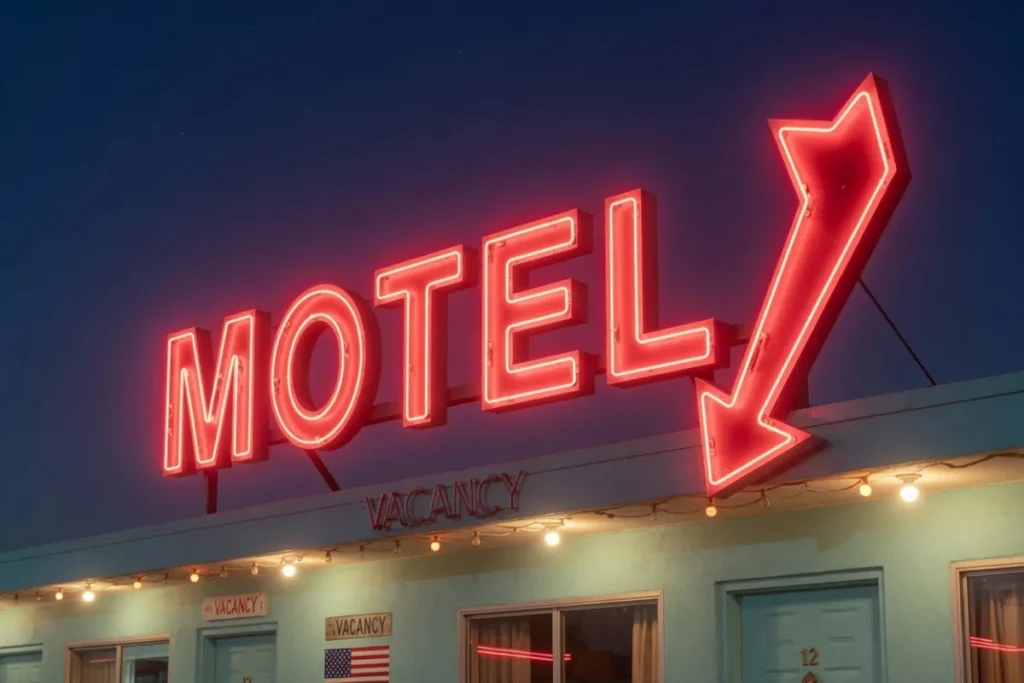
Ask anyone who studies the history of neon signs and they will point to the craft first, because it was demanding. A glass bender heated each tube, shaped it against a full-size pattern, sealed the electrodes, then filled it: neon for reds and oranges, argon with a drop of mercury for blues and greens, plus colored or coated glass for other shades. A large sign could take weeks of work. In the US, neon became the face of roadside America, with motels, diners and theaters competing for attention after dark. Las Vegas later built its whole identity on it. In Asia, cities like Tokyo and Hong Kong developed their own dense neon landscapes, which still inspire Tokyo-style neon decor today.
- Neon gas: red and orange light
- Argon and mercury: blue and green light
- Coated glass: whites, pinks and other shades
- Power: high-voltage transformers, often from about 2,000 V to 15,000 V

Why did neon signs decline, and how did they come back?
Neon signs declined from the 1950s and 1960s because backlit plastic signs with fluorescent tubes were cheaper to make and maintain. They came back from the 1990s through art and nostalgia, then massively in the 2010s thanks to flexible LED neon.
Glass neon was fragile, needed skilled repairs and ran on high voltage, while a fluorescent lightbox could be printed, lit and replaced quickly. As cities modernized, many classic signs went to the scrapyard, and neon picked up a slightly seedy image in some places. Preservation pushed back: the Neon Museum opened in Las Vegas in 1996, and in London, sign maker Chris Bracey's collection grew into God's Own Junkyard in Walthamstow. Artists such as Tracey Emin made handwritten neon a gallery language.
- Cause of decline: cost, fragility, maintenance, competition from plastic signs
- Preservation: museums and collectors saved historic signs
- Art: neon text became a contemporary art medium
- Technology: LED neon made the look affordable, safe and durable at 12 V
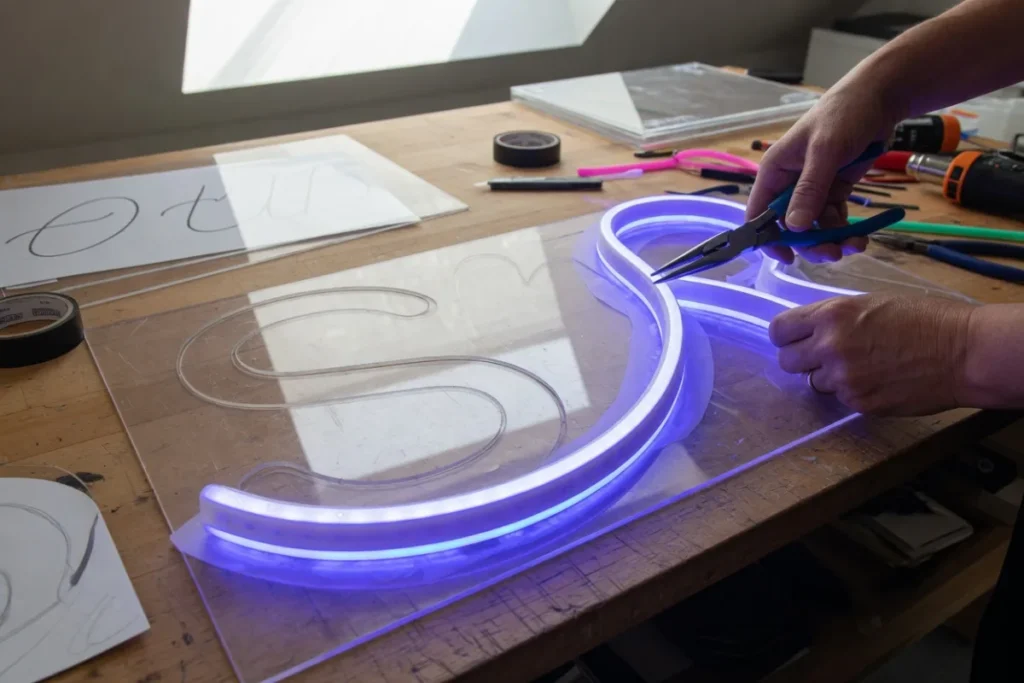
The latest chapter in the history of neon signs is technical. LED neon puts LEDs inside a silicone tube that diffuses the light into a continuous line, so it looks like glass neon without the gas, the glass or the high voltage.
Glass neon vs LED neon: the modern history of neon signs
Glass neon uses gas, glass tubes and high-voltage transformers, while modern LED neon uses LEDs in flexible silicone running on 12 V. That shift explains why neon signs moved from storefronts into bedrooms, weddings and offices.
| Technology | How it works | Voltage | Lifespan |
|---|---|---|---|
| LED neon (Helioneon) | LEDs in silicone tube | 12 V, cool to touch | Around 100,000 hours |
| Glass neon | Gas in hand-bent glass | High voltage | Long, if well maintained |
| Geissler tube (1857) | Gas in sealed glass | High voltage | Short, lab use |
LED neon also uses far less energy, about 8 to 15 W per meter for our signs, or roughly 12 W for a 1 m sign, and it is light enough to ship and hang like a picture. A sign of about 40 inches (100 cm) plugs into a normal outlet through a small 12 V power supply. Glass neon still has a unique depth of color that purists love, and for heritage restorations it remains the right choice. For a modern sign at home or in a shop, the full comparison is in our guide on glass neon vs LED neon, and our article on LED neon sign lifespan explains what that 100,000-hour rating means in years.
- Safety: 12 V versus thousands of volts
- Weight: light silicone versus fragile glass
- Shapes: both follow letters and logos closely
- Price: LED neon signs start from about $265, see our custom neon sign cost guide
Frequently asked questions about the history of neon signs
Who invented the neon sign?
French engineer and chemist Georges Claude is credited with inventing the neon sign. He developed a reliable neon tube, demonstrated it at the Paris Motor Show in December 1910, and his company sold the first neon advertising sign to a Paris barbershop in 1912. He received a US patent for his neon lighting system in 1915 and built an international business, Claude Neon, by selling franchises to sign makers in other countries.
When was neon gas discovered?
Neon gas was discovered in June 1898 by William Ramsay and Morris Travers at University College London. They found it while distilling liquefied air, saw a bright crimson glow when they passed a current through it, and named it after the Greek word neos, meaning new. Ramsay received the 1904 Nobel Prize in Chemistry for his work on the noble gases, a family that also includes argon, krypton and xenon.
What was the first neon sign?
The first neon advertising sign is widely credited to a barbershop on the Boulevard Montmartre in Paris, often named as the Palais Coiffeur, in 1912. It was sold by Georges Claude's company after his public neon demonstration in 1910. A large rooftop sign for Cinzano followed in 1913. Some early Paris signs are hard to date exactly, so historians present the barbershop as the generally accepted first rather than a certainty.
When did neon signs become popular in the US?
Neon signs became popular in the United States from 1923, when Los Angeles car dealer Earle C. Anthony installed two Packard neon signs bought from Claude's company. The glowing tubes caused a sensation, and neon spread quickly through the late 1920s and 1930s to diners, theaters, hotels and gas stations. The golden age lasted until the 1950s, when cheaper backlit plastic signs started to replace much of the glass neon.
Are modern neon signs still made with neon gas?
Most modern neon signs are not made with neon gas anymore. The large majority of decorative signs today use LED neon: LEDs inside a flexible silicone tube that spreads the light into a smooth line. It runs on 12 V, stays cool and lasts around 100,000 hours. Traditional glass neon, filled with neon or argon, is still made by skilled benders for heritage signs and art pieces, but it is now a niche craft.
In short, from Picard's glowing barometer to Claude's Paris tubes and today's LED neon, the history of neon signs is a story of one idea, light you can write with, reinvented every few decades. If you want to add your own line to it, send your words or logo through our contact page: we design every custom neon sign with a free 3D mockup within 24 hours, and ship in 7 to 10 days.
Your custom neon, designed for free in 24 h
- Describe your ideaA text, a logo or a simple sketch. It takes one minute.
- Get your mockup and priceWithin 24 h by email, no commitment.
- Approve, we make itFree express delivery in 7 to 10 days, set up in 3 minutes.
- Mockup and price within 24 h, no commitment
- Free express delivery, received in 7 to 10 days
- 3-year warranty, set up in 3 minutes
Get your free mockup

Guillaume Schlupp
Founder of Helioneon
Over 10 years of entrepreneurship in premium interior design. 500+ LED neons delivered across 13 countries under Helioneon and Light Genius. Leads product strategy, design and professional accounts.