Biophilic Design: The Guide to Reconnecting Interior Spaces With Nature

- Biophilic design brings nature into interior spaces through daylight, plants, water, raw materials and organic shapes. Its 14 patterns, grouped into three families, aim to improve the well-being, focus and comfort of occupants.
- You will find its origins, the principles, the benefits, a method for applying it, the role of light and the mistakes to avoid.
Biophilic design is an approach to architecture and interior design that brings nature into the spaces we occupy: daylight, plants, water, raw materials, organic shapes and views to the outdoors. Its goal is to improve the well-being, focus and comfort of the people inside. At Helioneon, we design custom neon signs that are often paired with living walls, and this guide is written for architects, interior designers and venue managers who want to apply biophilic design with a clear method.
We spend most of our time indoors, in offices, homes, stores and hotels that are often cut off from nature. Biophilic design starts from that observation and works to rebuild the connection, either directly or symbolically. With more than 500 neon signs delivered, several of them built into living wall projects for restaurants and offices, we have seen firsthand what this approach does for a space. Here are the principles, the benefits and the mistakes to avoid.
What is biophilic design?
Biophilic design is a design method that aims to strengthen the bond between a building's occupants and the natural world. It is not just about adding plants: it shapes light, air, materials, forms, colors and the layout of a space so that nature speaks to every sense.
The word comes from "biophilia," literally the love of living things. The idea is that humans, who evolved over thousands of years in close contact with nature, still carry a deep need for that contact. When a space is deprived of it, stress goes up and comfort goes down; when nature comes back in, people feel better, often without being able to say why.
- Direct nature: plants, water, daylight, fresh outdoor air
- Evoked nature: natural materials, organic shapes, botanical patterns
- Quality of space: open views, places of refuge, a variety of moods
- Goal: well-being, focus, a sense of safety and calm
Biophilic interior design therefore matters as much to the architect drawing a building as to the designer fitting out an office or a hotel. It can take the form of a large glass roof or simply a careful choice of materials and lighting. That flexibility is what makes it workable for almost any project.
Where does the idea of biophilia come from?
The concept of biophilia was popularized by the American biologist Edward O. Wilson in his book Biophilia, published in 1984, more than 40 years ago. In it, he argues that humans have an innate tendency to seek contact with other forms of life. Researcher Stephen Kellert later developed its application to architecture.
In 2014, the American consultancy Terrapin Bright Green published a landmark report, "14 Patterns of Biophilic Design," which sorts the principles into three families. That document is now one of the main working references for architects and for the building certifications that account for occupant well-being.
- 1984: Edward O. Wilson publishes Biophilia
- 2000s: Stephen Kellert formalizes biophilic design
- 2014: Terrapin Bright Green publishes the 14 patterns
- Today: adoption in offices, hotels, schools and hospitals
Biophilic design is part of a broader movement that puts occupant health at the center of how buildings are designed. It ties in with the conversation about quality of life at work, indoor air quality and energy efficiency, because a building with good natural light also uses less power.
The approach is gaining ground in many commercial office projects, as companies try to make their workplaces more appealing now that remote work has become widespread. When employees can work from home, the office has to offer more, and a more natural environment is part of that. Hotels and schools follow the same logic, while healthcare facilities are turning to it for patient comfort.
What are the principles of biophilic design?
The 14 biophilic design principles, defined by Terrapin Bright Green, fall into three families: nature in the space, natural analogues and nature of the space. Each pattern describes a concrete way to reconnect people with the living world.
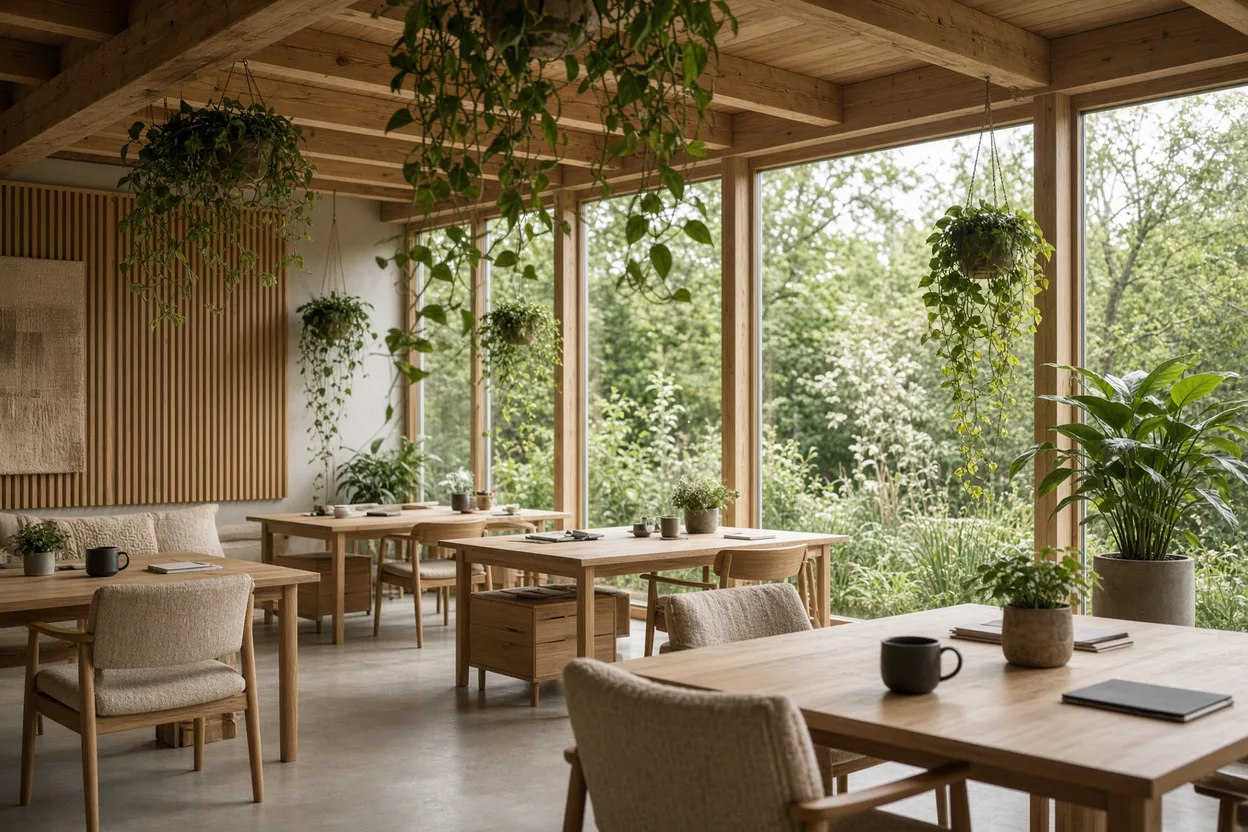
The first family covers the direct presence of nature: plants, water, daylight, shifts in airflow and temperature. The second brings together evocations: organic forms, natural materials, patterns drawn from living things. The third deals with how the space is organized: open views, sheltered nooks, a sense of mystery or discovery.
- Nature in the space: visual and non-visual connection with nature, presence of water, dynamic and diffuse light, thermal and airflow variability
- Natural analogues: biomorphic forms and patterns, material connection with nature, complexity and order
- Nature of the space: prospect, refuge, mystery, risk/peril
- In practice: pick a few patterns that suit the place rather than all of them
Not every project uses all 14 patterns, and that is not the point. An office will focus on daylight, views and greenery, while a restaurant will lean more on materials, organic shapes and cozy refuges. What matters is that every choice serves a clear intention.
What are the benefits for offices, hotels and retail?
Biophilic design improves reported well-being, focus and the appeal of a space. According to the Human Spaces report published by Interface in 2015, which surveyed about 7,600 employees in 16 countries, people who work in environments with natural elements report 15% higher well-being and 6% higher productivity.
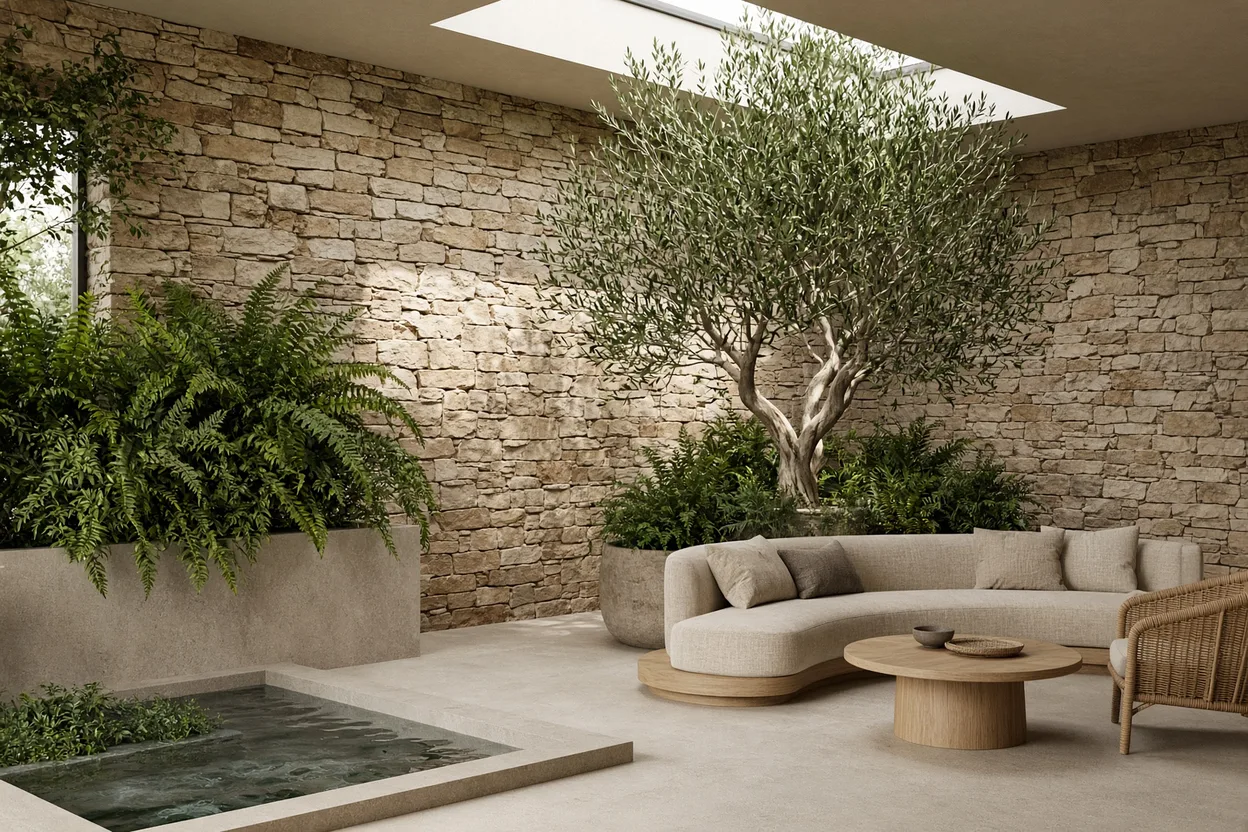
The figures vary by region: for Europe, the Middle East and Africa, the same report shows roughly 13% higher well-being and 8% higher productivity. These results are based on what employees say about themselves, so they call for some caution, but they point in the same direction as many studies on daylight and plants at work.
- Offices: well-being, focus, a stronger pitch when hiring
- Hotels: a sense of calm, a better perception of the stay
- Retail: longer visits, a memorable atmosphere, a responsible image
- Restaurants: conviviality, a warm atmosphere, a photogenic setting
In hospitality and food service, biophilic design also overlaps with work on the customer experience. A lobby filled with greenery or a dining room built from natural materials creates an atmosphere people remember, as we explain in our guide to sensory marketing and the five senses. For a restaurant, these choices are planned from the floor plan stage, as our article on restaurant layout and design explains in detail.
How to apply biophilic design in a project
To apply biophilic design, start with daylight and views, then add plants, natural materials and organic shapes, and finally work on the evening lighting. That order gives the best results on a controlled budget, because light and views cost little when they are planned early.
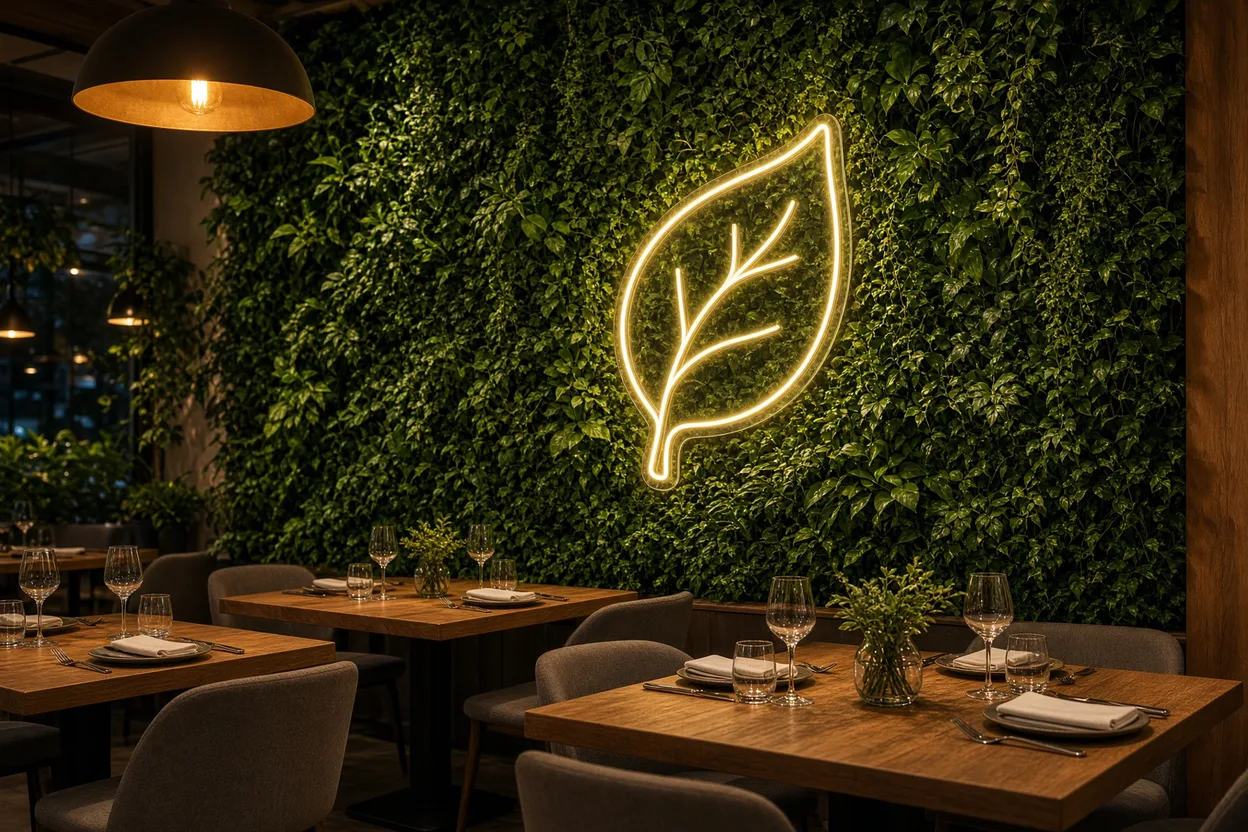
The table below lists the main levers, an example of how to use each one and the constraint to plan for. Decorative lighting comes first, because it can evoke nature even where live plants are hard to maintain.
| Biophilic lever | Example | Constraint to plan for |
|---|---|---|
| Light that evokes nature (neon) | Organic line or glowing foliage | Warm white, blended into the decor |
| Live plants | Living wall, planters, potted plants | Watering, light, upkeep |
| Daylight | Glass roof, skylights, sheer curtains | Glare, heat gain |
| Natural materials | Wood, stone, linen, cork, rammed earth | Cost, upkeep, fire rating |
| Water | Fountain, pool, the sound of water | Hygiene, noise, maintenance |
- Start simple: light, views and a few well-chosen plants
- Plan for upkeep: poorly maintained plants have the opposite effect
- Vary: alternate open areas with sheltered corners
- Measure: survey occupants before and after the project
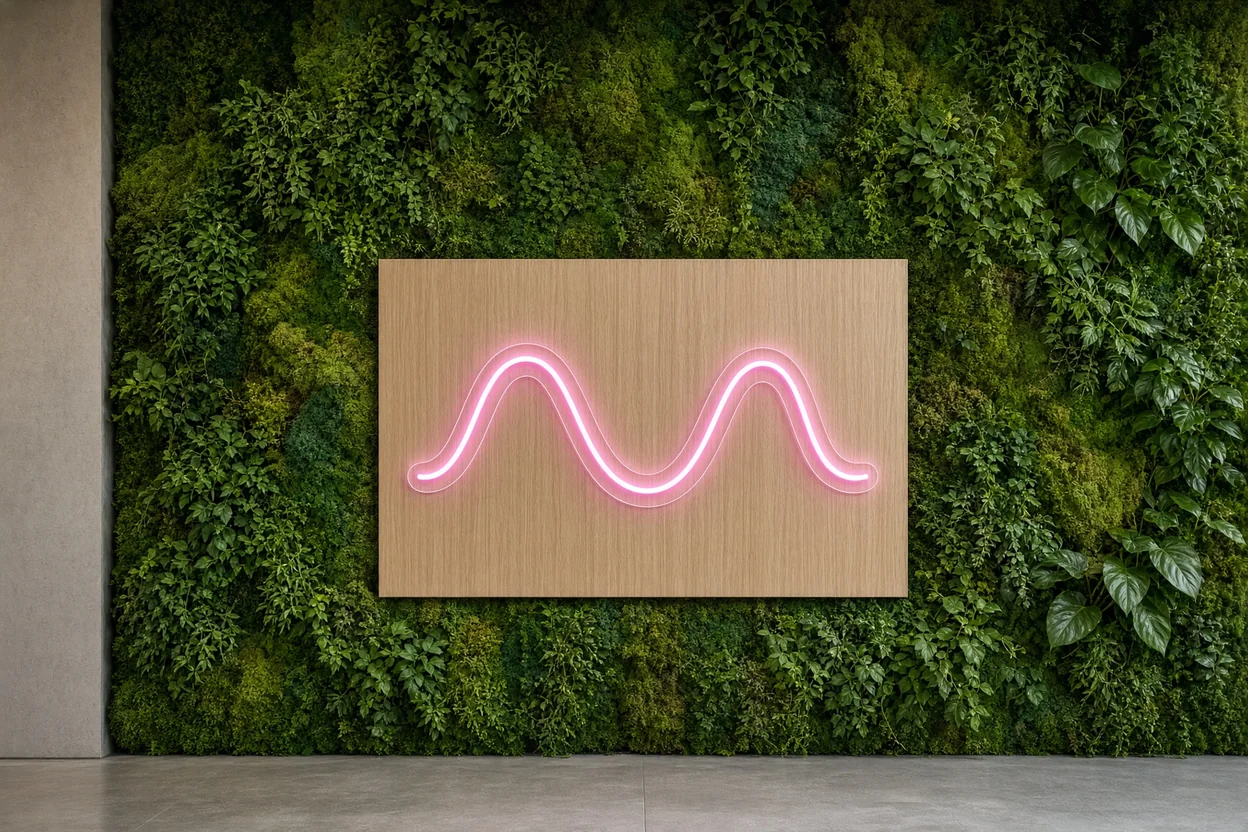
Pairing a living wall with a neon sign is a good example of a combination that works: the plants bring living nature, and the neon brings the identity of the place along with soft light in the evening. We cover this setup in detail in our guide to the living wall with a neon sign.
What role does light play in biophilic design?
Light is at the heart of biophilic design, because it sets our body clock and shapes how we perceive a space. The priority is to maximize daylight, then add artificial lighting that follows the rhythm of the day: brighter and neutral during the day, warmer and dimmer in the evening.
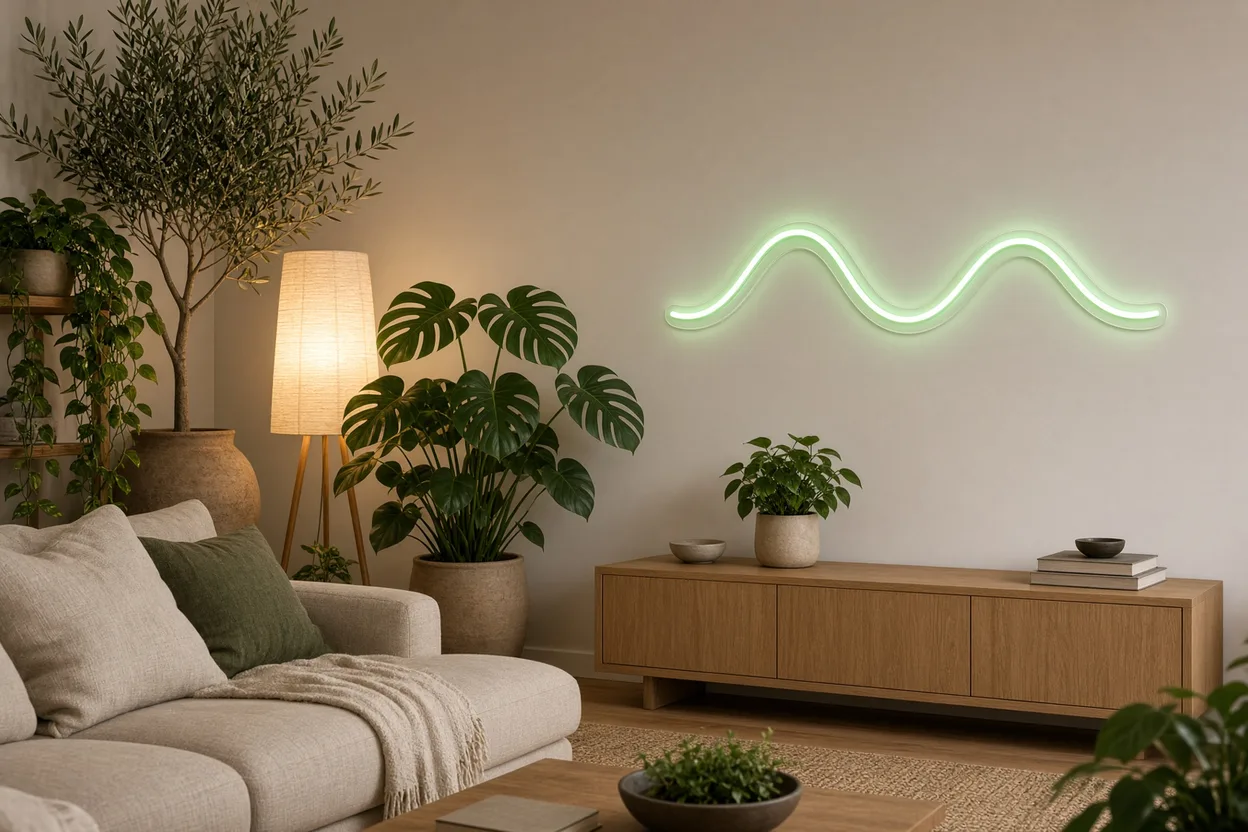
This approach lines up with the recommendations of the French health agency Anses, which in its 2019 opinion on LEDs advised favoring warm white home lighting, with a color temperature below 3,000 K, and reinforcing the contrast between day and night. Indirect lighting, which mimics the diffuse light of an overcast sky, is especially well suited, as our room-by-room guide to indirect lighting explains.
- Daytime: as much daylight as possible, topped up with neutral white
- Evening: warm white below 3,000 K, lower intensity
- Diffusion: soft, indirect light rather than bare sources
- Evocation: organic light shapes, reflections, leafy shadows
LED neon can play a part in evoking nature: a line that follows the curve of a plant, a glowing leaf or a wave, in warm white or soft green. It runs on 12V, stays cool to the touch and lasts 100,000 hours, so you can place it near plants without any risk of heating them.
What mistakes to avoid with biophilic design?
The most common mistakes are reducing biophilic design to a few decorative plants, neglecting plant care, using low-quality imitations and forgetting about daylight. A poorly thought-out biophilic project can even backfire.
When plants turn yellow for lack of light or water, they send a message of neglect, the exact opposite of the intended effect. That is why plant lighting, watering and a maintenance contract need to be planned from the design stage. Likewise, "nature" decor made of plastic and fake wood does not deliver the benefits of real materials.
- Plants alone: a green decor with no work on light or materials
- Forgotten upkeep: plants that wither and drag down the image of the place
- Imitations: fake materials that ring false
- Neglected light: dark spaces despite the plants
The best approach is gradual and genuine: a few principles applied well, maintained over time and explained to the people who use the space. Biophilic design works when it is lived, not when it is only on display.
Biophilic design FAQ
What are the 14 principles of biophilic design?
The 14 patterns defined by Terrapin Bright Green in 2014 fall into three families. Nature in the space covers visual and non-visual connection with nature, non-rhythmic sensory stimuli, thermal and airflow variability, presence of water, dynamic and diffuse light, and connection with natural systems. Natural analogues include biomorphic forms and patterns, material connection with nature, and complexity and order. Nature of the space covers prospect, refuge, mystery and risk/peril.
What is the difference between biophilic design and biomimicry?
Biophilic design aims to bring nature into spaces to improve occupant well-being: plants, daylight, materials, organic shapes. Biomimicry, on the other hand, borrows technical solutions from living things to solve engineering problems, such as ventilation inspired by termite mounds or a self-cleaning surface inspired by the lotus leaf. The first is about the experience of the people in a space, the second about the technical performance of objects and buildings.
How do you bring biophilic design into an office?
Start by placing workstations near the windows and clearing the views to the outside. Then add plants suited to the available light, natural materials such as wood and linen, and organic shapes in the furniture. Create a mix of zones, some open for collaboration and some more sheltered for focused work. Finally, design lighting that follows the rhythm of the day, more neutral in the morning and warmer toward the end of the day.
Do artificial plants count in biophilic design?
Artificial plants offer a visual reminder of nature, but they do not replace live plants, which also affect humidity, the perception of the air and the feeling that a space is alive. They can help in areas with no light, as long as they are good quality and do not become the default solution. In those spaces, evocations such as natural materials, botanical patterns or an organic light shape are often a better fit.
Can a neon sign fit into biophilic design?
Yes, a neon sign can be part of biophilic design if it evokes nature rather than replacing it. A line of light that follows the curve of a plant, a leaf or a wave, in warm white or soft green, pairs well with a living wall or a decor built from natural materials. LED neon runs on 12V, stays cool to the touch and lasts 100,000 hours, so it can be installed near plants without heating them.
Biophilic design reconnects interior spaces with nature through light, plants, materials and forms, with concrete benefits for well-being and for how appealing a place feels. To add an organic touch of light to an office, hotel or restaurant project, explore our custom neon signs for businesses, or reach us through our contact page to get a free 3D mockup within 24 hours. To dig deeper into the principles, read the "14 Patterns of Biophilic Design" report by Terrapin Bright Green.
Your custom neon, designed for free in 24 h
- Describe your ideaA text, a logo or a simple sketch. It takes one minute.
- Get your mockup and priceWithin 24 h by email, no commitment.
- Approve, we make itFree express delivery in 7 to 10 days, set up in 3 minutes.
- Mockup and price within 24 h, no commitment
- Free express delivery, received in 7 to 10 days
- 3-year warranty, set up in 3 minutes
Get your free mockup

Guillaume Schlupp
Founder of Helioneon
Over 10 years of entrepreneurship in premium interior design. 500+ LED neons delivered across 13 countries under Helioneon and Light Genius. Leads product strategy, design and professional accounts.