Warm White or Cool White Neon? How to Choose the Right Temperature
⚡ The essentials in 30 seconds
- Warm white vs cool white neon: compare Kelvin temperatures, see which white suits each room, and choose with confidence.
- Free 3D mockup within 24 hours.
Choose warm white (2700-3500K) for bedrooms, living rooms and hospitality spaces, and cool white (6000-6500K) for modern retail, gaming setups and workspaces. Neutral white, around 4000-5500K, sits in between and suits kitchens and offices. The right choice depends on the mood you want, so here is how to get it right first time.
White sounds like the simple option when you order a neon sign, then the temperature question appears and suddenly it isn't. At Helioneon, white is consistently one of the most requested colors for personalized signs, which is exactly why we let you preview both tones on a free 3D mockup within 24 hours when you design your own neon sign.

What does Kelvin actually mean?
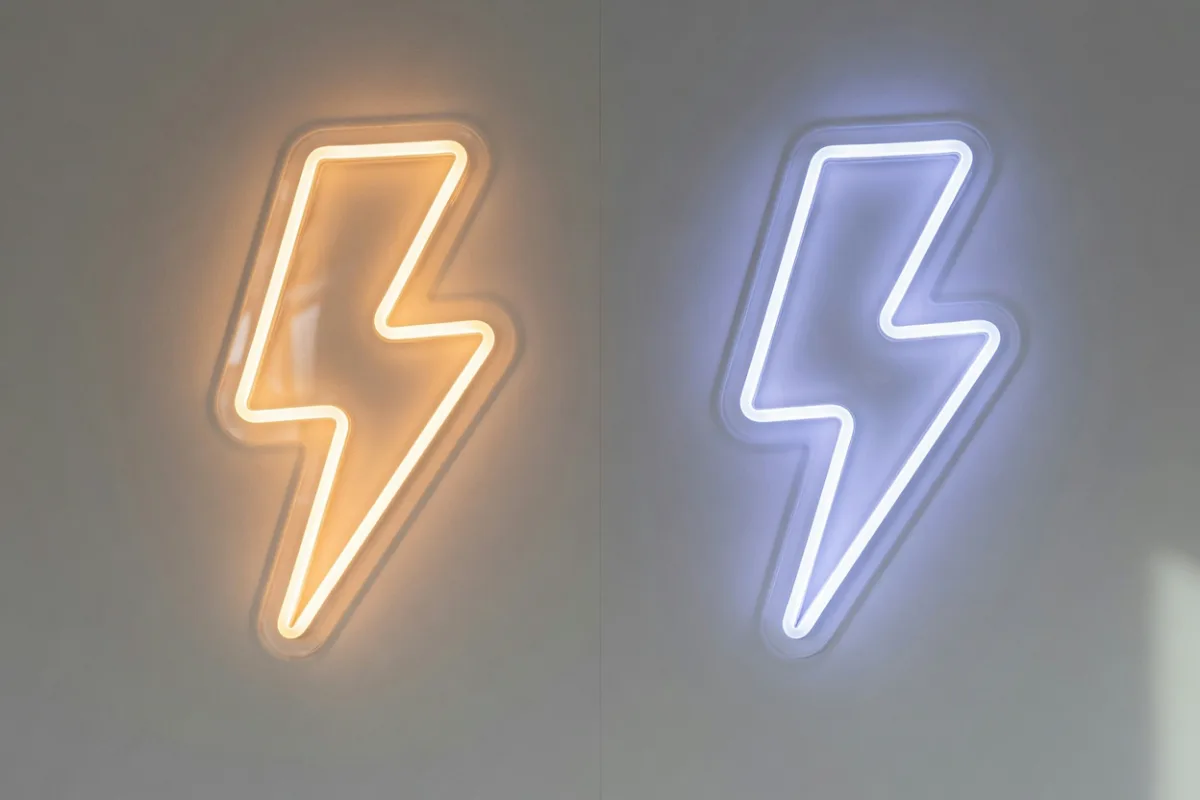
Color temperature is measured in Kelvin (K), and the scale runs backwards from what most people expect. Lower numbers look warmer. A candle flame sits around 1,900K, a traditional incandescent bulb around 2,700K, midday daylight between 5,500 and 6,500K. So a low Kelvin white glows golden and relaxed, while a high Kelvin white looks blue-tinged and alert.
For LED neon, three bands cover almost every situation. Warm white spans roughly 2700-3500K. Neutral white runs from 4000 to 5500K. Cool white starts around 6000K and tops out near 6500K. Memorise those three numbers and you can decode any lighting spec sheet, because the same logic applies to bulbs, strips and panels.
Warm white (2700-3500K): the cozy one
Warm white is firelight in tube form. It flatters skin, softens shadows and makes a room feel settled. That's why hotels and restaurants lean on it so heavily: the hospitality industry has known for decades that people linger longer under warm light.
Use it anywhere you want people to relax. Bedrooms first, obviously, and we've gathered plenty of bedroom neon ideas if you need inspiration. Living rooms, reading corners, restaurant walls and wedding backdrops all belong in this band too. A warm white script sign above a sofa, at around 3000K, reads as candlelight rather than signage. Frankly, if you're unsure which white to pick for a home interior, pick warm. It's the safe wrong answer that almost never is one.
Neutral white (4000-5500K): the balanced middle
Neutral white is the least talked about and the most underrated. At 4000-5500K it reads as clean without turning clinical, close to natural morning light. Colors underneath it stay true, which matters wherever accuracy counts.
It earns its keep in kitchens, home offices, salons and shops. A bakery sign in neutral white makes pastries look like themselves, and a logo sign in a reception area looks professional without feeling cold. When a business client can't decide, I usually steer them here, because neutral white photographs well under both daylight and evening conditions. That flexibility is hard to beat.
Cool white (6000-6500K): crisp and modern
Cool white has bite. At 6000K and above it carries a faint blue edge that reads as technical, fresh and awake, the same quality daylight has at noon. It creates the strongest contrast against dark walls, so it pops harder in photos than any other white.
It suits gaming rooms, barbershops with an industrial look, gyms, tech offices and shop windows that need to cut through daytime brightness. But keep it away from bedrooms. Cool light in the 6000K range is widely reported to suppress melatonin more than warm light, and honestly, a 6500K sign above your headboard is a mistake you'll notice by Wednesday.

Which white for which room?
Here is the shortcut version, room by room:
- Bedroom: warm white, 2700-3000K, ideally with a dimmer for the evening wind-down.
- Living room: warm white around 3000K, or neutral if the room is very bright and modern.
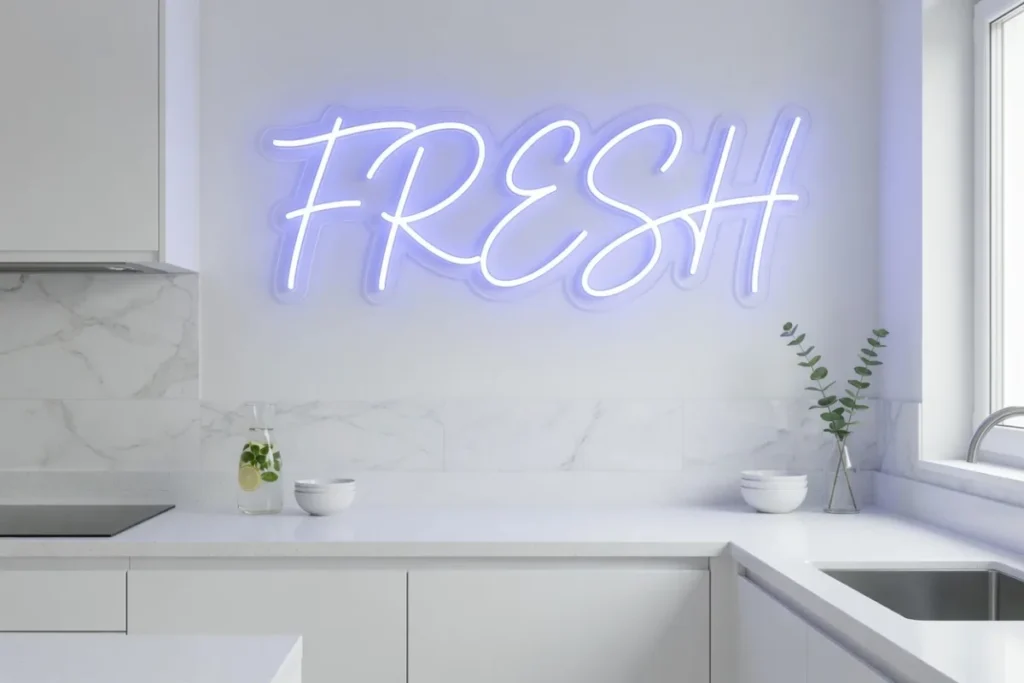
- Kitchen: neutral white, 4000-4500K, clean but not sterile.
- Home office: neutral to cool, 4500-5500K, to support focus during the day.
- Gaming setup: cool white, 6000-6500K, usually paired with colored accents.
- Restaurant or bar: warm white, 2700-3200K, because appetite and atmosphere live there.
- Shop window: cool or neutral white for daytime visibility, warm if the brand is cozy or artisanal.
Hallways and bathrooms are the two rooms people forget to plan. A hallway sign greets everyone twice a day, so match it to the mood you want at the front door: warm for welcome, neutral for gallery-clean. Bathrooms take either extreme surprisingly well, warm white for evening baths or cool white for sharp morning routines. And a 2026 trend worth copying: a small warm white word at picture-rail height rather than eye level, which lifts the whole corridor.
One more variable worth knowing: the sign itself. Our LED neon uses a 6 mm silicone tube that diffuses light into one continuous line, so the white stays even across every letter instead of showing hot spots. Whichever temperature you choose, it renders smoothly. If you're still weighing up size, font and color together, our guide on how to choose a neon sign walks through the whole decision.
Can you change your mind later?
Not the temperature itself: a warm white tube stays warm white for its full lifespan, which is around 100,000 hours for our signs. What you can change is intensity. Every Helioneon sign ships with a dimmer, and dropping a neutral white to 30% brightness pushes it visually towards cozy, while running it at full power keeps it crisp. That covers a surprising amount of indecision.
Dimming has a side benefit too. LED neon already draws little power, roughly comparable to a laptop charger for a typical sign, and running it dimmed reduces consumption even further. So order the temperature that matches your room's daytime character, then use the dimmer to tune the evenings. And if you truly can't decide, ask for the free 3D mockup in both whites. Seeing your own words in each tone settles the debate in about ten seconds.
FAQ: warm white vs cool white neon
Is warm white or cool white better for a bedroom?
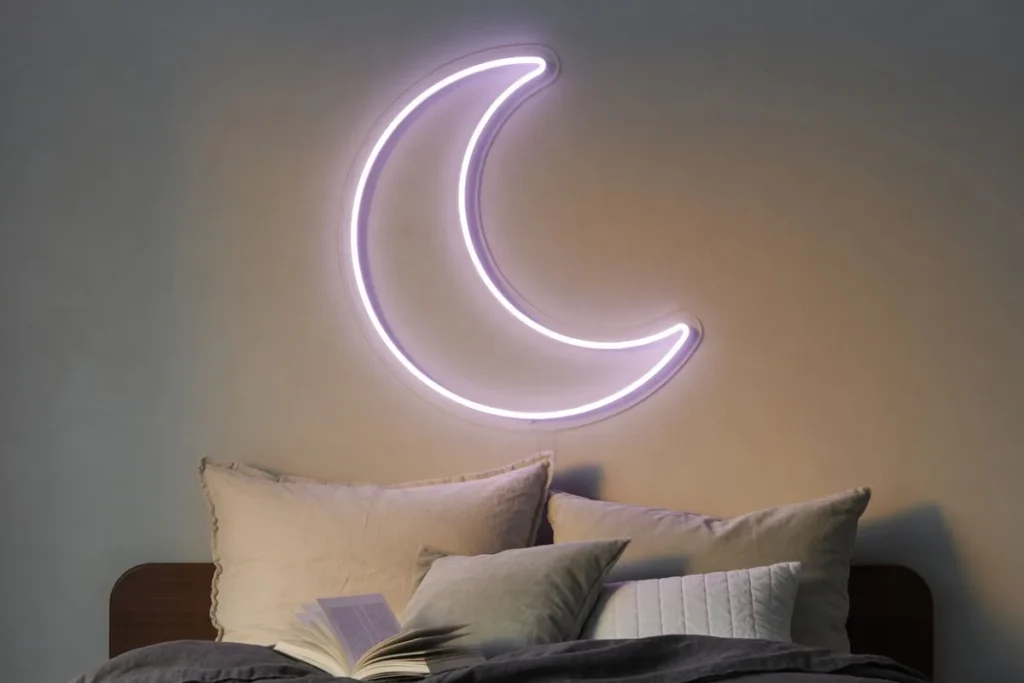
Warm white, ideally 2700-3000K. It mimics evening firelight, helps the body wind down and flatters the room. Cool white sits near daylight temperature, which can delay sleepiness. If you want flexibility, pair a warm white sign with a dimmer for late-night softness.
What Kelvin is warm white neon?
Warm white LED neon typically sits between 2700K and 3500K. At 2700K it resembles a classic incandescent bulb, golden and soft. At 3500K it stays warm but slightly brighter in character, a good middle ground for living rooms and hospitality interiors.
Which white looks best in photos?
Cool white creates the strongest contrast against dark backgrounds, so it pops hardest on camera. Neutral white is the most reliable all-rounder because it photographs well in both daylight and evening shots. Warm white photographs beautifully in dim, moody settings like weddings and bars.
Can one neon sign switch between warm and cool white?
A standard single-color sign cannot change temperature: the tube is made in one white and keeps it. You can adjust brightness with the included dimmer, which visually softens the light. If switching tones matters to you, mention it when requesting your free 3D mockup.
Does color temperature affect energy use?
Barely. Warm and cool white LED neon draw essentially the same power for the same tube length, and both run on safe 12V current. Brightness settings matter far more: dimming a sign to half intensity cuts its consumption noticeably, whatever its color temperature.