Light Spectrum: Understanding Light Colors from Sun to Neon

- The light spectrum splits light by wavelength, from about 380 to 780 nm (violet to red). The sun shows a continuous spectrum while neon gas emits a line spectrum around 640 nm.
- This guide covers spectrum types, neon's red glow, LED and bulb spectra, color temperature, and practical decoration uses.
The light spectrum is the breakdown of a light according to its wavelengths, that is, according to its colors. The part visible to the human eye extends from about 380 to 780 nanometers, from violet to red. Each source has its own spectrum: continuous for the sun, line spectrum for a gas like neon. At Helioneon, this concept explains why neon color meaning and psychology never quite produce the same rendering depending on the technology.
Understanding the light spectrum helps you choose a light: warm or cool white, a saturated color, lighting that renders skin tones or materials well. With more than 500 neon signs delivered, we see how these choices change the atmosphere of a living room, a shop or a restaurant. This guide simply explains what a spectrum is, how to observe it and what it reveals about each light source.
What Is a Light Spectrum?
A light spectrum is the set of radiations that make up a light, classified according to their wavelength. You obtain it by passing the light through a prism or a grating, which separates the colors and spreads them into a colored band, like a rainbow.
Light is an electromagnetic wave. Its wavelength, measured in nanometers, determines the perceived color: short wavelengths appear violet or blue, long ones appear red. Beyond the visible, you find ultraviolet on one side and infrared on the other, which the eye does not see.
- Ultraviolet: less than 380 nm, invisible, responsible for sunburns
- Visible: from about 380 to 780 nm, from violet to red
- Infrared: more than 780 nm, invisible, felt as heat
- Unit: the nanometer, one billionth of a meter
Isaac Newton was the first to study this phenomenon methodically, in the 1660s, by decomposing sunlight with a prism then recomposing it into white light. He showed that white light is a mixture of all colors, not a pure color.
What Are the Colors of the Light Spectrum?
The colors of the visible spectrum go from violet to red, passing through blue, green, yellow and orange. Traditionally seven are counted, following Newton, but the spectrum is actually continuous: the colors blend into each other without a sharp boundary.

| Perceived color | Approximate wavelength | Example of source |
|---|---|---|
| Neon red | Around 640 nm | Gas neon, Helioneon red LED neon |
| Violet | 380 to 450 nm | Black light, sky at dusk |
| Blue | 450 to 495 nm | Blue LED, screen |
| Green | 495 to 570 nm | Foliage, green LED |
| Yellow | 570 to 590 nm | Sodium lamp of old streetlights |
| Orange and red | 590 to 780 nm | Sunset, flame |
The eye is not equally sensitive to all these colors. In full light, it perceives green-yellow best, around 555 nm, which explains why safety vests and some signs use this hue. At night, sensitivity shifts toward blue-green.
- Rainbow: a natural spectrum, created by water droplets that act as a prism
- Seven colors: a cultural division inherited from Newton, not a physical reality
- Magenta and pink: absent from the spectrum, they arise from a mixture of red and blue
- White: the sum of all colors, or of three well-chosen colors
What Are the Different Types of Light Spectra?
We distinguish three main types of light spectra: the continuous spectrum, which contains all colors without interruption, the emission line spectrum, made of a few precise colors, and the absorption spectrum, where dark lines appear on a continuous background.

- Continuous spectrum: emitted by a very hot body, like the sun or the filament of a bulb
- Emission line spectrum: emitted by an excited gas, like neon, hydrogen or sodium
- Absorption spectrum: a continuous spectrum crossed by a gas that removes certain colors
- Band spectrum: produced by certain molecules and by the phosphors of white LEDs
In the 19th century, physicists Gustav Kirchhoff and Robert Bunsen showed that each chemical element emits its own lines, like a fingerprint. This discovery gave birth to spectroscopy, which for example allows knowing the composition of stars millions of kilometers away without ever touching them.
The spectrum of the Sun, observed closely, also contains hundreds of fine dark lines, called Fraunhofer lines. They correspond to the elements present in the solar atmosphere, which absorb certain colors as the light passes.
You can observe a spectrum at home, without laboratory equipment. If you tilt a CD or a DVD under a lamp, its very fine grooves break the light like a grating, and you see colored bands appear. Under a classic bulb, the band is continuous, because the filament emits all colors. Under a fluorescent tube, it breaks into colored lines, because the light comes from precise lines. When you try it in front of a red neon, you see almost only red and orange, which clearly shows that its light is not a mixture of all colors. It is a simple experiment, but it makes the difference between spectrum types very concrete.
Why Does Neon Glow Red? The Neon Gas Spectrum
Neon glows orange-red because its light spectrum is a line spectrum, dominated by red and orange lines, notably around 640 nm. When an electric discharge excites the gas, its atoms emit only these precise colors, which gives the so characteristic hue of signs.
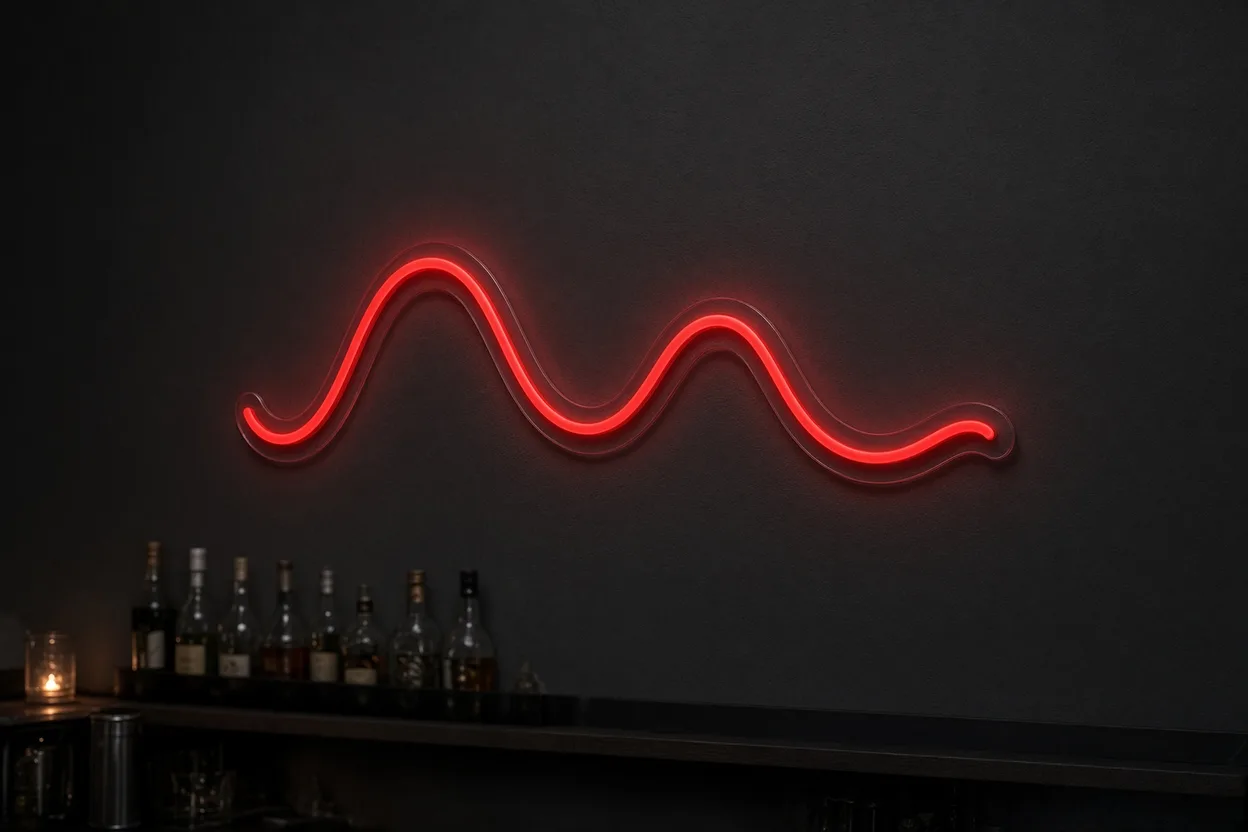
It is actually thanks to its spectrum that neon was discovered. In 1898, chemists William Ramsay and Morris Travers isolated a new gas in liquefied air and observed its brilliant red lines, never seen before. They named it “neon”, from the Greek “new”. Our article on the history of neon signs tells how Georges Claude turned them into signs from 1910.
- Neon: red and orange lines, for the red of classic signs
- Argon with a little mercury: blue and ultraviolet lines, base of the other colors
- Helium: a pale pink to orange-white light
- Phosphors: powders deposited in the glass to obtain green, yellow or white
An LED neon works differently: there is no gas, but light-emitting diodes powered at 12V, whose light is diffused by a silicone tube. Each colored LED emits a fairly narrow band of spectrum, which gives frank colors close to those of glass neon. Our article on how to make an LED neon sign details this technology.
What Is the Spectrum of an LED, a Bulb or the Sun?
The sun and incandescent bulbs have a continuous spectrum, which contains all colors. A white LED has a spectrum with two humps: a narrow blue peak, produced by the diode, and a wide yellow-green band, produced by the phosphor that covers it. A fluorescent tube has a spectrum made of lines.
These differences explain why two lights that appear white do not render colors the same way. A continuous and well-balanced spectrum highlights skin, wood or fabrics; a spectrum poor in red can make an interior dull or a face pale.
- Sun: continuous spectrum, with a maximum in green-blue at noon
- Incandescent: continuous spectrum, rich in red and infrared, hence its heat
- White LED: blue peak and yellow band, adjustable according to the phosphor
- Fluorescent tube: a few marked lines, sometimes a somewhat cool rendering
To measure the quality of a spectrum, manufacturers use the color rendering index, or CRI, on a scale from 0 to 100. An incandescent bulb reaches almost 100, because its spectrum is continuous; a good indoor LED exceeds 80, and premium models 90. Standards typically recommend at least 80 for most workspaces.
Light Spectrum and Color Temperature: What Link?
Color temperature, expressed in kelvins, summarizes the overall tint of a white spectrum: a spectrum rich in red and orange gives a warm white, around 2,500 to 3,000 K, while a spectrum rich in blue gives a cool white, beyond 4,000 K.
It attaches directly to the continuous spectrum of heated bodies: an object brought to 2,700 K emits a light comparable to that of a classic bulb, an object at 6,500 K a light close to the overcast sky. Our guide warm white vs cool white neon helps choose according to the room. At Helioneon, our warm white turns around 2,500 K and our cool white between 4,000 and 5,000 K.
- Warm white: 2,500 to 3,000 K, for a living room, a bedroom or a restaurant
- Neutral white: 3,500 to 4,000 K, for a kitchen or an office
- Cool white: 4,000 to 6,500 K, for a workshop or a technical space
- Evening: favor warm whites, less rich in blue
In the evening, health authorities recommend limiting exposure to blue-rich lights, which disrupt sleep rhythms. Ambient lighting in warm white or soft color is therefore more suitable than a cool light in rest rooms.
How to Use the Light Spectrum in Decoration?
In decoration, knowing the light spectrum allows choosing light colors that match the materials and the desired atmosphere: warm tones for wood and textiles, cool tones for concrete and metal, and saturated colors to create a focal point.
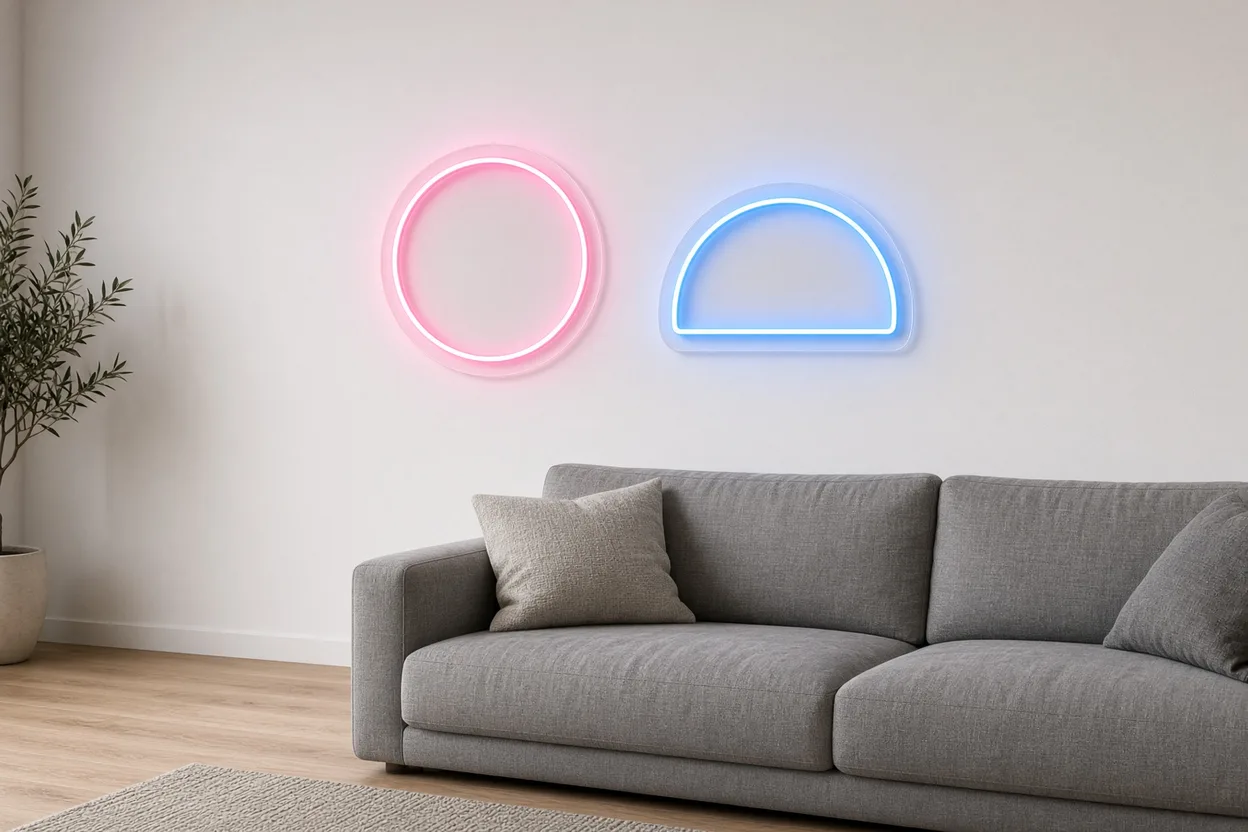
The colors of a neon also mix on the walls, according to the principle of additive synthesis: red and blue give magenta, red and green yellow, the three together white. This is what an LED neon vs LED strip lights does, which combines three LEDs to display millions of shades with a remote.
- White wall: it faithfully reflects the neon color and extends it around it
- Dark wall: it absorbs the light and makes the luminous line stand out
- Colored wall: it modifies the perceived hue, to test before choosing
- Two neons: their colors mix where their halos meet
A Helioneon LED neon consumes from 8 to 15 W per meter and stays cool to the touch, which allows testing several locations without constraint. Our 13 colors and the RGB option cover the essentials of the visible spectrum, from violet to red, with a 3D mockup to visualize the rendering before fabrication.
Frequently Asked Questions About the Light Spectrum
What is a light spectrum?
A light spectrum is the breakdown of a light into its different wavelengths, that is, into its colors. You observe it by passing the light through a prism or a grating. The part visible to the human eye goes from about 380 nm, violet, to 780 nm, red. Each light source, from the sun to an LED, has a spectrum that is its own.
What are the colors of the light spectrum?
The visible spectrum goes from violet to red, passing through blue, green, yellow and orange. We traditionally speak of seven colors since Newton, with indigo, but the spectrum is continuous and the hues blend into each other. Certain colors like magenta or pink do not exist in the spectrum: they arise from a mixture of red and blue.
What are the 3 types of spectra?
We distinguish the continuous spectrum, emitted by a very hot body like the sun or a filament, which contains all colors; the emission line spectrum, emitted by an excited gas like neon, composed of a few precise colors; and the absorption spectrum, where dark lines appear on a continuous background because a gas has absorbed certain wavelengths.
Why is neon red?
Because neon gas, when excited by an electric discharge, emits a line spectrum dominated by red and orange, notably around 640 nm. It is its signature, which moreover allowed its discovery in 1898. The other colors of glass signs come from other gases or fluorescent powders, and LED neons use colored diodes.
What light spectrum to choose for a living room?
For a living room, choose a warm white light, between 2,500 and 3,000 K, with a color rendering index higher than 80, or 90 for spaces where you want to highlight materials. Possibly add a colored decorative source, like a neon, to create a focal point. In the evening, limit cool lights, rich in blue.
The light spectrum explains almost everything we perceive of a light: its color, its warmth, its way of highlighting a face or a material. From the sun to neon, each source has its signature. To choose the color of a neon suited to your interior or your business, start your project via our contact page for a free neon sign quote and receive a free 3D mockup within 24 h. To go deeper into the physics of the visible, NASA's page on visible light is a good starting point.
Your custom neon, designed for free in 24 h
- Describe your ideaA text, a logo or a simple sketch. It takes one minute.
- Get your mockup and priceWithin 24 h by email, no commitment.
- Approve, we make itFree express delivery in 7 to 10 days, set up in 3 minutes.
- Mockup and price within 24 h, no commitment
- Free express delivery, received in 7 to 10 days
- 3-year warranty, set up in 3 minutes
Get your free mockup

Guillaume Schlupp
Founder of Helioneon
Over 10 years of entrepreneurship in premium interior design. 500+ LED neons delivered across 13 countries under Helioneon and Light Genius. Leads product strategy, design and professional accounts.