Fluorescent vs Phosphorescent: The Real Difference and What It Changes for Lighting Decor
- Fluorescent materials re-emit light immediately and stop when the source is off, while phosphorescent ones store energy and glow for minutes to over 8 hours. This distinction shapes how you use each for lighting decor.
- You will find clear definitions, simple tests to tell them apart, black light uses, neon comparisons, and paint choices for decor.
Fluorescent vs phosphorescent: both materials absorb light and re-emit it, but a fluorescent material stops glowing as soon as the source is turned off, while a phosphorescent material continues to glow in the dark for several minutes or even several hours. At Helioneon, these two phenomena are part of everyday work, because they explain the light from tubes, LEDs, and every personalized neon sign.
The two terms are often confused, especially since everyday language uses "fluo" for anything very bright. This guide simply explains what happens in the material, how to recognize one from the other, the role of black light, and why the neon you hang on the wall is neither one nor the other in the strict sense. With more than 500 neon signs delivered, this is one of the questions customers ask most often.
What is luminescence?
Luminescence refers to any emission of light that does not come from heat. Fluorescence and phosphorescence are two forms of it: in both cases, a material absorbs energy, often ultraviolet light, then releases it as visible light.
An incandescent bulb, by contrast, produces light because its filament is heated to more than 2,000 °C. Luminescent materials stay cold. That is what makes it possible to create paints, inks, or objects that glow without heating up.
- Photoluminescence: the material is excited by light, which is the case for fluorescent and phosphorescent effects
- Electroluminescence: the light comes from an electric current, as in an LED
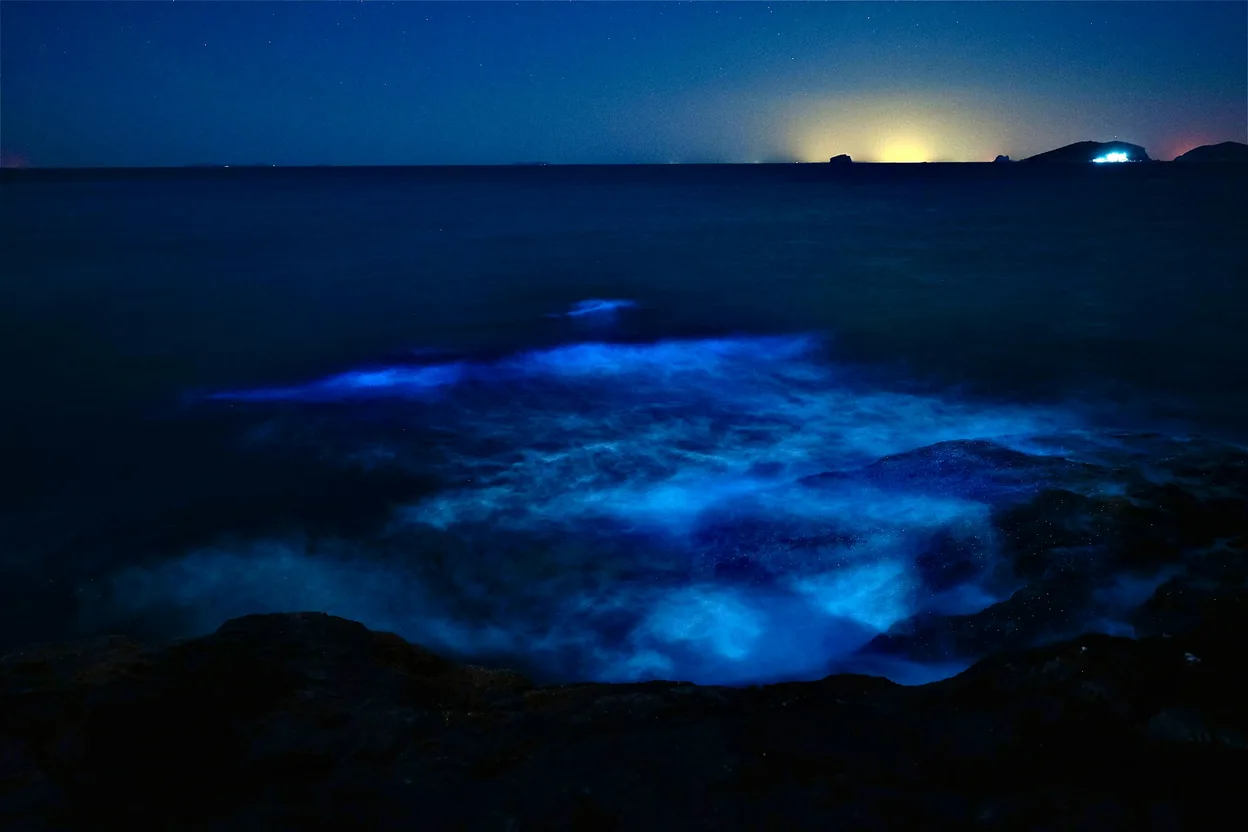
- Chemiluminescence: a chemical reaction produces the light, as in a glow stick
- Bioluminescence: living organisms produce their own light, as fireflies do
Knowing whether a material is fluorescent or phosphorescent therefore comes down to a question of time: how long the material holds the energy before releasing it. Everything else follows from that, from decor uses to safety guidelines.
What does fluorescent mean?
A fluorescent material absorbs invisible or barely visible light, usually ultraviolet, and re-emits it almost instantly as brighter visible light. As soon as the source is turned off, the emission stops in a fraction of a second.
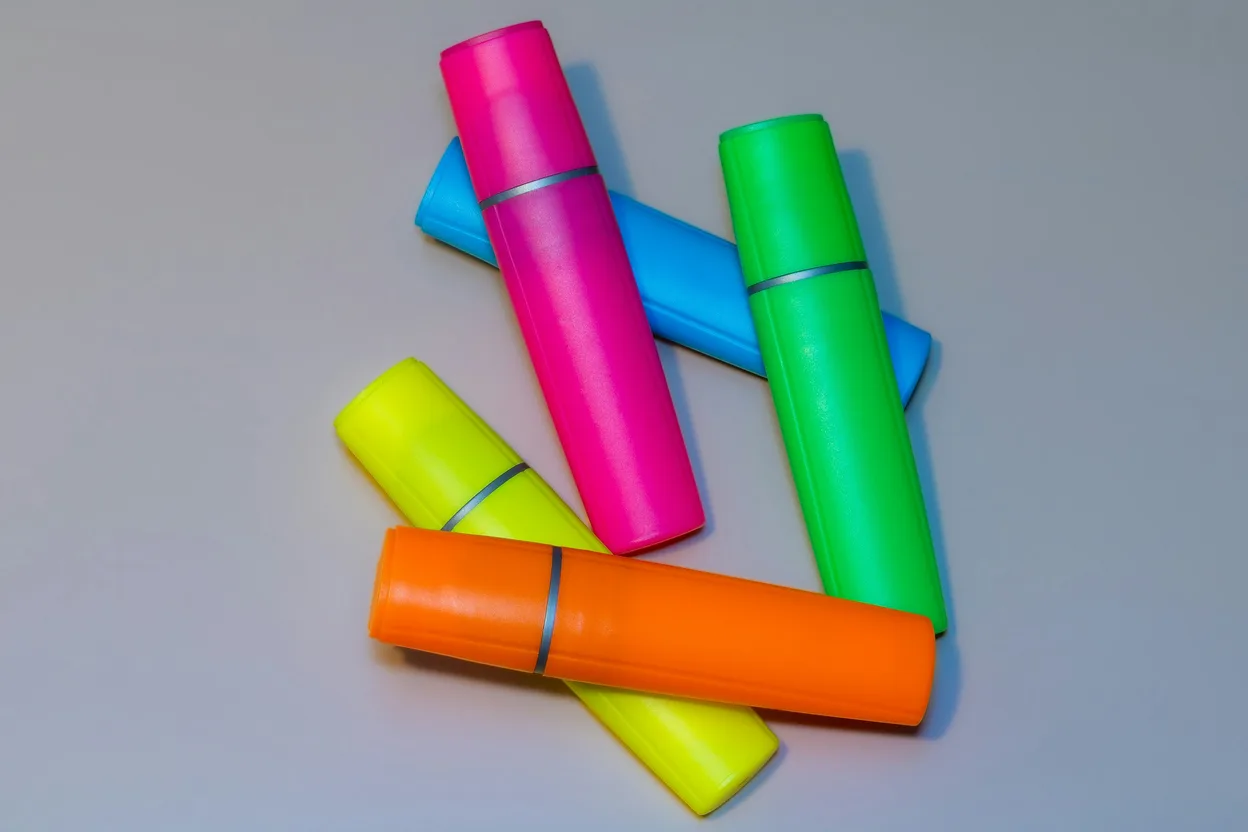
That is why a highlighter or a safety vest looks so bright in daylight: it converts part of the sun's ultraviolet into visible color, and therefore reflects more light than an ordinary color. In complete darkness, however, it becomes dull again.
- Speed: the light is re-emitted almost instantly, then stops right away
- Required source: light is needed, often ultraviolet, for the effect to exist
- Colors: very saturated yellow, pink, orange, green, and blue
- Examples: highlighters, yellow safety vests, fluorescent paints, fluorescent tubes, white LEDs
The fluorescent tube used in offices and kitchens works on this principle. An electric discharge excites mercury vapor, which emits mostly ultraviolet. The white powder deposited inside the tube, called a phosphor, converts those ultraviolet rays into visible white light.
What does phosphorescent mean?
A phosphorescent material absorbs light, stores it, then releases it slowly, which allows it to glow in the dark after the source is turned off. Depending on the pigment, the glow lasts from a few minutes to several hours, fading gradually.
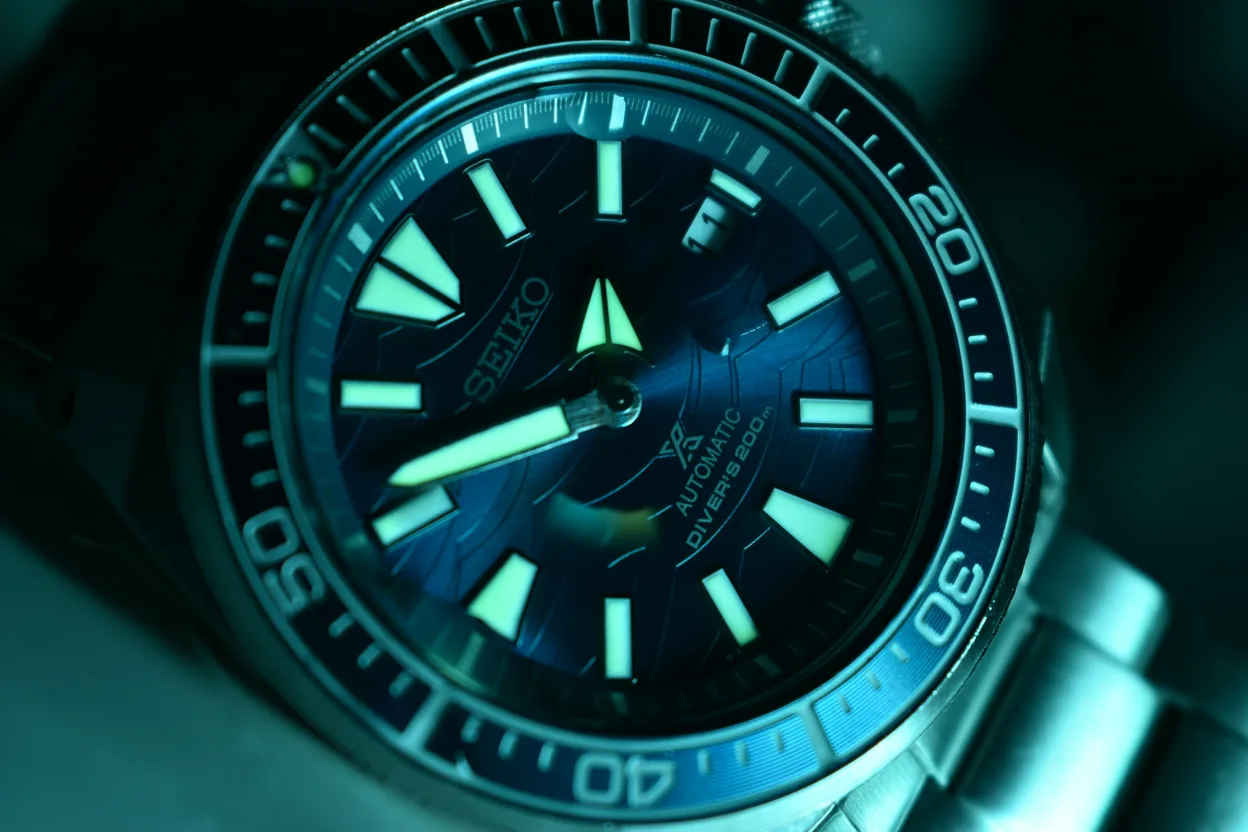
The phenomenon comes from the fact that the energy remains "trapped" longer in the material before being released. Modern pigments based on strontium aluminate can glow for more than 8 hours after a good charge, whereas older zinc sulfide pigments faded much faster.
- Charge: the material must be exposed to daylight or a lamp
- Afterglow: it continues to glow in the dark, more and more faintly
- Colors: mainly yellow-green and blue-green, the brightest shades
- Examples: ceiling stars, watch hands, emergency exit signs
Historically, some watch dials glowed thanks to radium paint, which is radioactive and was used until the 1960s. That was not phosphorescence but radioluminescence. Current pigments are non-radioactive and safe in normal use.
Fluorescent vs Phosphorescent: How to Tell the Difference?
To know whether an object is fluorescent or phosphorescent, turn off the light: if it continues to glow by itself in the dark, it is phosphorescent; if it goes out immediately but lights up under an ultraviolet lamp, it is fluorescent. This simple test is enough in almost every case.
| Source or material | How it produces the light | Does it glow in the dark without a source? |
|---|---|---|
| Helioneon LED neon | LEDs powered at 12V, diffused by silicone | No, turns off as soon as power is cut |
| Fluorescent paint | Converts UV into bright color | No, stops immediately |
| Phosphorescent paint | Stores the light and re-emits it | Yes, from a few minutes to several hours |
| Fluorescent tube | Mercury UV converted by a phosphor | No |
| Gas neon | Gas excited by high voltage | No |
Everyday language keeps the confusion going. People say "fluo" for a very bright color, and "neon" for a saturated pink or green, even though neither term describes the physical phenomenon. A ceiling star that glows at night is phosphorescent, even if it is bought in the "fluo" aisle.
- Darkness test: persistent glow, therefore phosphorescent
- UV lamp test: very bright glow under UV, therefore fluorescent
- Daylight test: abnormally bright color, often fluorescent
- Label: "photoluminescent" usually means a phosphorescent product
In practice, the question "fluorescent or phosphorescent?" mainly comes up when buying paint, a sticker, or a party accessory. Manufacturers sometimes use both words on the same package, which does not help. A simple rule: if the product promises to "glow in the dark" or is labeled photoluminescent, it is phosphorescent; if it promises "ultra bright" colors or an effect under black light, it is fluorescent. Some products combine both pigments for a bright look in the daytime and a glow at night, and then cost a bit more, often 20 to 30% more.
What role does black light play?
Black light is a lamp that emits mostly near-ultraviolet light, around 365 to 395 nanometers, and very little visible light. It makes anything fluorescent stand out dramatically: white textiles, fluorescent paints, certain papers, and even teeth.
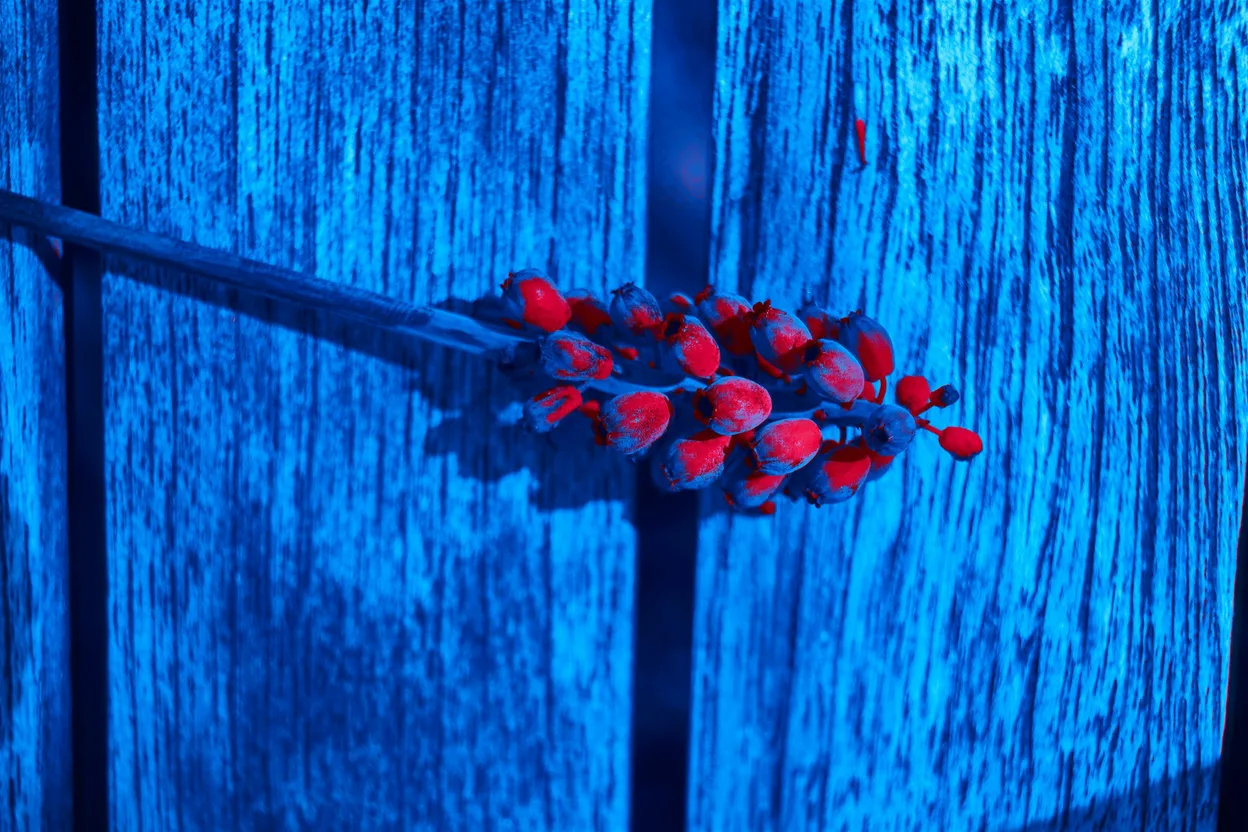
It is the tool of "UV" parties, escape rooms, black-light mini-golf, and some exhibitions. It also charges phosphorescent materials, which continue to glow once the lamp is turned off. For a neon party, combining black light with a few colored neon signs creates a very graphic atmosphere.
- Fluorescent effect: fluorescent objects seem to light up on their own
- Phosphorescent effect: objects charge and still glow after the light is off
- Precaution: do not look directly at the lamp for a long time
- Professional use: checking banknotes, detecting stains, inspecting surfaces
Consumer UV lamps stay in the ultraviolet A range, the least energetic, but prolonged exposure of the eyes and skin is not recommended. For a party, a few hours with lamps aimed at the walls and not at faces is more than enough.
Is neon fluorescent or phosphorescent?
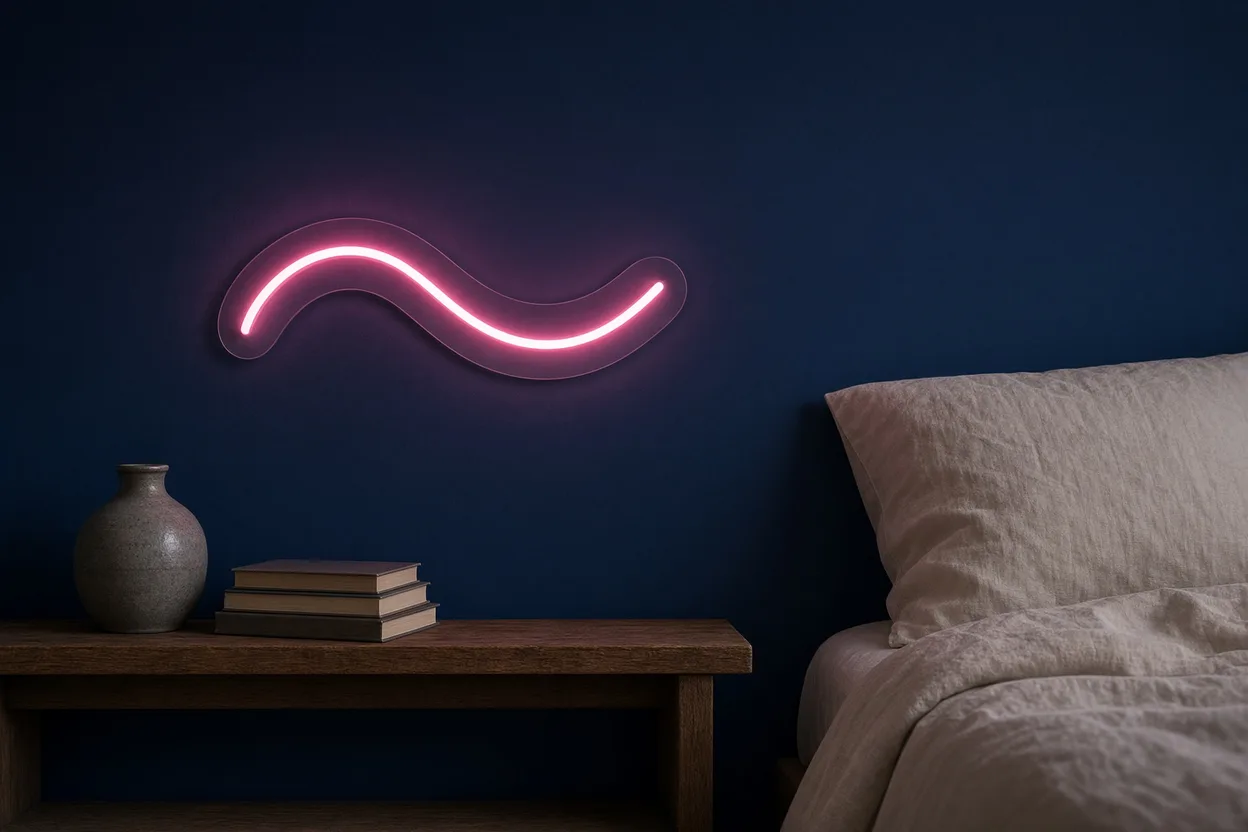
Fluorescent or phosphorescent? Neon is neither one nor the other in the strict sense: a gas neon glows because a gas is excited by high voltage, and an LED neon glows because light-emitting diodes produce the light. Fluorescence only comes into play in certain cases, to obtain colors or white light.
Pure neon gas gives a red-orange light. For other colors, glass tubes use other gases such as argon with a little mercury, and often a phosphor coating inside the glass, which works exactly like in a fluorescent tube. Our article on glass neon vs LED neon details these techniques.
- Gas neon: electric discharge in a gas, at several thousand volts
- Fluorescent tube: mercury vapor and fluorescent powder
- White LED: blue LED covered with a yellow phosphor, therefore a bit of fluorescence
- LED neon: LEDs at 12V in a silicone tube that diffuses the light
A Helioneon LED neon operates at very low voltage, 12V, consumes 8 to 15 W per meter, and stays cool to the touch. It turns off as soon as the power is cut, with no residual glow. To understand how to make one in detail, see our guide on how to make an LED neon sign.
These differences have very concrete consequences. An incandescent bulb converts only about 5% of its energy into light, the rest being lost as heat. A gas neon requires a transformer that raises the voltage to several thousand volts, often between 2,000 and 15,000 V depending on the tube length. An LED neon runs on 12V and heats very little, which makes it simpler to install in a bedroom, living room, or shop.
Fluorescent vs Phosphorescent: Which Paint to Choose for Decor?
Choose phosphorescent paint if you want a decor that glows by itself in the dark, and fluorescent paint if you want bright colors in daylight or a spectacular effect under black light. The two combine well, for example in a child's bedroom or a bar.
- Child's bedroom: phosphorescent stars on the ceiling, a soft glow that fades on its own
- Bar or game room: fluorescent paint and black light for a decor that changes at night
- Marking: phosphorescent strips on steps or light switches
- Graphic wall: fluorescent patterns paired with a colored neon sign
Phosphorescent paint does not replace lighting: its glow is weak and fades quickly at first. For real ambient light, an LED neon is more suitable, with a lifespan of about 100,000 hours and a 3-year warranty at Helioneon. Our article on neon sign safety for kids' rooms also explains why very low voltage is reassuring in a bedroom.
On the practical side, phosphorescent paint gives its best result in thick coats applied over a white undercoat, which reflects the light back toward the pigment. Plan on 2 to 3 coats for a visible glow. Fluorescent paint also needs a white background, otherwise the colors lose much of their brightness. In both cases, the fluorescent vs phosphorescent question is settled according to when you want the effect: during the day and under UV for fluorescent, at night for phosphorescent.
Frequently Asked Questions: Fluorescent vs Phosphorescent
What is the difference between fluorescent and phosphorescent?
A fluorescent material absorbs light, often ultraviolet, and re-emits it immediately as a bright color: it stops glowing as soon as the source is turned off. A phosphorescent material stores the energy and releases it slowly: it continues to glow in the dark for several minutes or several hours. The simplest test is to turn off the light and see whether the object still glows.
Does a fluorescent object glow in the dark?
No, a fluorescent object does not glow by itself in complete darkness. It needs a light source, especially ultraviolet, to emit its bright color. Under a black light lamp it seems to light up, but as soon as the lamp is turned off it becomes dull again. Objects that still glow after the light is off are phosphorescent, like ceiling stars.
How long does phosphorescent paint glow?
It depends on the pigment and the charge it received. Modern strontium aluminate paints can glow for more than 8 hours after good exposure to light, but their brightness is mainly visible during the first minutes, then it fades gradually. Older zinc sulfide paints go out much faster. A UV lamp lets you recharge them quickly.
Is a neon fluorescent?
Not in the strict sense. A gas neon glows because a gas is excited by high voltage, and pure neon gives a red-orange light. Some colors of glass neon do use a fluorescent coating inside the tube. An LED neon, on the other hand, produces its light with diodes; its white LEDs contain a phosphor, but the whole unit turns off as soon as the power is cut.
Is black light dangerous?
Consumer black light lamps emit mostly ultraviolet A, the least energetic, and present no danger in occasional use. However, avoid looking directly at the lamp for a long time and limit prolonged skin exposure. For a party, aim the lamps at the walls and decor rather than at faces.
Remember the essential point: fluorescent vs phosphorescent, it all comes down to time. Fluorescent returns the light immediately, phosphorescent keeps it and releases it in the dark, and neon produces its own light as long as it is powered. Whether your project is more fluorescent or phosphorescent, a real light source remains the best complement. For a colored light line that gives character to a room or a shop, start your project via our contact page for a free quote and receive a free 3D mockup within 24 hours. For more on the physics of the phenomenon, the Wikipedia article on phosphorescence is a good starting point.
Your custom neon, designed for free in 24 h
- Describe your ideaA text, a logo or a simple sketch. It takes one minute.
- Get your mockup and priceWithin 24 h by email, no commitment.
- Approve, we make itFree express delivery in 7 to 10 days, set up in 3 minutes.
- Mockup and price within 24 h, no commitment
- Free express delivery, received in 7 to 10 days
- 3-year warranty, set up in 3 minutes
Get your free mockup

Guillaume Schlupp
Founder of Helioneon
Over 10 years of entrepreneurship in premium interior design. 500+ LED neons delivered across 13 countries under Helioneon and Light Genius. Leads product strategy, design and professional accounts.