Scandinavian Style: The Guide to a Bright, Simple, and Warm Interior
- Scandinavian style achieves a bright, simple, and warm interior with light-colored walls, blond wood, natural textiles, and multiple soft light sources. With more than 500 neon signs delivered, lighting proves as important as furniture.
- This guide covers origins, colors and materials, key designers, the role of light, room-by-room tips, and differences from Japandi and hygge.
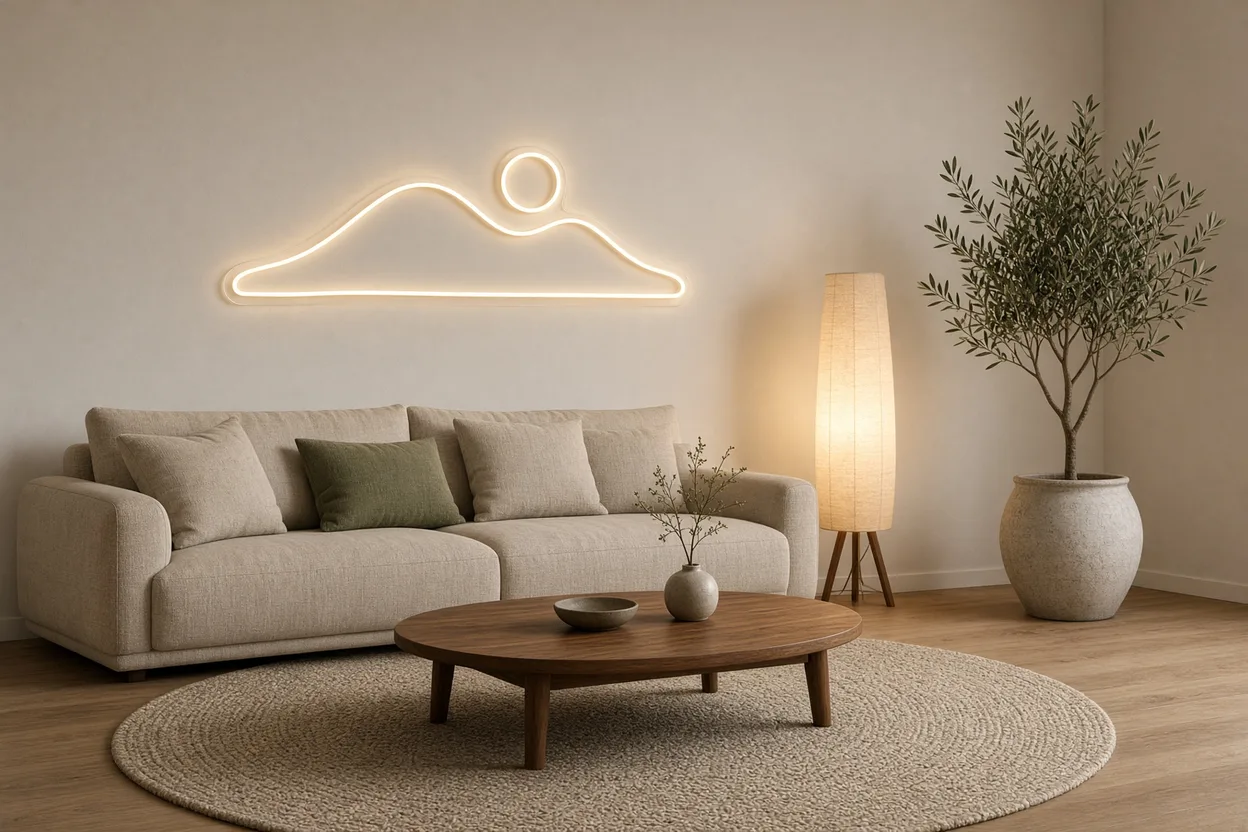
The Scandinavian style is a decorating style that originated in the Nordic countries in the mid-20th century. It combines simple lines, light woods, a soft palette, comfortable textiles, and plenty of light. Its goal: practical, bright, and warm interiors. At Helioneon, we often design a custom neon sign in warm white for these interiors.
This style remains one of the most requested in the United States, among homeowners as well as in cafes, bed and breakfasts, and offices. With more than 500 neon signs delivered, we have learned that a successful Nordic interior depends as much on its lighting as on its furniture. This guide explains where this style comes from, how to recognize it, and how to adopt it room by room.
What is Scandinavian style?
Scandinavian style is a way of decorating that prioritizes simplicity, function, and comfort: furniture with clean shapes, natural materials, light colors, and soft light distributed throughout the room. It aims for interiors that are pleasant to live in rather than spectacular.
It comes from Denmark, Sweden, Norway, and Finland, often associated with Iceland under the term Nordic countries. These countries share long, dark winters, a strong tradition of woodworking, and a culture of useful and durable objects. The decor follows directly from that.
- Simplicity: few ornaments, clean lines, and uncluttered surfaces
- Function: every piece of furniture should serve and last
- Comfort: soft textiles, thick rugs, and welcoming seating
- Light: light-colored walls and multiple light sources to make up for the winter
This movement is therefore not just a catalog aesthetic. It carries a democratic idea: beautiful and well-made objects should be accessible to as many people as possible. This philosophy explains its worldwide success for more than 70 years.
Where does Scandinavian style come from?
This style took hold in the 1950s, when Danish, Swedish, and Finnish designers combined wood craftsmanship with the principles of modernism. The traveling exhibition "Design in Scandinavia", presented in the United States and Canada from 1954 to 1957, made this movement known around the world.
Its roots are older. As early as the 1920s and 1930s, architects like Alvar Aalto in Finland sought to soften modernism with bent wood and organic forms. Aalto also co-founded the Artek publishing house in 1935, which still produces his furniture today.
- 1920s to 1930s: first bent-wood furniture and anti-glare lamps
- 1950s to 1960s: golden age of Danish, Swedish, and Finnish design
- 1970s to 1990s: democratization through flat-pack furniture
- Since the 2010s: strong comeback with hygge and social media
Flat-pack furniture played a major role in spreading the style in the United States. A Swedish brand founded in 1943 made Nordic lines accessible to millions of households, even though pieces by the great designers remain exceptional objects, often produced by historic publishers.
What colors and materials for a Scandinavian style?
The Nordic palette is based on white, beige, light gray, and blond wood, enhanced with a few soft touches such as blue-gray, sage green, powder pink, or black for contrasts. The materials are natural: light wood, wool, linen, cotton, leather, and ceramic.
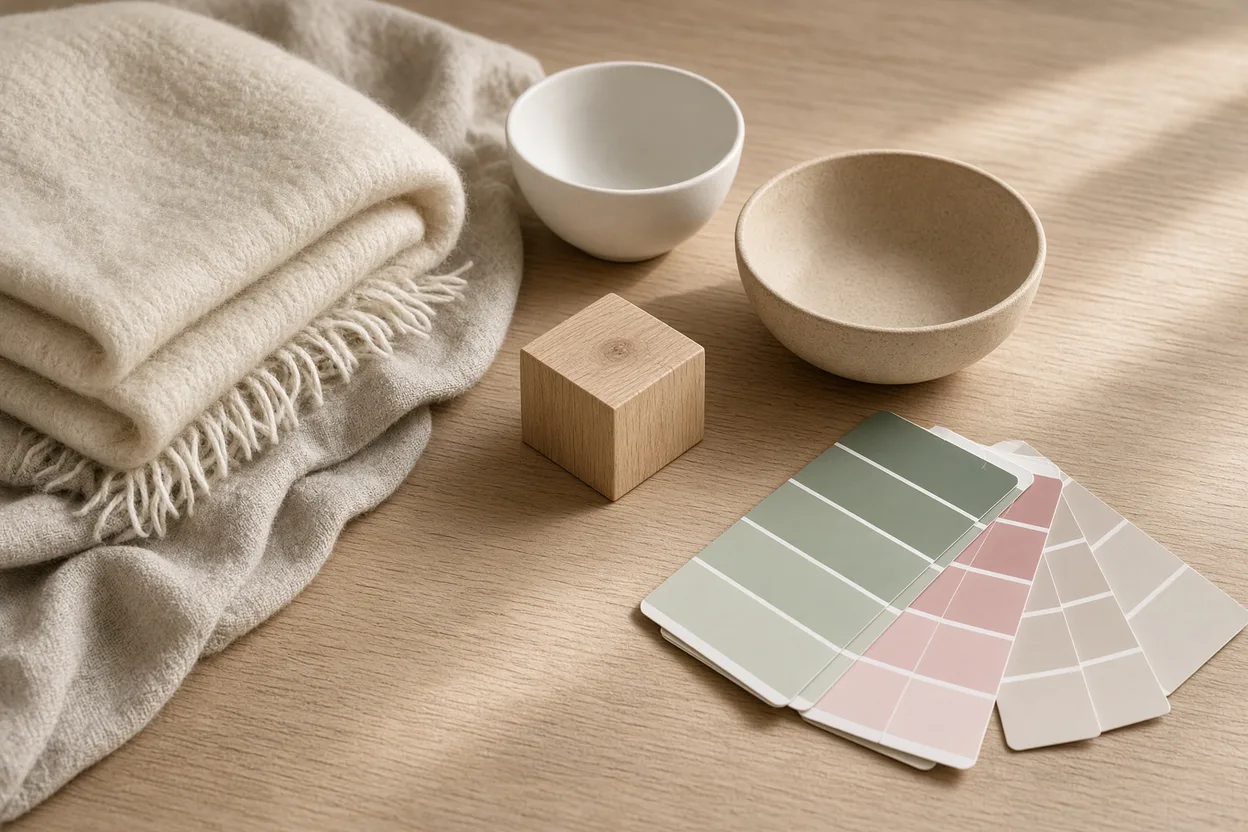
White dominates because it reflects light, which matters a lot when days are short. It is used on walls and sometimes on floors, but it is always warmed with wood and textiles, otherwise the room becomes cold.
- Light woods: oak, birch, ash, beech, and pine, often oiled or whitewashed
- Textiles: wool throws, linen cushions, thick rugs, synthetic skins
- Accents: thin black metal, matte ceramic, glass, and rattan
- Plant life: green plants and dried branches to bring life
A simple rule helps maintain balance: about 70% neutral tones, 20% wood and natural materials, and 10% color or black to structure. These proportions are not a standard, but they avoid the two classic mistakes, the clinical all-white and the overload of objects.
Which furniture and designers shaped Scandinavian design?
A few pieces of furniture and lighting fixtures sum up this movement: Hans Wegner's Wishbone chair, Arne Jacobsen's Egg chair, Alvar Aalto's Paimio chair, and Poul Henningsen's pendants. Their common points are simple shapes, high manufacturing quality, and comfort thought out in detail.
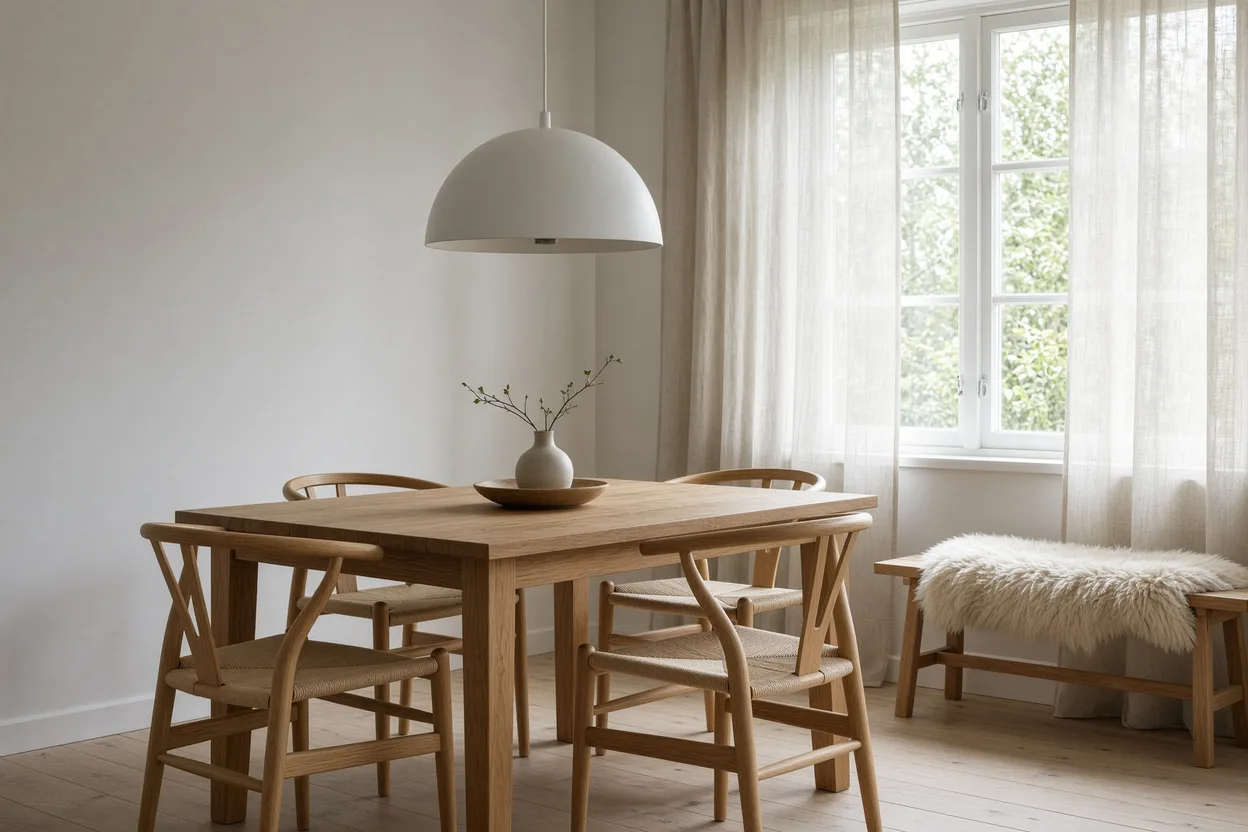
- Wishbone chair (1949): Hans Wegner, Y-shaped back and woven cord seat
- Egg chair (1958): Arne Jacobsen, designed for a Copenhagen hotel
- Paimio chair (1930s): Alvar Aalto, bent birch for a sanatorium
- PH lamps: Poul Henningsen, overlapping shades that hide the bulb
These pieces remain widely copied, which makes the style easy to reproduce on a small budget. For a coherent interior, however, a few solid and well-designed pieces of furniture are better than a complete set of fragile copies. Nordic decor values the object that lasts, often passed down from one generation to the next.
Seating is generally low and open, legs are thin and slightly angled, storage is closed and without visible handles. Dual-purpose furniture is also preferred, such as a storage bench in the entryway or an extendable table in the dining room, very useful in small homes.
The price of a Nordic interior depends mainly on the key pieces. A solid oak table or a designer chair costs more than a copy, but they resell well and survive moves. When the budget is tight, invest first in what you touch every day, such as the sofa, the table, and the bedding, then complete over time with thrifted objects. This patience is part of the Nordic spirit, which prefers thoughtful purchases to impulse buys.
Why is light at the heart of Scandinavian style?
Light occupies this place because the Nordic winter is very dark: in Stockholm or Oslo, there are only about 6 hours of daylight at the December solstice. Interiors have therefore been designed to capture natural light and complement it with many soft artificial sources.
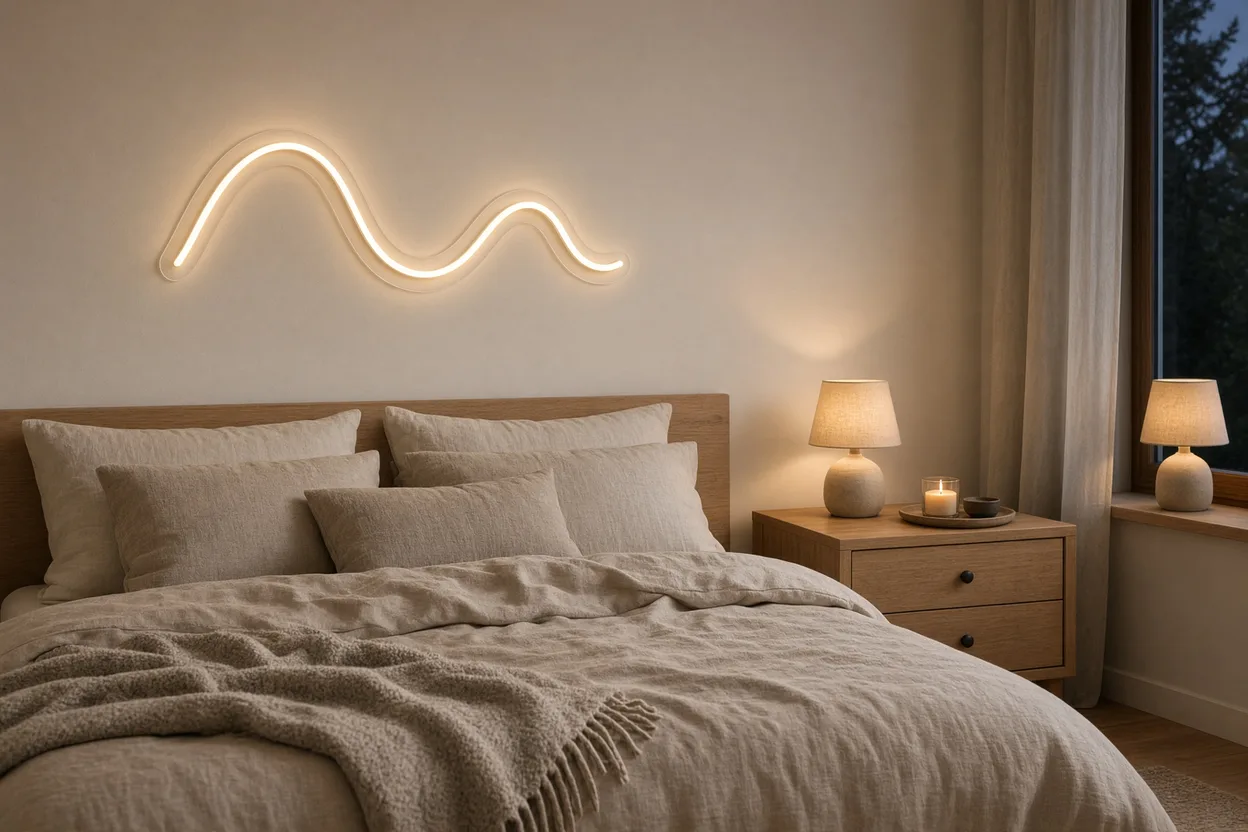
Rather than a powerful ceiling light, low light points are multiplied: table lamps, wall sconces, candles, string lights, and pendants above the table. This light in several layers creates the atmosphere that the Danes call "hygge", made of comfort and warmth.
| Light source | Role in a Scandinavian interior | Recommended tint |
|---|---|---|
| Helioneon warm white LED neon | Soft and indirect line on the wall | Around 2,500 K |
| Pendant above the table | Centered light, without glare | 2,700 to 3,000 K |
| Table lamp | Reading corner and evening ambiance | 2,700 K |
| Wall sconce | Accent lighting in hallways | 2,700 to 3,000 K |
| Candles and string lights | Warm points for the hygge spirit | Flame, around 1,900 K |
The choice of color temperature makes all the difference. A white that is too cold gives an office look, while a warm white makes the wood more golden and the textiles more welcoming. Our article warm white vs cool white neon explains how to choose. At Helioneon, our warm white is around 2,500 K, which pairs well with light woods.
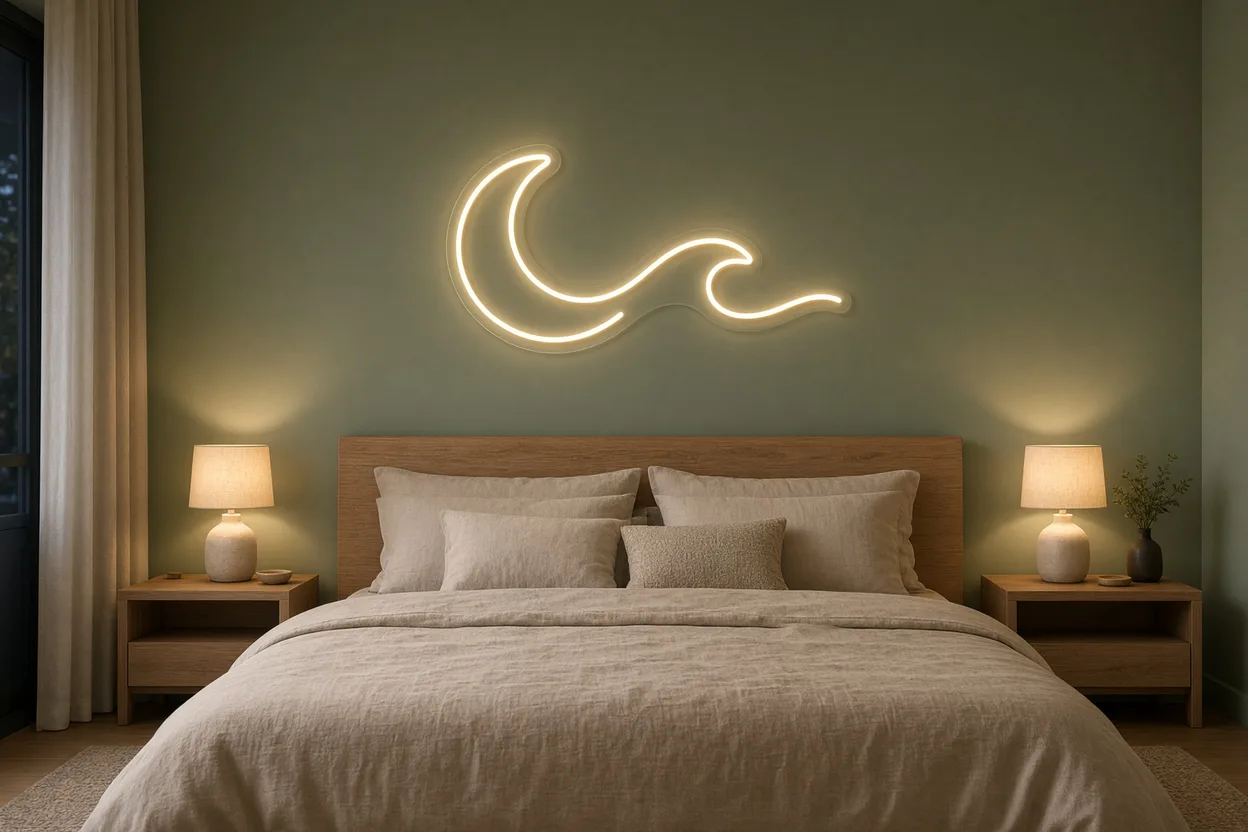
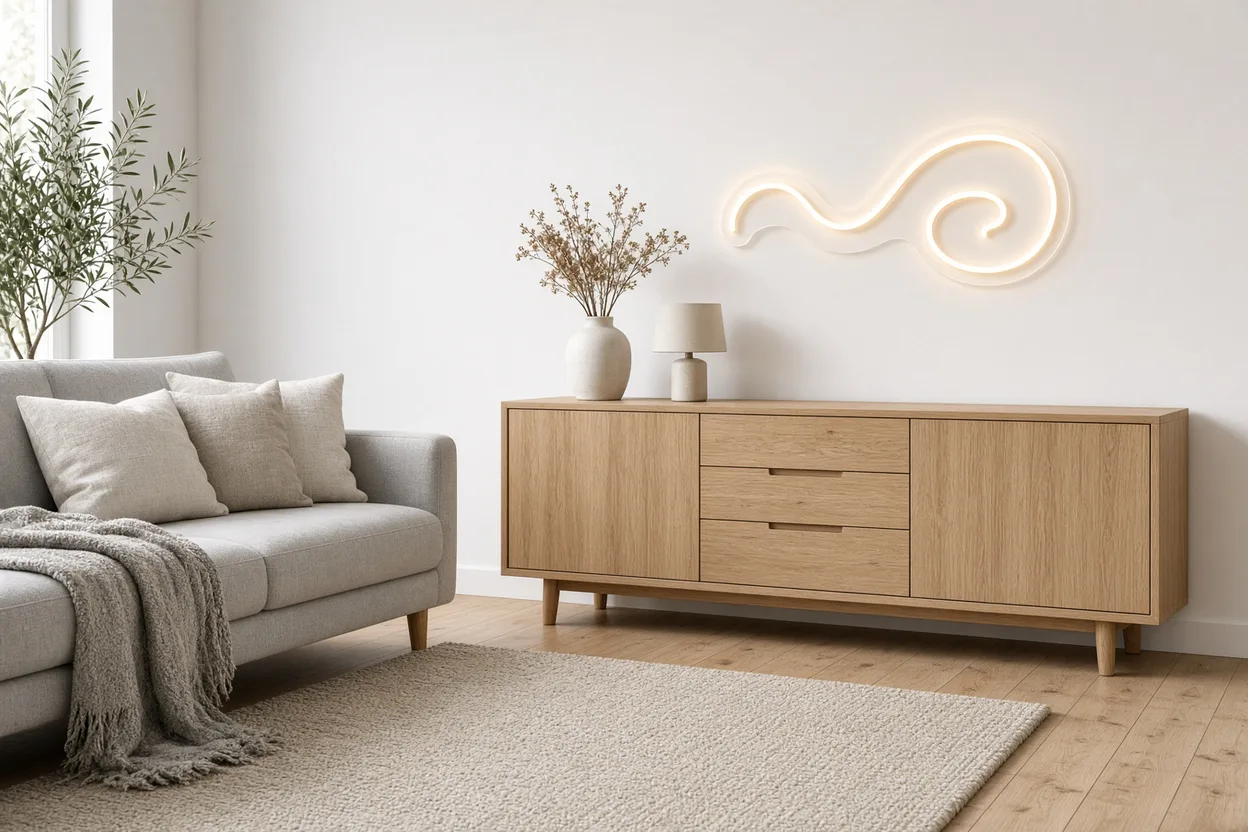
A warm white neon works particularly well in indirect lighting, placed behind a headboard, above a shelf, or along a wall. A simple line, a curve, or a short word is enough. It runs on 12V, consumes 8 to 15 W per meter, and stays cool to the touch, which allows it to be placed near textiles.
How to adopt Scandinavian style room by room?
To adopt it, start by lightening the room, painting the walls in a light tone, adding blond wood and natural textiles, then distributing three or four soft light sources. Decorative objects come last, and in small numbers.
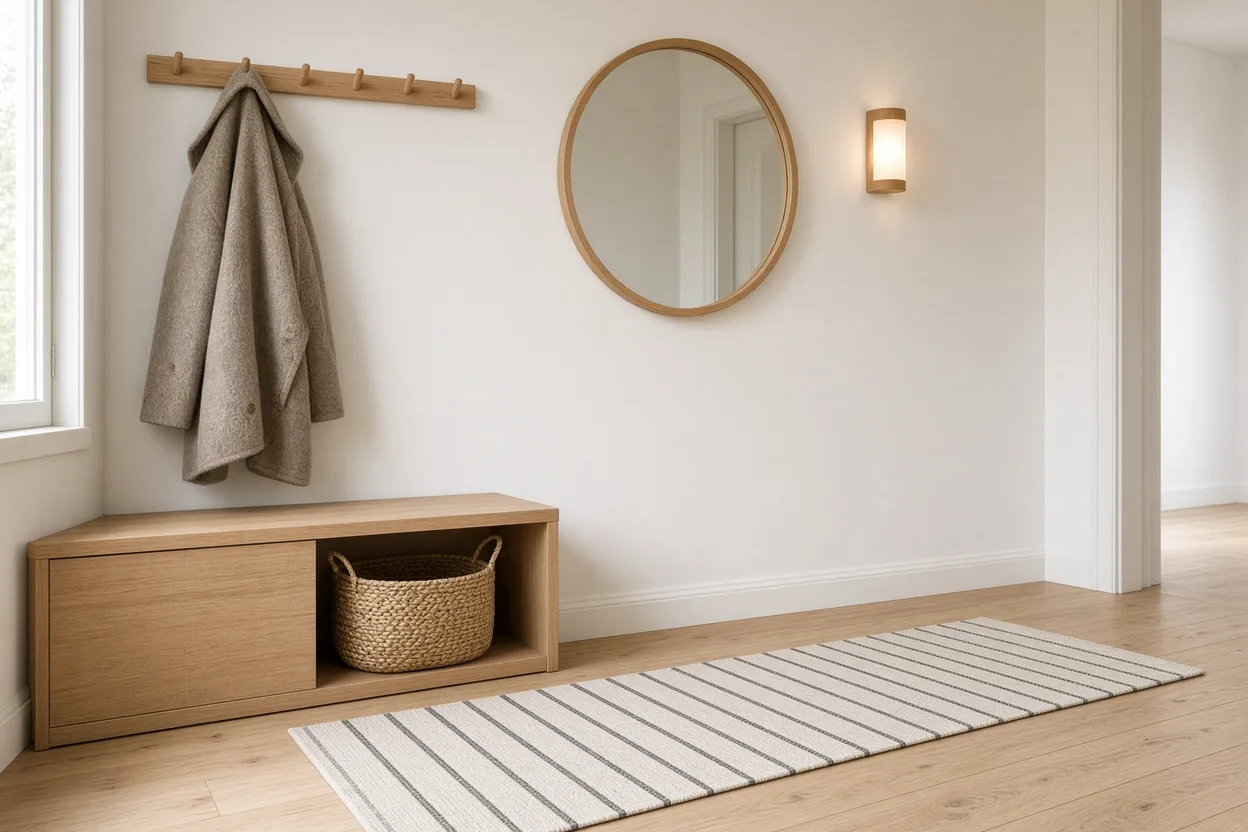
- Living room: light gray sofa, wool rug, oak coffee table, and several low lamps
- Bedroom: linen bedding, wood or fabric headboard, dimmed light on both sides
- Kitchen: white fronts, wood countertop, pendants above the island
- Entryway: storage bench, hooks, round mirror, and a warm wall sconce
The living room is often the room that requires the most care, because evenings are spent there. Our guide on living room ambient lighting details how to distribute the sources to obtain a soft ambiance without dark areas.
In a professional space, the same logic applies. A cafe, a bed and breakfast, or a practice benefits from adopting a light base and natural materials, with warm light that puts clients at ease. A discreet logo or word in warm white neon brings identity to the place without breaking the sobriety of the decor.
Small spaces particularly benefit from this approach. Because light walls visually enlarge the room and furniture on legs lets you see the floor, a studio looks larger as soon as these codes are adopted. It then suffices to limit the number of furniture pieces, choose closed storage, and multiply mirrors to bounce daylight toward the back of the room.
Scandinavian, Japandi, or hygge: what are the differences?
Scandinavian is a complete decorating style, hygge is a Danish philosophy of comfort and well-being, and Japandi is a recent fusion between Scandinavian decor and Japanese decor. They are often confused because they share a taste for wood, simplicity, and soft light.
- Scandinavian: light wood, white, soft textiles, bright and convivial atmosphere
- Hygge: a way of living, made of candles, throws, and shared moments
- Japandi: more pared down and more contrasted, with dark woods and low lines
- Lagom: the Swedish notion of "just enough", neither too much nor too little
If you like Scandinavian but want a more minimalist and more zen look, our guide to Japandi style shows how to add Japanese rigor. The two styles combine very well, especially in bedrooms and rest spaces.
The mistakes to avoid are the same for the three approaches: too much white without material to warm it, a ceiling light that is too powerful as the only lighting, and accumulated objects that make the sense of space disappear. When a Nordic interior looks cold, the solution is almost always to add wood, a textile, and warmer light.
Frequently asked questions about Scandinavian style
What is Scandinavian style in decor?
It is a decorating style from the Nordic countries that prioritizes simplicity, function, and comfort. It is recognized by its light walls, blond woods, natural textiles such as wool and linen, furniture with clean lines, and soft light distributed in several points. It seeks to create bright, warm, and practical interiors, designed for the long winters of northern Europe.
What are the colors of Scandinavian style?
Its colors are mainly white, beige, light gray, and the natural tone of blond wood. A few soft touches are added, such as blue-gray, sage green, powder pink, or terracotta, and a little black to structure with frames, furniture legs, or lighting fixtures. Bright colors remain rare and occasional.
What is the difference between Scandinavian style and Japandi style?
Scandinavian is lighter and more convivial: blond wood, white, soft textiles, and a bright atmosphere. Japandi takes this warmth but adds Japanese rigor, with lower lines, more emptiness, darker woods in contrast, and a more earthy palette. Japandi is therefore more pared down and more contrasted, while Scandinavian remains softer and more family-oriented.
What lighting to choose for a Scandinavian interior?
Choose several sources of soft light rather than a single powerful ceiling light: a pendant above the table, table lamps, wall sconces, and possibly a luminous line in indirect lighting. Prefer a warm white, between 2,500 and 3,000 K, which highlights the wood and textiles. Add candles or string lights in the evening for the hygge spirit.
Can a neon fit into Scandinavian decor?
Yes, provided it remains understated. In a Scandinavian interior, a neon works in warm white, with a simple shape: a line, a curve, a short word, or a small symbol. Placed above a bed, a shelf, or a wood sideboard, it brings indirect and soft light. Avoid saturated colors and long phrases, which would break the sought-after calm.
The Scandinavian style boils down to a few rules: light walls, blond wood, natural textiles, few objects, and warm light distributed throughout the room. To add a luminous line that respects this balance, launch your project via get a free neon sign quote and receive a free 3D mockup within 24 hours. For the history of the movement, the Wikipedia page on Scandinavian design is a good starting point.
Your custom neon, designed for free in 24 h
- Describe your ideaA text, a logo or a simple sketch. It takes one minute.
- Get your mockup and priceWithin 24 h by email, no commitment.
- Approve, we make itFree express delivery in 7 to 10 days, set up in 3 minutes.
- Mockup and price within 24 h, no commitment
- Free express delivery, received in 7 to 10 days
- 3-year warranty, set up in 3 minutes
Get your free mockup

Guillaume Schlupp
Founder of Helioneon
Over 10 years of entrepreneurship in premium interior design. 500+ LED neons delivered across 13 countries under Helioneon and Light Genius. Leads product strategy, design and professional accounts.