How Bright Are LED Neon Signs? Lumens, Intensity and Dimmers
⚡ The essentials in 30 seconds
- How bright are LED neon signs? What lumens mean, how colour and length change intensity, and how a dimmer tunes the glow day and night.
- Get the facts here.
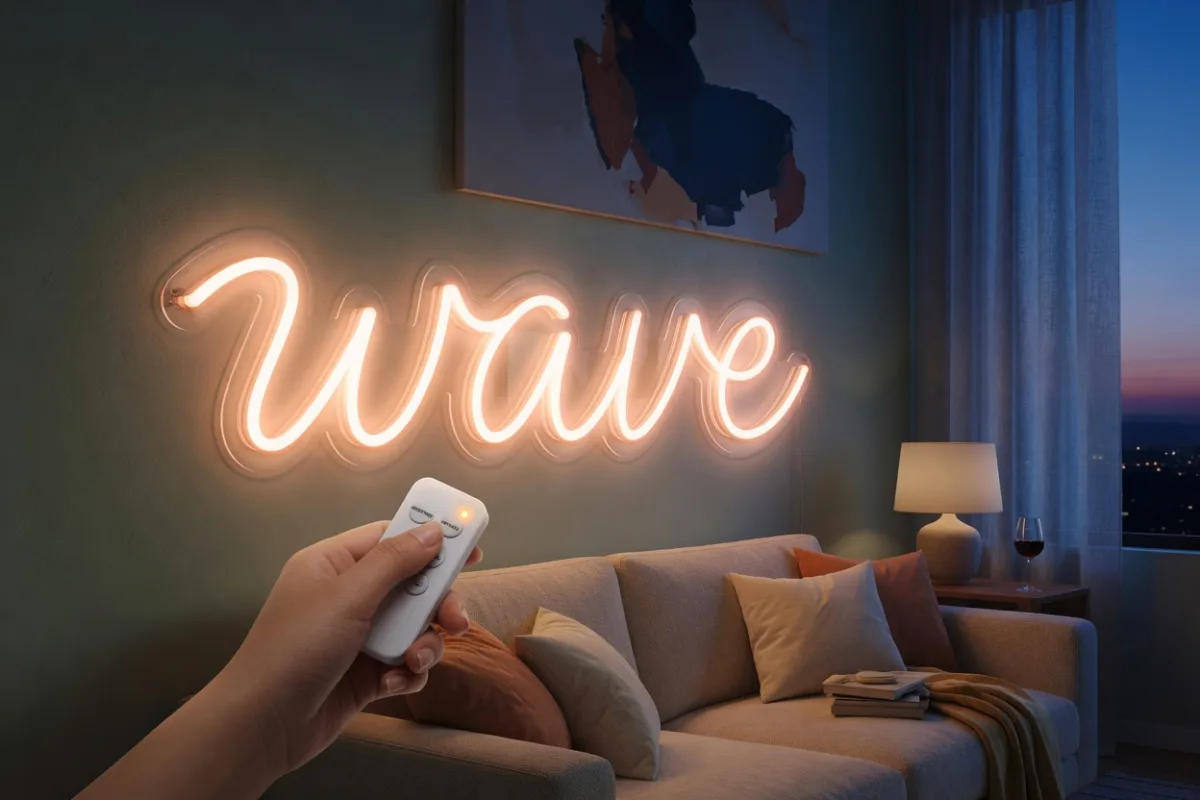
LED neon signs are bright enough to read from across a street at night, yet they're ambient lighting, not task lighting: a typical sign emits a few hundred lumens, comparable to a soft lamp rather than a ceiling light. Brightness depends on colour, tube length and LED density, and a dimmer adjusts it to the moment.
Brightness is the question buyers ask third, after price and size, and it's the one with the most confusing answers online. So let's clear it up properly. Every Helioneon sign ships with a dimmer as standard, and when you design your own neon sign, the free 3D mockup within 24 hours helps you judge scale and presence before anything is made.
Lumens vs watts: what actually measures brightness
Watts measure how much power a light consumes. Lumens measure how much light it emits. The two used to travel together in the incandescent era, when a 60W bulb reliably meant about 700 lumens, but LEDs broke that link: a modern LED produces the same 700 lumens from 8 to 10 watts.
So ignore watts when judging brightness. For scale: a candle gives roughly 12 lumens, a bedside lamp 300 to 500, a living room ceiling light 1,500 or more. LED neon tube typically emits somewhere in the range of 100 to 300 lumens per metre depending on colour and density, which places a mid-sized sign firmly in bedside-lamp territory. That's by design, and it's the right design.
Is a neon sign bright enough to light a room?
Not on its own, and anyone who tells you otherwise is selling something. A neon sign is accent lighting: it creates atmosphere, colour and a focal point, while your main lights handle actual visibility. Think of it the way you'd think of a fireplace. Nobody reads by firelight, but nobody calls a fireplace pointless.
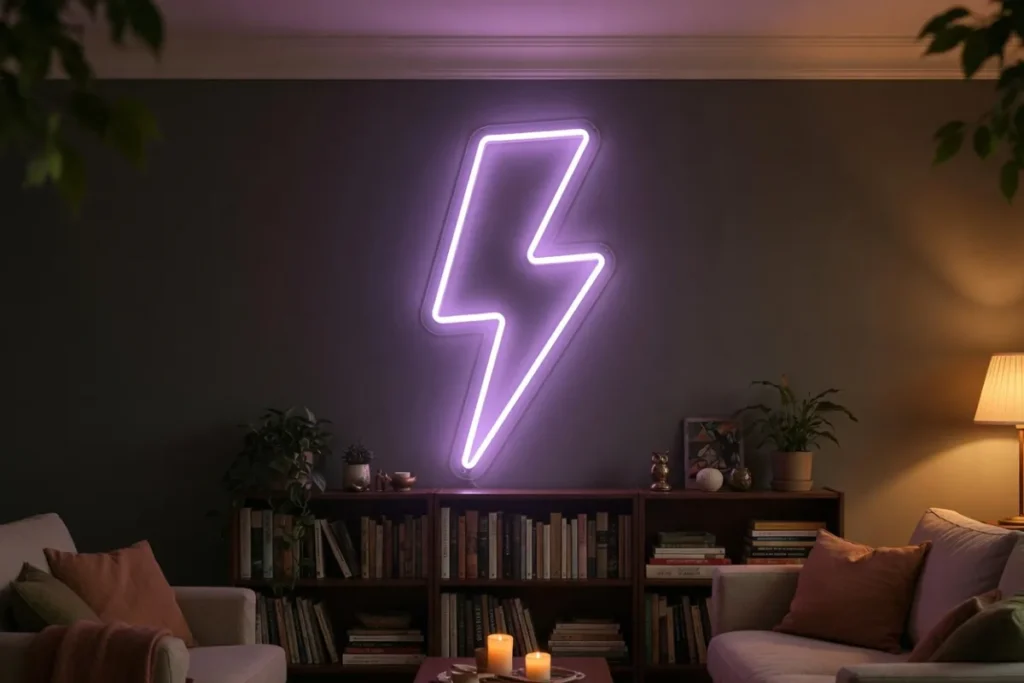
What it does do superbly is dominate a dim room. Switch the ceiling light off in the evening and a single 80 cm sign will wash a wall in colour, light faces for photos and make the space feel deliberately designed. In a fully lit room it reads as a glowing graphic. At night it becomes the room. That range is the product.
What affects a neon sign's brightness?
Three factors do most of the work:
- Colour. White and yellow tubes emit the most light for a given tube; deep blue, purple and red sit noticeably lower. That's physics, not a defect: the human eye is most sensitive to the green-yellow middle of the spectrum.
- Tube length. More metres of lit tube means more total lumens in the room. A 1-metre word and a 3-metre logo differ enormously in overall presence.
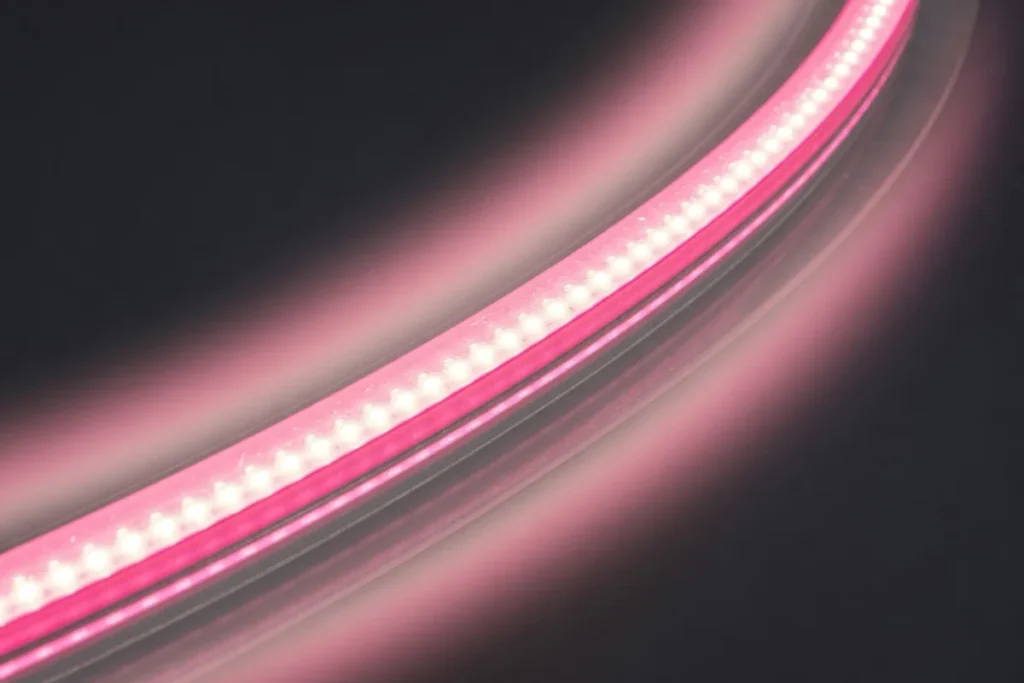
- LED density. Quality tube packs more chips per metre (often 100-120), which raises brightness and keeps the line perfectly continuous. Our 6 mm silicone tube diffuses those chips into one unbroken stroke with no visible dots.
Background matters too, and people forget it. The same sign looks twice as punchy on a dark green wall as on white paint, because perceived brightness is really contrast. If you want maximum impact for minimum lumens, darken the wall, not the order form. More sizing guidance lives in our article on how to choose a neon sign.
Dimmers and remotes: brightness on demand
The dimmer is the most underrated part of the whole product. Every Helioneon sign includes one, and it changes what the sign is: 100% for a party, 50% for dinner, 10% as a night glow. One object, three moods, no electrician.
Dimming also trims power draw, which was modest to begin with: a typical sign consumes about as much as a laptop charger at full brightness, and our power consumption breakdown shows the running cost lands at a few pence per evening. Since LEDs dim by pulsing rather than starving, the colour stays true at every level, unlike old filament dimming that turned everything orange.
Remote-control options take the same idea further, with brightness steps and timers managed from the sofa. Whichever controller you use, set a level for each scenario once and stick to those presets. Rooms feel calmer when their lighting is repeatable rather than improvised nightly.

Day vs night: tuning the glow
Daylight is the stress test. Direct sun delivers tens of thousands of lux, so no decorative sign competes with a bright window at noon; in a sunlit room a neon reads as coloured line art, softly lit. From late afternoon onwards it takes over, and by night even 30% intensity feels vivid.
A practical evening routine: full brightness until dinner, half after, and for bedrooms, 10-20% or off at sleep time, because glare is real. If a sign faces your bed or sofa head-on, mount it slightly above eye level and let it graze the wall; you get the glow without the stare. Businesses should think in reverse: run brighter during opening hours for street visibility, then dim overnight. The tube is rated for around 100,000 hours, so a decade of daily glow barely dents its lifespan.
How does it compare with glass neon?
Brightness parity is one reason LED took over. Metre for metre, quality LED neon matches or exceeds the perceived brightness of traditional glass tube, and it does so at 12V instead of several thousand volts, from a fraction of the power. Glass also fades as its gas and electrodes age, while LED output declines far more slowly across a roughly 100,000-hour life. The full picture, weight and safety included, sits in our glass neon vs LED neon guide.
Against backlit box signs, neon trades floodlight power for shape: it draws its message in light rather than lighting a panel around it. That's why it reads at a glance and photographs so well. If you want a wall bathed evenly, buy a different product. If you want the words themselves to glow, this is the one.
FAQ: LED neon sign brightness
How many lumens is an LED neon sign?
Roughly 100 to 300 lumens per metre of tube, depending on colour and LED density. A typical 80 cm to 1 m sign therefore emits a few hundred lumens overall, similar to a soft bedside lamp: designed for atmosphere rather than task lighting.
Can I dim an LED neon sign?
Yes. Helioneon signs ship with a dimmer as standard, letting you slide from full brightness down to a faint glow. LED dimming keeps the colour accurate at every level, and running the sign dimmed also reduces its already low power consumption.
Which neon colour is the brightest?
White and yellow appear brightest, because the human eye is most sensitive to the middle of the visible spectrum. Deep blue, red and purple emit less perceived light from the same tube. If daytime visibility matters, choose a light, warm colour.
Is a neon sign too bright for a bedroom?
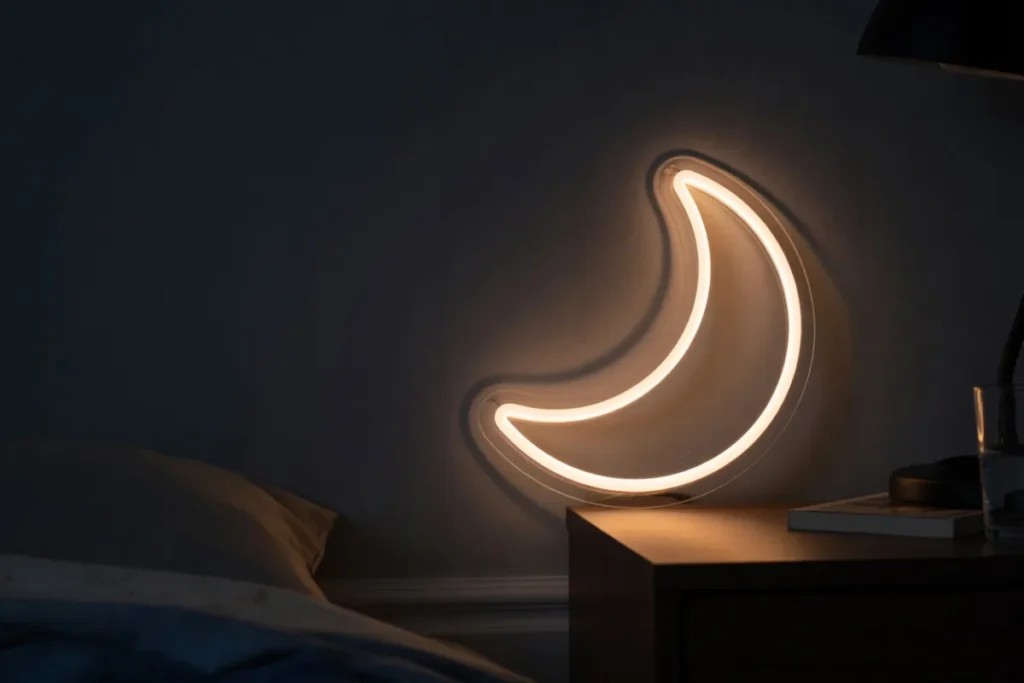
Not with a dimmer. At 10-20% intensity a neon sign works as a gentle night glow, softer than most bedside lamps. Choose a warm colour, mount it slightly above eye level to avoid glare, and dim it down as bedtime approaches.
Can you see an LED neon sign in daylight?
Yes, though with less drama than at night. In a sunlit room the sign reads as glowing line art rather than a beacon, since daylight delivers far more lux than any decorative light. Lighter colours and darker backgrounds improve daytime presence considerably.