LED neon sign lifespan: 100,000 hours, here’s why it lasts so long

A quality LED neon sign lasts on average 50,000 to 100,000 operating hours, equivalent to 14 to 27 years at 10 hours daily use. Helioneon LED neon signs come with a 3-year contractual warranty covering LEDs, driver and structure, and remain stable in luminosity throughout their useful life with proper care.
At Helioneon, we manufacture custom LED neon signs in flexible silicone for UK homes and businesses. The question of LED neon sign lifespan comes up systematically: how long will my sign actually last? This guide gives precise figures, the factors that influence durability and our practical care advice.

How long does a LED neon sign really last?
A premium LED neon sign reaches between 50,000 and 100,000 operating hours, depending on LED chip quality, driver electronics and environmental conditions. At Helioneon, we guarantee 100,000 hours of operation on our standard models, which equals approximately 27 years at 10 hours daily use, 13 years at 24/7 continuous use, or 41 years if used only in the evening.
This longevity comes from three combined elements: high-grade Epistar (or equivalent) LEDs, an energy-efficient 12 V driver compliant with EN 61347-2-13, and silicone tube protected from UV. Lower-grade signs sold under £50 typically last 10,000 to 20,000 hours only, hence the importance of choosing a recognised manufacturer.
| Use scenario | Daily duration | Lifespan in years |
|---|---|---|
| Casual home use | 5 h/day | ~55 years |
| Standard home use | 10 h/day | ~27 years |
| Café/restaurant | 12-15 h/day | ~18-22 years |
| Shop window | 16 h/day | ~17 years |
| Continuous outdoor | 24 h/day | ~11 years |
What factors influence LED neon sign lifespan?
Five main factors shape the actual LED neon sign lifespan: LED chip quality, driver efficiency, ambient temperature, brightness setting and exposure to UV (outdoor signs). Indoor signs from quality manufacturers easily reach the announced 100,000 hours.
- LED chip quality: Epistar grade A reaches 100,000h vs 30,000h for cheap chips.
- Driver efficiency: a 92 %+ driver protects LEDs from premature aging.
- Brightness setting: permanent dimming at 70 % can extend lifespan by 30 %.
- Ambient temperature: ideal range is 0-35 °C, beyond that lifespan drops.
- UV exposure: outdoor signs need UV-resistant silicone (IP65 outdoor version).

Indoor vs outdoor: how much shorter is the lifespan outdoors?
An outdoor LED neon sign without UV protection loses on average 25 to 40 % of its useful life compared to an equivalent indoor sign. Specifically, a Helioneon outdoor model with IP65 protection and UV-stabilised silicone reaches 70,000 to 80,000 hours, against 100,000 hours indoors. This is why we offer two distinct ranges: indoor classic and outdoor IP65.
The main outdoor wear factors are UV (yellowing of low-grade silicone), rain (ingress through poorly sealed connectors), wind (mechanical stress on fittings) and freezing temperatures below -10 °C (which strain electronic components). For business outdoor signs, we always recommend our certified IP65 range plus a sealed driver enclosure.
3-year warranty and lumen degradation: what to know
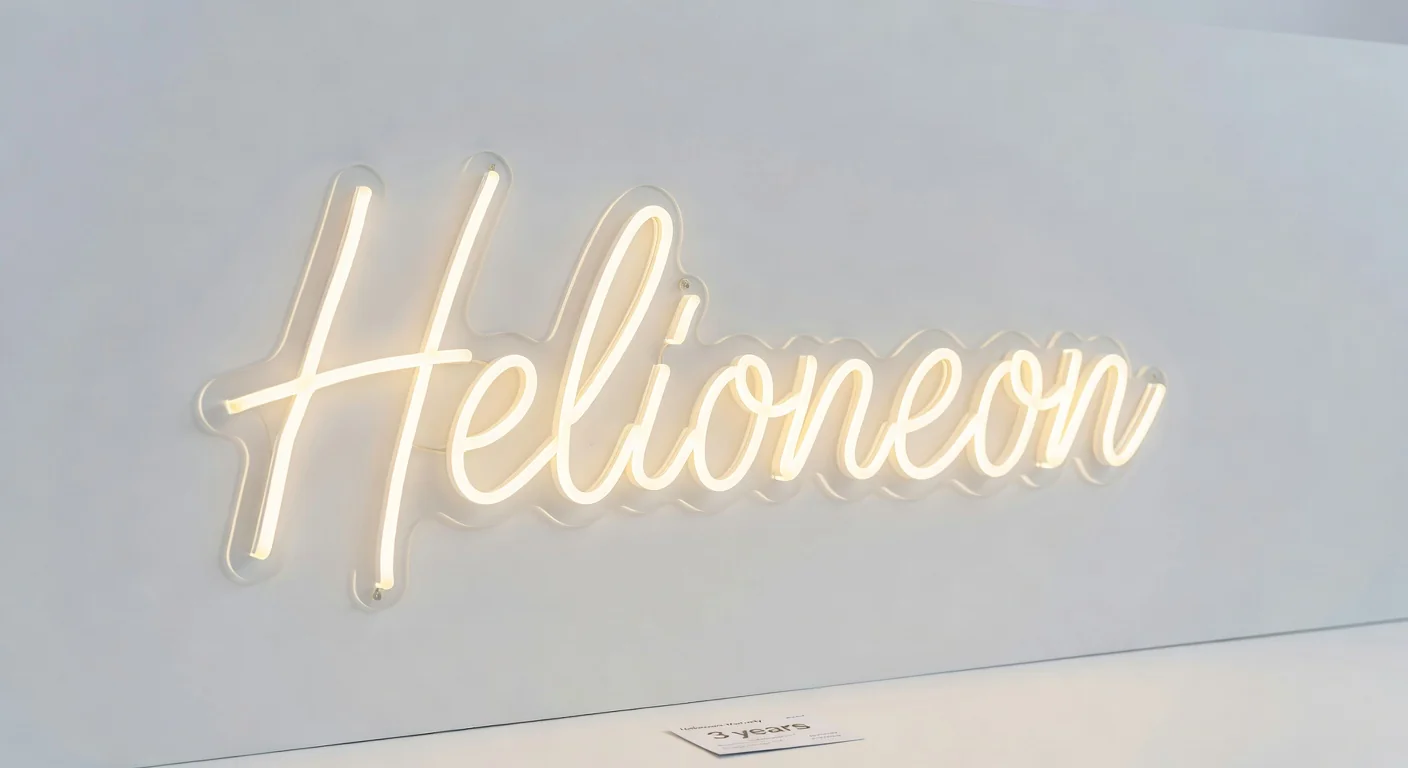
The Helioneon contractual warranty covers 3 full years with no hidden clauses. It includes LED chips, driver, silicone tube and acrylic mounting, and provides free replacement of any defective component. Beyond 3 years, our LED neon signs continue to operate without issue, with the only expected change being a slow lumen depreciation, around 10-15 % at 70,000 hours.
This degradation, called L70 in the lighting industry, means that the LED retains 70 % of its initial brightness at the end of useful life. In practice it remains virtually invisible to the naked eye, the LED appears just slightly less bright but the colour remains stable. For more on the underlying technology, see the Wikipedia article on LEDs.
LED vs gas neon: lifespan compared
The lifespan gap between LED and gas neon is dramatic. A traditional gas neon lasts 8,000 to 15,000 hours on average, against 100,000 hours for a quality LED neon. In other words, a LED neon sign lasts 6 to 10 times longer at much lower cost. For a complete comparison, see our guide Custom neon sign cost UK.
Beyond pure lifespan, gas tubes also lose 30 to 50 % of their efficiency after a few thousand hours, requiring power increase to maintain visible brightness. The LED, in contrast, holds its full power throughout its life thanks to a constant-current driver, which guarantees stability of consumption and visual rendering.
How to maximise your LED neon sign lifespan
Four practical gestures noticeably extend the useful life of a LED neon sign. First, plug the driver into a surge-protected multi-socket to absorb mains spikes. Second, avoid wrapping the driver cable around heating metal objects. Third, dust the driver once a year with a dry cloth. Fourth, never feed the neon through an incompatible LED dimmer.
- Surge protection: protects the driver against mains microspikes.
- Driver ventilation: never enclose it in a tight cabinet without airflow.
- Yearly cleaning: dry cloth on tube and driver, no harsh chemicals.
- LED-compatible dimmer: Helioneon dimmer or known LED-rated brand.
- Outdoor IP65: for any installation exposed to weather.
Frequently asked questions about LED neon sign lifespan
Can a LED neon sign really last 100,000 hours?
Yes, with a quality manufacturer (Epistar grade A LEDs or equivalent and certified driver) the 100,000-hour figure is realistic. It corresponds to standard manufacturer ratings in the LED industry. For Helioneon signs, we contractually guarantee 3 years and observe in real conditions a lifespan well above 70,000 hours on signs installed since 2018.
Does the warranty cover normal wear and tear?
The Helioneon 3-year warranty covers any manufacturing defect or premature failure, but not normal LED ageing (slow lumen depreciation after 70,000 hours) which is industry-standard. It also does not cover damage caused by misuse: incompatible dimmer, mains overload, drop or shock to the silicone tube. In practice, less than 1 % of our annual sales trigger a warranty claim.
What happens after 100,000 hours of use?
After 100,000 hours, the LED neon sign continues to operate but with a slow drop in brightness (10-15 % loss at this point). The sign remains usable for many more years, simply slightly less bright. The first component to truly fail is generally the driver after 30,000 to 50,000 hours of continuous use, which is replaceable in 5 minutes at low cost.
Does outdoor exposure shorten lifespan a lot?
Yes, with a non-protected indoor sign installed outside, the lifespan can drop by 50 to 70 % due to UV exposure and humidity. With our certified IP65 outdoor range, the difference reduces to 25-40 % only, with realistic operation between 70,000 and 80,000 hours. This is why we always recommend choosing the right range from the start.
For a free quote on your LED neon sign with our 3-year warranty included, visit the Helioneon UK page. We answer within 24 hours with a 3D preview and detailed warranty terms.