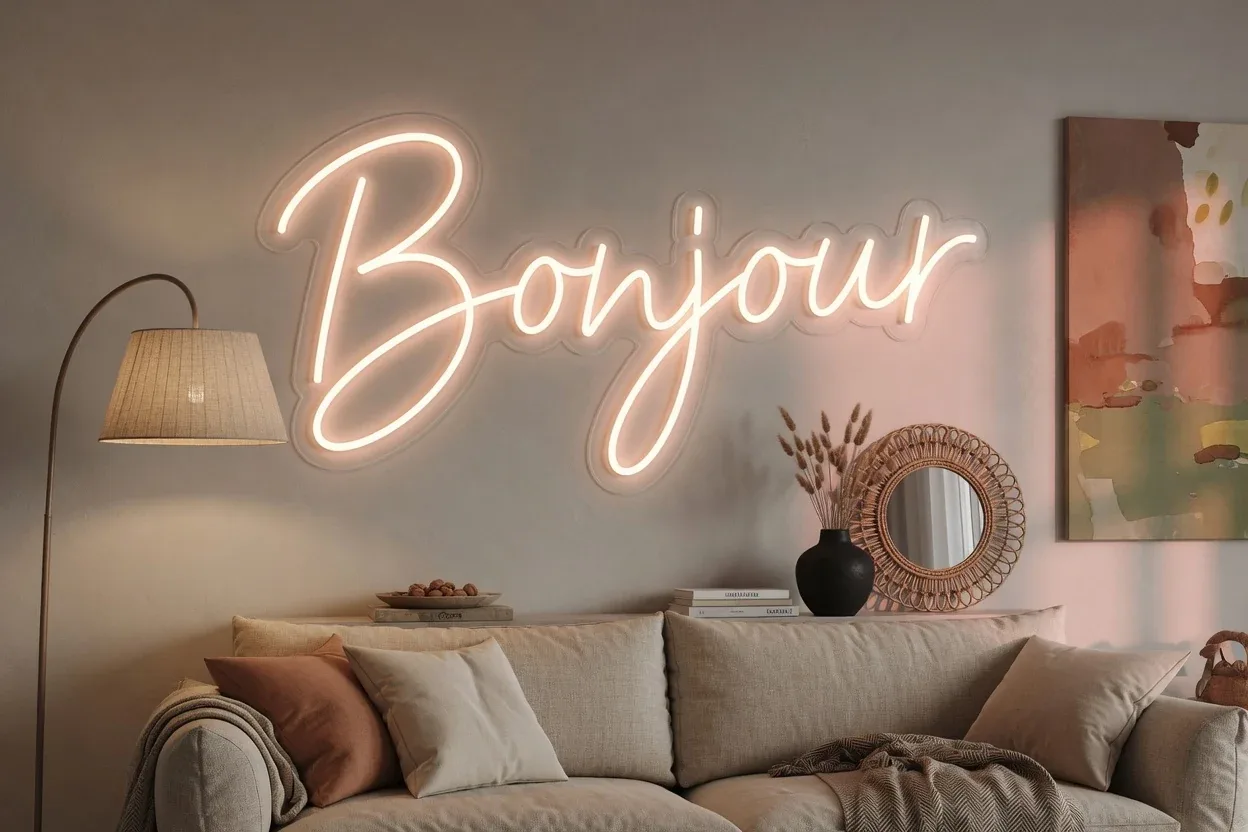
Neon light colours for the living room: which shade fits each vibe
- LED neon signs use 8 to 15 watts per metre of lit tube, about 12 W/m on average. A 1 metre sign running 8 hours daily uses about 35 kWh per year, costing roughly £5 at £0.14 per kWh.
- Find a ready-made kWh and cost table, the simple calculation formula, what changes the wattage, and practical ways to lower the bill.
The ideal neon light colours for a living room depend on the mood you want and the palette you already have: warm white (3,000 K) leads 32% of projects for its universal look, followed by pink (21%) and amber (14%). In practice, warmer tones calm the room; cooler tones energise the space and raise power use slightly.
At Helioneon, clients ask almost every week which neon light colours to pick so the living room feels right. This guide gathers our maker tips, the setups that actually work, how each hue affects power draw, and the traps to avoid before you lock in production.
How neon light colours transform a living room vibe
The colour of a living room LED neon works on three levels: the emotion it creates, how large the room feels, and how readable the text is. A warm tone (2,700-3,000 K) builds a cocoon, while a cool tone (5,000 K and up) reads clean and spacious. In between, saturated hues (pink, amber, green, blue) act more as a visual signature than as the main light source.
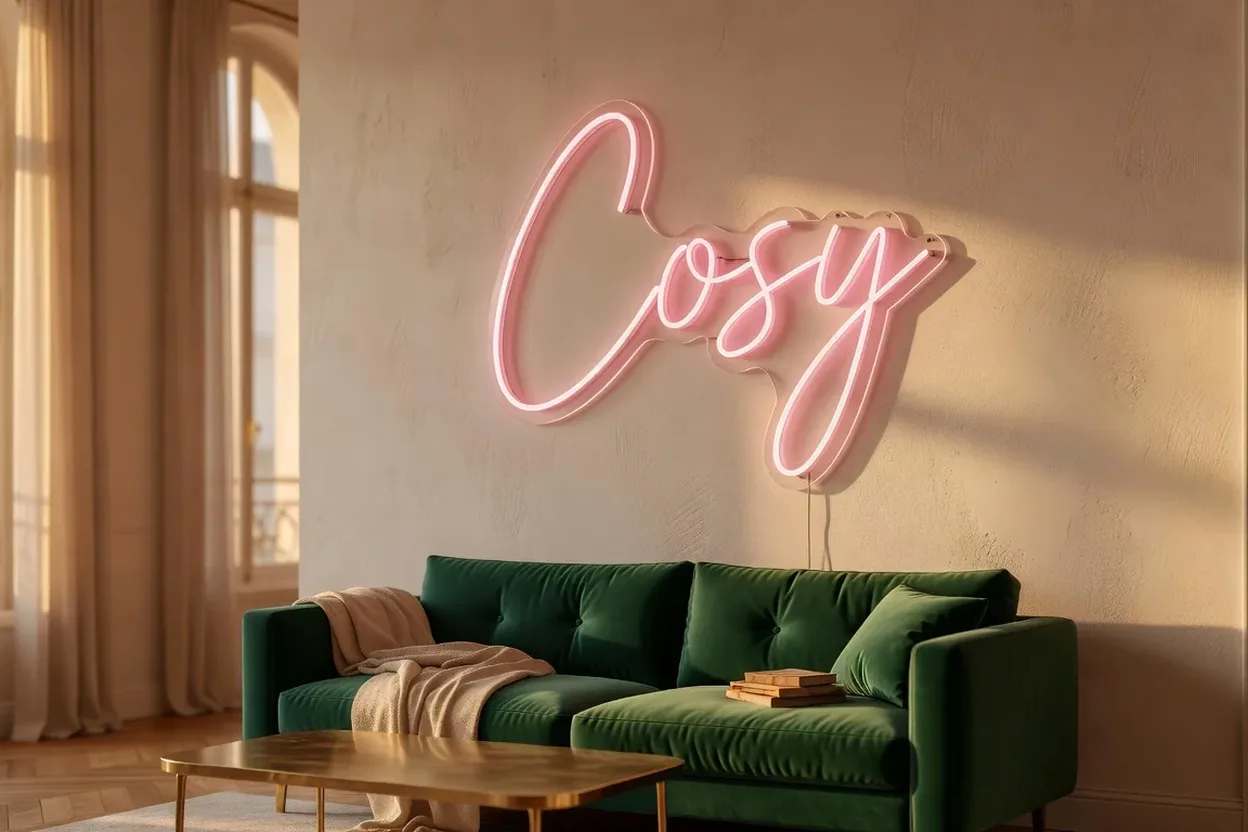
Concretely, a living room under about 215 sq ft takes a warm tone better and avoids a clinical feel, while a large open plan that flows into the kitchen can handle neutral white (4,000 K) without throwing the whole space off. The colour also needs to talk to your furniture: an emerald velvet sofa pairs well with pink or amber, while a Scandinavian interior usually prefers a minimal warm white.
- Emotion: warm = calm, cool = stimulation, saturated = energy or romance.
- Perceived volume: lighter tones open the room visually, warmer tones pull focus inward.
- Text readability: white, yellow, and pink give the best contrast on most walls.
- Camera appeal: pink and amber dominate Instagram and Pinterest living room feeds.

Top 7 neon light colours for living rooms in 2026
The top 7 neon light colours for living rooms selected at Helioneon in 2026 track how interiors are evolving: pastels are rising, warm white stays on top, and living room neon sign modern decor ideas for 2026 keep winning over people who like smartphone control. This ranking is based on 480 confirmed orders from January through April 2026.
| Colour | Temperature / Code | Mood it evokes | Ideal interior style |
|---|---|---|---|
| Warm white | 3,000 K | Cocoon, timeless | Scandinavian, classic |
| Pastel pink | ~600 nm | Romantic, camera-ready | Boho, japandi |
| Amber | 2,200 K | Cosy, vintage | Industrial, mid-century |
| Neutral white | 4,000 K | Bright, contemporary | Loft, minimalist |
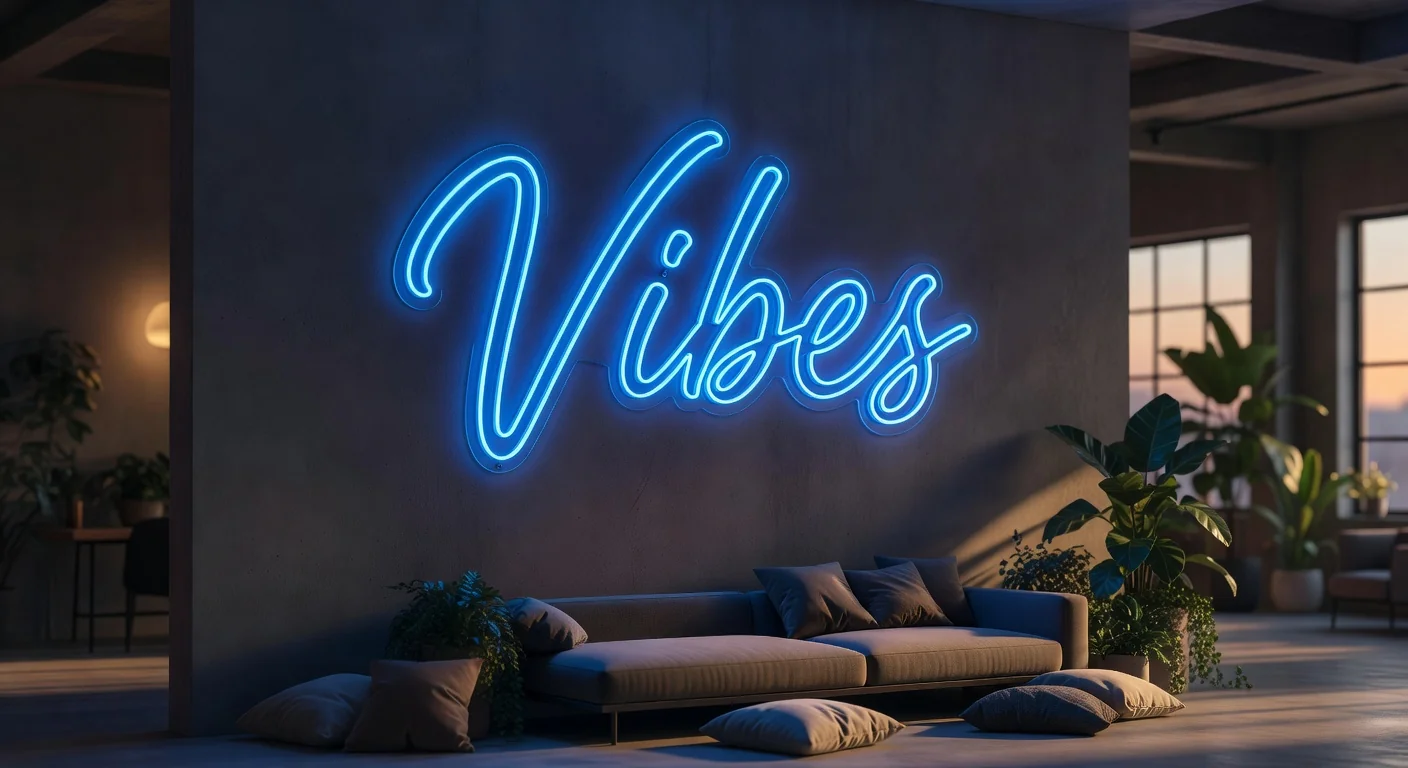
| Glacier blue | ~470 nm | Energetic, futuristic | Tech, gaming, teen room |
| Deep red | ~660 nm | Intense, strong signature | Cinema, art deco |
| Programmable RGB | Multi 16M colours | Flexible by night | Smart home, gamers |
Note that an RGB neon sign: colours, how it works, and control needs a bit more budget (15% to 25% extra) and a Wi-Fi compatible driver, but it lets you match the colour to every part of the day. For a first living room LED neon, warm white remains the safest bet, followed by pastel pink for softer moods.

Which colour fits your living room style?
Interior style should lead the colour choice. A Scandinavian or japandi living room calls for natural tones (warm white, soft amber) that extend the Nordic feel, while an industrial loft can take stronger hues like glacier blue or deep red. Contemporary classic interiors work well with pastel pink or neutral white, depending on whether wood or stone dominates.
It also helps to factor in the main wall colour behind the sign: on an off-white wall, every hue pops; on a dark wall (terracotta, forest green, midnight blue), warm white or pastel pink gives the best contrast. Our custom neon sign maker includes a real-scale 3D preview so you can see the effect on your own wall before you confirm.
- Scandinavian / japandi: warm white 3,000 K, amber 2,200 K, light pastel pink.
- Boho / vintage: amber, golden yellow, powder pink.
- Industrial loft: glacier blue, deep red, neutral white 4,000 K.
- Contemporary / minimalist: warm white, neutral white, saturated monochrome.
- Art deco / cinema: intense red, deep amber, emerald green.
How colour affects power use and lifespan
Not all LED neon colours draw the same power. At a similar perceived brightness, cool white and blue are the hungriest (around 14-15 W/m), while pink, amber, and red stay the most efficient (8-10 W/m). In practice, on a one-meter neon lit 8 hours a day, the yearly gap stays around £2 to £2, but over several years of use the colour choice also affects how hard the driver works.
For a deeper dive into LED neon sign power consumption in watts, kWh, and cost, we published a numbers-first guide that breaks down the yearly bill metre by metre and colour by colour. On lifespan, red LEDs have historically been the most stable (up to 100,000 hours without visible fade), while blue LEDs need a higher-quality driver to hold output over the long run.
- Cool white (5,000 K): 14-15 W/m, more power hungry but very bright.
- Warm white (3,000 K): 12 W/m, the sweet spot for draw and mood.
- Pink / amber / red: 8-10 W/m, top efficiency.
- Blue / green: 11-13 W/m, excellent lifespan with a premium driver.
- Programmable RGB: 13-16 W/m depending on the active mode, flexible but power hungry.
How to match neon colour with your existing lighting
A living room LED neon does not light the room alone; it is a visual accent. The golden rule is to avoid clashing colour temperatures: warm white on the neon with cool white ceiling spots creates an unpleasant split. Better to harmonise temperatures (all warm or all neutral) or pick a saturated neon (pink, blue, red) that clearly stands apart from existing white sources.
Placement matters a lot. Above a sofa, an amber neon builds a cosy evening halo. On the TV wall, neutral white or glacier blue supports movie nights without eye strain. Behind a bookcase, pastel pink adds a focal point without overwhelming the view. That is why we always point clients to how to choose a neon sign: the all-in-one US guide for 2026, size and colour included.
Traps to avoid when picking a neon LED colour
Three mistakes come up often with clients choosing their first living room neon colour. First, picking cool white (5,000-6,000 K) because it seems to "light better": in a relaxation space the result feels too clinical. Second, choosing a hue too close to the host wall (pink on pink, blue on navy) so the message loses contrast. Third, forgetting full-intensity behaviour: at 100% power, some saturated colours can feel almost blinding in a small room. Always pair RGB with a suitable guide to LED neon brightness, lumens, and dimmers.
- Cool white in the living room: skip it; stay at 3,000 K max.
- Colour too close to the wall: weak contrast, hard-to-read message.
- RGB with no dimmer: harsh intensity, cheap look. Always add a dimmer.
- Too many colours with no plan: three colours max on one neon to stay elegant.
- Skipping the 3D test: always validate with the Helioneon preview before production.
To go deeper on the role of colour temperature in interior lighting, the Wikipedia article on colour temperature is a solid academic reference for understanding kelvin values.

How Helioneon helps you pick the right colour
Our process for living room LED neon colour rests on three steps: a short brief (preferred colour, wall photo, target mood), a 3D preview in the chosen tone on your wall, and a physical silicone tube sample test if you are torn between two colours. That cuts returns and makes sure the delivered hue matches what you pictured.
The online configurator at Helioneon already includes 13 standard colours plus a programmable RGB mode. Want something ready to hang? Our neon signs for room and wall decor show what a colourful accent can do in a living room. For custom work (exact Pantone, gradient, complex multicolor), our design studio turns each request around within 24 hours. The 3-year neon sign warranty covers colour stability across the full life of the neon, with no visible fade before 100,000 hours of use.
FAQ on neon light colours for the living room
Which neon light colours work best in a small living room?
For a living room under about 215 sq ft, prioritise warm white (3,000 K) or pastel pink at reduced intensity (50-70%). These tones calm the room without visually flooding the space. Avoid cool white and full-power RGB, which can feel oppressive in small volumes.
Do red or pink work in a family living room?
Yes, if you keep intensity moderate (30-50% max) and mount the neon more than about 6 ft off the floor. Pastel pink is the most family-friendly option because it stays easy on the eyes, while deep red works better as a spot accent (above a bookcase or behind a bar). Both hues draw very little power (8-10 W/m) and offer excellent LED lifespan.
How much does a programmable RGB LED neon cost?
A programmable RGB LED neon costs 15% to 25% more than an equivalent single-colour version, or about £110 to £340 for a standard home size. The premium covers the Wi-Fi driver, the smartphone control app, and a palette of 16 million colours. It is the right pick if you bounce between moods or host themed nights often.
Can you combine several colours on one neon?
Yes, up to three colours on one neon with a clean result. Beyond that, you risk a "string light" look that weakens the message. The most requested mixes are white + pink for bedrooms, amber + blue for cinema living rooms, and a custom two-tone for couple names or logos. The upcharge for a simple two-colour design is about 10-15% versus a single-colour piece.
Do neon LED colours fade over time?
With quality LEDs (Epistar chips or equivalent), the colour stays stable for the full useful life of the neon, up to 100,000 hours. On the LED neon sign lifespan guide to 100,000 hours, you may see a slight brightness drop (10-15%) after 70,000 hours at worst, but no meaningful hue shift. Low-grade LEDs can yellow or blue after only a few thousand hours, which is why a trusted maker matters.
To explore the full palette, configure your living room LED neon in the neon light colours you want, and get a free 3D preview, head to the Helioneon custom neon sign page. Our design studio replies within 24 hours with a real-scale mock-up on your wall.
Your custom neon, designed for free in 24 h
- Describe your ideaA text, a logo or a simple sketch. It takes one minute.
- Get your mockup and priceWithin 24 h by email, no commitment.
- Approve, we make itFree express delivery in 7 to 10 days, set up in 3 minutes.
- Mockup and price within 24 h, no commitment
- Free express delivery, received in 7 to 10 days
- 3-year warranty, set up in 3 minutes
Get your free mockup

Guillaume Schlupp
Founder of Helioneon
Over 10 years of entrepreneurship in premium interior design. 500+ LED neons delivered across 13 countries under Helioneon and Light Genius. Leads product strategy, design and professional accounts.