12V LED Neon Flex: How It Works, Safety, Install and Power Use in 2026

- LED neon signs use 8 to 15 watts per metre of lit tube, about 12 W/m on average. A 1 metre sign running 8 hours daily uses about 35 kWh per year, costing roughly £5 at £0.14 per kWh.
- Find a ready-made kWh and cost table, the simple calculation formula, what changes the wattage, and practical ways to lower the bill.
A 12V LED neon flex sign is decorative lighting powered by extra-low voltage, so it is safe to touch and you can install it without an electrician. It runs on a simple 12V adapter plugged into a standard socket, while glass neon needs 5000 to 15000V. At Helioneon, every custom neon sign in a silicone tube ships in 12V with its power supply. This guide explains why that choice changes everything for safety and power use.
12V LED neon flex has become the modern decor neon standard for a simple reason: it combines safety, low draw, and an install anyone can handle. Extra-low voltage removes the shock risk that came with traditional gas neon. With a lifespan of 100,000 hours, more than 11 years of continuous use, and more than 500 neon signs delivered, we see in the field that 12V clears most neon-related worries. So let’s look at how neon lights work in practice.
What exactly is 12V LED neon flex?
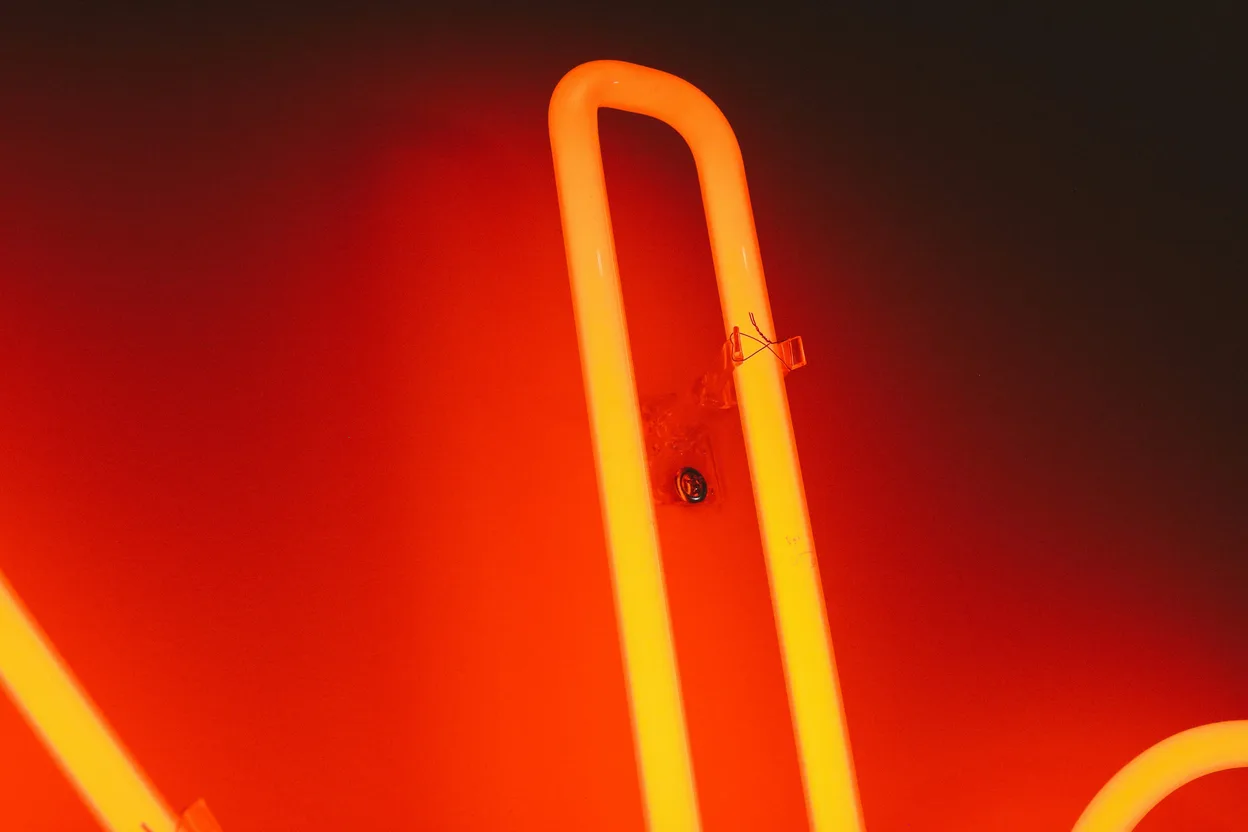
12V LED neon flex is a soft silicone tube that holds high-density LEDs, powered by 12-volt direct current. The light no longer comes from high-voltage gas like glass neon. It comes from diodes that create an even glow. The silicone tube spreads that light evenly, so you get a true neon look without the old constraints.
The “12V” label is the operating voltage, not a brand or a size. In other words, it is the technical core of the product. That low voltage puts the sign in the extra-low voltage safety class, which is why install stays low risk. We break down the tube tech on our flexible LED neon page, with full detail on monoline silicone.
- Soft silicone tube: holds the LEDs and spreads light evenly
- 12V power: low-voltage DC, safe to touch
- Adapter included: plugs into a standard household socket
- Even glow: no visible hot spots, authentic neon look
Why is 12V LED neon flex safer than gas neon?
12V LED neon flex is safer than gas neon because it runs on extra-low voltage, with no gas and almost no heat. A traditional glass neon tube climbs to 5000 or even 15000 volts to excite the gas, while 12V stays under the threshold that is hazardous to the human body. Extra-low voltage is treated as non-hazardous to touch under normal conditions, as noted in documentation on extra-low voltage and in are neon signs dangerous? Safety truth in 2026.
Safety does not stop at electricity. A 12V LED neon flex sign does not get hot, stays cool to the touch, and holds no gas or mercury. So it fits kids’ rooms, homes with pets, and public spaces. That is also why we cover it in our glass neon vs LED neon comparison, where the safety gap is obvious.
- Extra-low voltage: 12V vs 5000 to 15000V for gas neon
- No heat: the tube stays cool, so zero burn risk
- No gas or mercury: safer around kids and pets
- Unbreakable silicone: no glass shards if it takes a hit

How does 12V LED neon flex power supply work?
Power for a 12V LED neon flex sign comes from an adapter that converts 120V from a household socket into 12V DC. That transformer, included with every Helioneon sign, does the hard work: you plug in, and the sign lights up. It is what keeps the whole setup safe, so you never need to open a breaker panel or call a pro.
Adapter output must cover the sign’s draw with a safety margin. The longer the sign, the more power it needs, which is why we size the supply to your format before it ships. You do not run any math. For more complex setups, our LED neon sign installation guide walks through each hookup step.
- Transformer role: convert 120V from the socket into 12V DC
- Adapter included: sized to your neon format before shipping
- Safety margin: output always exceeds real consumption
- Direct plug-in: standard socket, no electrical work

How do you install and wire 12V LED neon flex yourself?
Installing 12V LED neon flex takes a few minutes on your own, because low voltage removes any need for an electrician. You mount the acrylic backing on the wall with the included kit, connect the sign to its adapter, then plug into a socket. No special skills required, so anyone can do it.
The one detail to plan is the cable path to the socket. Place the sign within reach of a receptacle, or use a discreet extension cord. Measure before you drill. For placement ideas by room and wall type, our wall decor ideas that work guide covers practical setups from plasterboard to tile.
- Mount the backing: screws and anchors included in the install kit
- Connect the adapter: join the sign to its 12V transformer
- Plug into a socket: no work on the electrical system
- Plan the cable: keep the sign near a socket or use an extension
12V LED neon flex, 24V or 120V: which should you pick?
For indoor decor, 12V LED neon flex is still the best pick, because it balances safety and simplicity. 24V is mainly for very long runs to limit voltage drop, while direct 120V targets specific pro installs. Here is a clear chart so you can match each voltage to the right use.
| Voltage | Touch safety | Transformer | Best use |
|---|---|---|---|
| 12V | Extra-low voltage, safe | Adapter included | Indoor decor neon, gifts, bedrooms |
| 24V | Extra-low voltage, safe | Higher-output adapter | Very long runs, large signs |
| 120V | Mains voltage, real hazard | Pro install required | Specific industrial cases |
| Gas neon | 5000 to 15000V, high hazard | High-voltage transformer | Traditional glass neon |
In short, 12V covers almost every decor and custom neon. 24V steps in when length gets extreme, and direct 120V stays reserved for narrow technical cases. For a home sign, a gift, or a small business piece, 12V LED neon flex is the default.

What is the real power draw of 12V LED neon flex?
Power use for 12V LED neon flex is very low, on the order of a few dollars of electricity per year with daily use. An LED neon sign can use up to 80% less energy than a gas neon of similar size, because LEDs turn energy into light instead of wasting it as heat. That is one of the big cost arguments for 12V versus glass.
Over time, the bill stays light. Even lit for several hours every evening, a decor neon barely moves your statement. The real savings lever is lifespan, which we cover in our guide to LED neon sign power consumption. A durable 12V sign costs less than a cheap model you replace every year.
- Low wattage: only a few watts for a standard decor neon
- Up to 80% savings versus equivalent gas neon
- Tiny yearly cost: a few dollars of electricity per year
- Lifespan: 100,000 hours, more than 11 years of continuous use, with no replacement

What if a 12V LED neon flex sign will not light up?
If a 12V LED neon flex sign stays dark, the cause is almost always the supply or a connection, rarely the tube itself. Start by checking that the adapter is plugged in and that the socket works. A loose transformer or a switched socket explains most “dead” signs. Work by elimination before you assume a defect.
If it still fails, check the connector between the sign and the adapter, then try another socket. Isolate each link in the chain. When nothing helps, support takes over: every Helioneon sign includes a 3-year warranty and free diagnostics. If you are unsure, reach our team through the contact form for a free neon quote.
- Check the socket: test another device to confirm it works
- Check the adapter: firm connection and indicator on if it has one
- Inspect the connector: between the sign and its transformer
- Contact support: free diagnostics and 3-year warranty if there is a defect
Frequently asked questions about 12V LED neon flex
Is 12V LED neon flex dangerous to touch?
No, 12V LED neon flex is not dangerous to touch under normal use. It runs on extra-low voltage, well below the threshold treated as risky for the human body, unlike glass neon that climbs to 5000 or 15000 volts. That is exactly why you can install it yourself without an electrician. The tube also stays cool to the touch, so there is no burn risk. That dual safety, electrical and thermal, is why 12V LED neon flex fits kids’ rooms and homes with pets. Just keep the adapter and the 120V cable out of reach of young children.
Which power supply should you choose for 12V LED neon flex?
For 12V LED neon flex, pick the supply by the sign’s wattage, with about a 20% safety margin. At Helioneon you do not calculate anything: the 12V adapter is included and sized to your sign format. A longer sign needs more power, so the unit that ships always matches your order. If you replace a lost adapter, choose a UL-listed 12V model whose output exceeds the sign’s draw. Skip uncertified low-end transformers, which can overheat. If you are unsure, support can give you the exact rating for your sign.
How much does 12V LED neon flex cost to run per year?
A 12V LED neon flex sign usually costs a few dollars in electricity per year with several hours of daily use. Its draw is measured in watts, not tens of watts, so the bill impact stays tiny. An LED neon can use up to 80% less energy than a gas neon of similar size, because LEDs waste almost no energy as heat. The real savings line is not the already-low draw, but lifespan: with 100,000 hours on the clock, the sign does not need replacing for more than 11 years, even if left on continuously. A durable model costs far less than a cheap neon you buy again every year.
Do you need an electrician to install 12V LED neon flex?
No, you do not need an electrician to install 12V LED neon flex. Install means mounting the acrylic backing with the included kit, connecting the sign to its adapter, then plugging into a standard household socket. Extra-low voltage removes any need to touch the building wiring, so the job stays open to everyone. The only planning point is the cable path to a socket, which you should map before you drill. For trickier walls like tile or plasterboard, our installation guide covers the right hardware. In a few minutes, the sign is up and running.
What length of LED neon can 12V power?
On 12V you can power the large majority of decor and custom neons, including common lengths up to several metres (several feet and beyond). Past a certain run length, voltage drop can show up, which is why very large signs sometimes move to 24V for stable output. 24V limits that loss on long runs. At Helioneon we match voltage and supply to the format you order, so you get even light from end to end. For a home sign, a gift, or a small business piece, 12V covers every need. Out-of-range formats get a custom power plan.
Does 12V LED neon flex get hot like gas neon?
No, 12V LED neon flex does not heat up like gas neon. It stays cool or only slightly warm to the touch. LEDs make light with very little thermal loss, unlike gas neon that runs hot and glass that can burn. That lack of heat removes burn risk and sharply cuts fire risk. So a 12V LED neon flex sign can stay on for hours without worry, even near fabrics or in a bedroom. That is one reason it replaced gas neon in interior decor. The silicone tube does not warp from that tiny residual warmth.
In short, 12V LED neon flex brings safety, low running cost, and simple install into one product. To configure yours with a supply already matched to the design, start your project on our contact page for a free neon quote and get a free 3D mockup within 24 hours.
Your custom neon, designed for free in 24 h
- Describe your ideaA text, a logo or a simple sketch. It takes one minute.
- Get your mockup and priceWithin 24 h by email, no commitment.
- Approve, we make itFree express delivery in 7 to 10 days, set up in 3 minutes.
- Mockup and price within 24 h, no commitment
- Free express delivery, received in 7 to 10 days
- 3-year warranty, set up in 3 minutes
Get your free mockup

Guillaume Schlupp
Founder of Helioneon
Over 10 years of entrepreneurship in premium interior design. 500+ LED neons delivered across 13 countries under Helioneon and Light Genius. Leads product strategy, design and professional accounts.