Wall sconce height: how high to install a sconce, room by room

- Wall sconce height is typically 63 to 71 inches from the floor in living rooms and hallways. Mount reading sconces 43 to 51 inches above the floor by a bed, and bathroom sconces 71 to 79 inches above a mirror.
- You get a room-by-room height table, neon placement rules, mistakes to avoid, and clear FAQ answers.
The right wall sconce height is usually between 63 and 71 inches (1.60 to 1.80 m) from the floor in a living room or hallway, just above eye level, so the light washes the wall without glare. Above a bed, drop toward 43 to 51 inches (1.10 to 1.30 m) from the floor; above a mirror, rise toward 71 to 79 inches (1.80 to 2 m). At Helioneon, the same logic guides the placement of every custom neon sign on the wall.
These wall sconce height benchmarks are not mandatory codes. They are decorator and electrician conventions that flex with ceiling height, fixture design, and how the room is used. With more than 500 neons delivered, we have seen how a few inches change the look of a wall. Here are the recommended heights room by room, the mistakes to avoid, and the rules to respect in the bathroom.
What is the standard wall sconce height?
The standard wall sconce height is about 67 inches (1.70 m) from the floor, measured at the centre of the fixture or at the wire exit point, which puts the light source just above the eyes of a standing person. That height lights the wall and the room without putting the bulb in your direct line of sight.
The goal is twofold: avoid glare when you look straight at the light source, and put light where it is useful. A sconce that sits too low blinds people who are standing; a sconce that sits too high mostly lights the ceiling and leaves the lower wall in shadow.
- General benchmark: 63 to 71 inches (1.60 to 1.80 m) from the floor in living areas
- Low ceiling: under about 7 ft 10 in (2.40 m), stay near 63 inches (1.60 m)
- High ceiling: above about 8 ft 10 in (2.70 m), rise toward 71 to 79 inches (1.80 to 2 m)
- Measurement: take the height at the centre of the sconce, not at the backplate
For a run of sconces on the same wall, alignment matters as much as height. Keep every fixture at the same height and space them evenly, often 5 to 8 feet (1.50 to 2.50 m) apart depending on output and the effect you want.
If you are torn between two heights, pick the higher one in a circulation space and the lower one in a room where people sit, because the eye line drops when you are seated. When the ceiling is very high, as in a loft or older apartment, a sconce set too low looks stranded; in a small studio, a sconce set too high can make the room feel crushed. The best habit is to view the room from the spot where you spend the most time, then fine-tune by a few inches. And if the wall will hold art or a mirror, align the sconce with the top edge for a cleaner composition.
Wall sconce height by room: summary table
Each room has its own ideal wall sconce height, depending on whether you want to read, do makeup, walk through, or set a mood. The table below sums up the most common benchmarks, to adjust for your ceiling height and the fixture you choose.
| Location | Recommended height | Goal |
|---|---|---|
| Helioneon LED neon on the wall | Centre between 59 and 67 inches (1.50 and 1.70 m) | Decor and ambiance, at eye level |
| Living room, family room | 63 to 71 inches (1.60 to 1.80 m) | Ambiance, light on the wall |
| Hallway, entry | 67 to 75 inches (1.70 to 1.90 m) | Circulation without glare |
| Bedroom, reading light | 43 to 51 inches (1.10 to 1.30 m) | Reading in bed |
| Bathroom, above the mirror | 71 to 79 inches (1.80 to 2 m) | Face lit without shadow |
| Stairway | 71 to 79 inches (1.80 to 2 m) above the steps | Safety and comfort |
| Exterior, beside the door | 67 to 79 inches (1.70 to 2 m) | Light the entry and the lock |
On a stairway, measure from the nosing of the step under the sconce, not from the ground-floor slab. At a front door, the sconce is often set at the top of the door, or slightly above, on the lock side.
- Reading: low, adjustable source close to the shoulder
- Seeing yourself: source at or above face level
- Circulation: source high enough not to get in the way
- Decor: source at eye level, where the gaze naturally lands
How high to install a sconce above a bed?
Above a bed, a reading sconce is usually set between 43 and 51 inches (1.10 and 1.30 m) from the floor, or about 16 to 24 inches (40 to 60 cm) above the mattress. It should light the book without blinding the person next to you, and stay reachable from the pillow so you can switch it off easily.
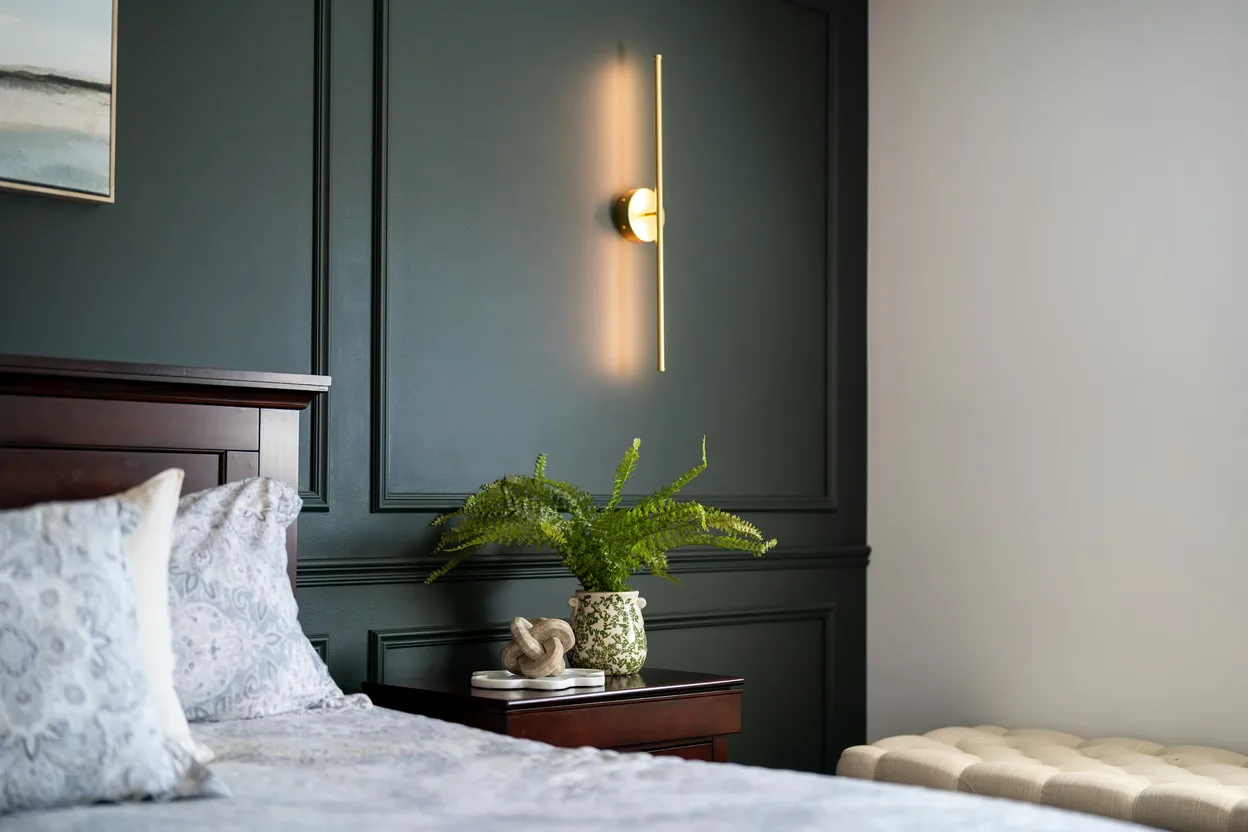
Wall sconce height then depends on the bed and the headboard. With a low bed, drop toward 43 inches (1.10 m); with a tall platform or a thick headboard, rise toward 51 inches (1.30 m). Laterally, centre the sconce on the nightstand, or shift it slightly inward to aim at the reading zone.
- Reading sconce: adjustable arm, beam aimed downward
- Ambient sconce: higher, around 59 to 67 inches (1.50 to 1.70 m), for soft light
- Switch: built in or within reach from the bed
- Colour temperature: warm white, around 2700 K, to support winding down
For ambient light above the headboard, a neon or light strip set higher creates a soft halo on the wall. That is a form of indirect lighting, and it pairs well with two side reading sconces. An LED neon stays cool to the touch and runs on 12V, which makes it a good fit for a bedroom.
What height for a bathroom sconce?
In the bathroom, a sconce is usually placed above the mirror, around 71 to 79 inches (1.80 to 2 m) from the floor, or on each side of the mirror at face height, around 59 to 67 inches (1.50 to 1.70 m). Side lighting cuts shadows under the eyes and chin, which is ideal for shaving or makeup.
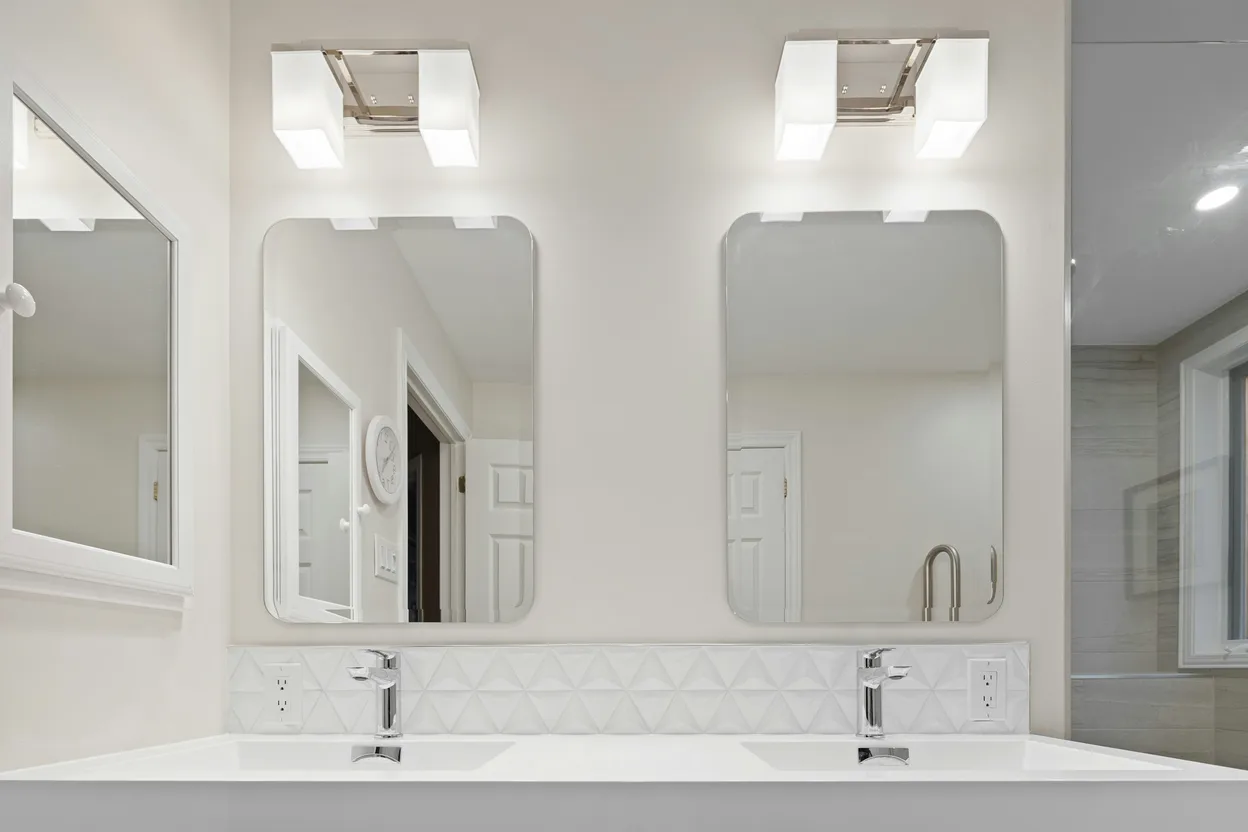
The bathroom also brings safety rules. In the UK, BS 7671 (the IET Wiring Regulations) divides the bathroom into zones 0, 1 and 2; in the United States the National Electrical Code has no zones but requires fixtures listed for damp or wet locations near a tub or shower. In practice, a sconce close to a shower must be protected against water spray. The zone heights below follow British and European rules and are a useful reference for clearances around the tub and shower.
- Zone 0: inside the tub or shower tray, extra-low voltage only
- Zone 1: above the tub or shower, up to 2.25 m (about 7 ft 5 in) in height
- Zone 2: a 60 cm (about 2 ft) band around zone 1
- Outside the zones: the rest of the room, with less strict rules
Have an electrician confirm the protections and wet or damp ratings that fit your layout. Our article on bathroom neon signs covers the precautions for decorative lighting in this wet room.
Wall sconce height in the living room, hallway, or stairway
In the living room, set sconces around 63 to 71 inches (1.60 to 1.80 m) to light the wall and build ambiance; in a hallway, around 67 to 75 inches (1.70 to 1.90 m) so they stay out of the way; on a stairway, around 71 to 79 inches (1.80 to 2 m) above the steps, spaced so no tread is left in shadow.
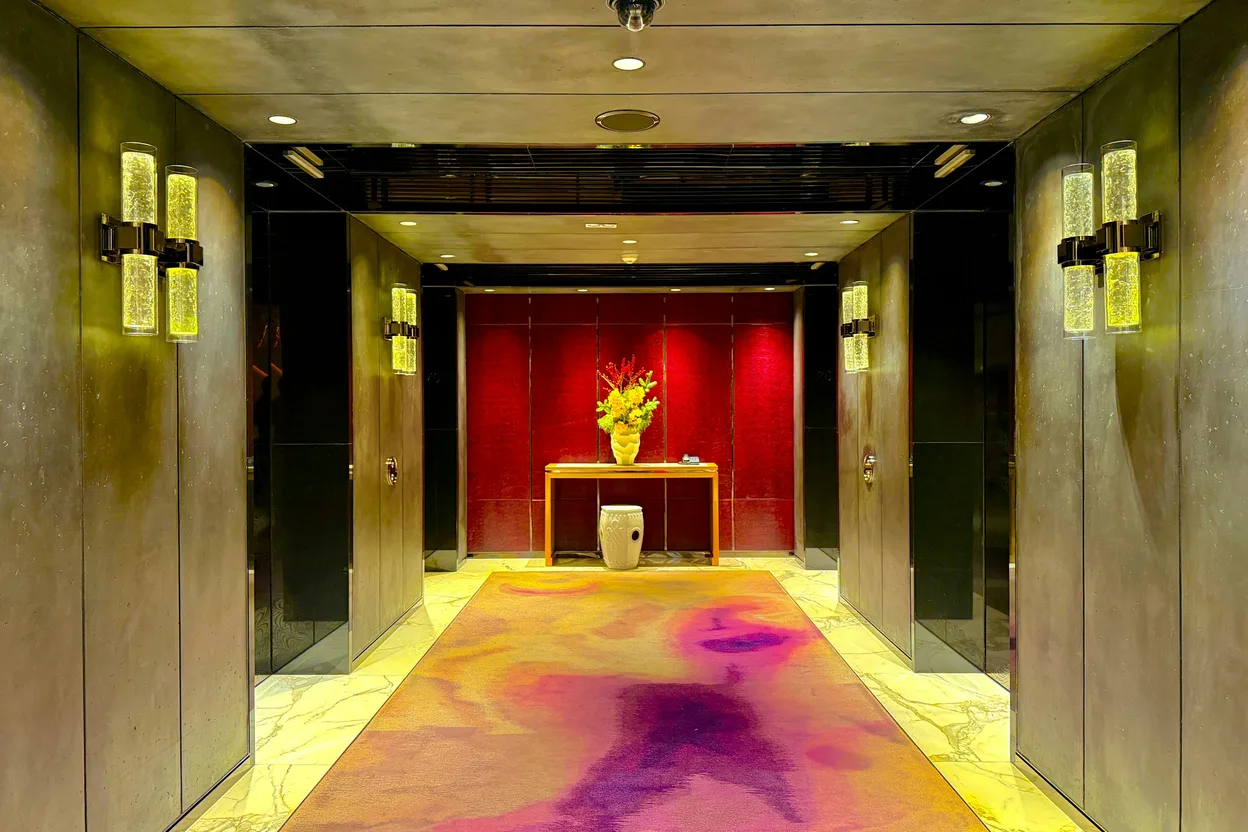
In the living room, the sconce is mainly about mood. It backs up a ceiling fixture or table lamps and highlights art, a bookcase, or a textured wall. Our guide to living room ambient lighting explains how to layer several sources so dark corners disappear.
- Living room: two sconces on either side of a sofa or fireplace
- Narrow hallway: flat sconces that project little from the wall
- Long hallway: one sconce about every 6.5 to 10 feet (2 to 3 m)
- Stairway: sconces on the uphill side, following the slope
In a hallway under about 39 inches (1 m) wide, choose models that project less than 4 inches (10 cm) from the wall so you do not bump into them. Sconces that throw light up and down visually stretch the space.
How high to place a decorative neon on the wall?
A decorative neon is usually centred between 59 and 67 inches (1.50 and 1.70 m) from the floor, at eye level, like a piece of art. Above furniture such as a sofa, console, or headboard, leave about 8 to 12 inches (20 to 30 cm) between the top of the furniture and the bottom of the neon.
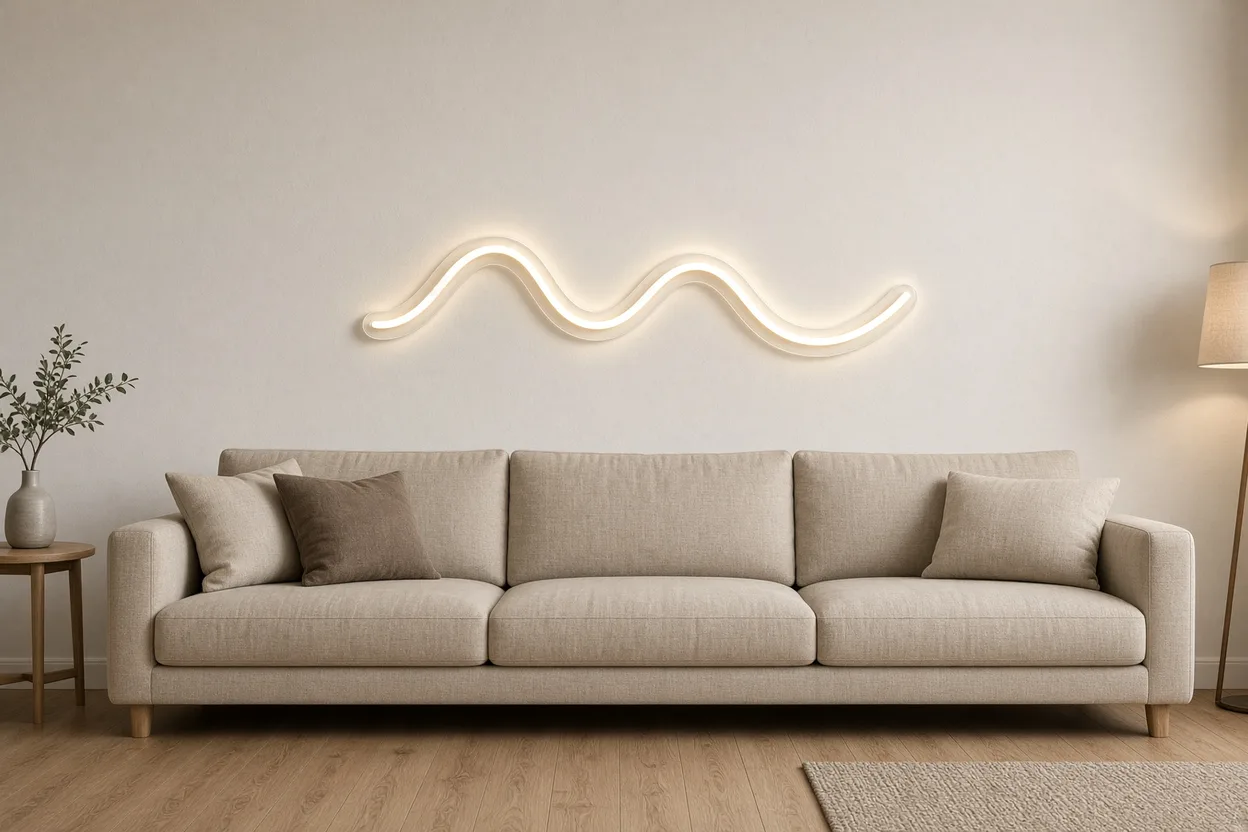
Unlike wall sconce height, which aims to light the room, neon height serves another goal: it is not meant to illuminate the space but to catch the eye and set a mood. It can therefore sit lower than a classic sconce. Size matters too: as a rule of thumb, it spans about one third to one half the width of the wall or the furniture below it. Our guide on how to install a LED neon sign covers mounting by wall type.
- Above a sofa: 8 to 12 inches (20 to 30 cm) above the backrest
- Above a bed: 12 to 16 inches (30 to 40 cm) above the headboard
- Behind a counter: visible from the entry, often between 71 and 87 inches (1.80 and 2.20 m)
- Photo corner: centre near 63 inches (1.60 m), so it sits behind faces
A Helioneon LED neon draws about 8 to 15 W per metre and plugs into a standard outlet through its transformer, with a cable often about 5 feet (1.5 m) long. Plan the outlet location before you lock in the height, or allow for a discreet raceway for the cord.
Mistakes to avoid when mounting a sconce
On wall sconce height, the most common mistakes are mounting too low (which causes glare), ignoring the furniture that will sit below, forgetting alignment with other light sources, and choosing light that is too cool for a rest space.
- Too low: the bulb enters the field of view and causes glare
- Too high: light goes to the ceiling and the wall stays dark
- Poor alignment: sconces at different heights on the same wall
- Misplaced wire exit: check before drilling for a new lighting point
Before you drill, run a quick test: mark the height with a pencil or painter’s tape, hold the sconce there, and view it from the sofa, the bed, or the entry. A few minutes of testing save unnecessary holes. For any new lighting point, shut off power at the breaker and call an electrician if you are not sure of the work.
For more guidance on electrical safety around the home, Electrical Safety First’s bathroom safety advice is a useful reference from a leading electrical safety charity.
Frequently asked questions about wall sconce height
What is the ideal wall sconce height?
The ideal wall sconce height is about 63 to 71 inches (1.60 to 1.80 m) from the floor in a living room or hallway, just above the eye line of a standing person. That height lights the wall without glare. Drop toward 43 to 51 inches (1.10 to 1.30 m) for a reading light above a bed, and rise toward 71 to 79 inches (1.80 to 2 m) above a bathroom mirror or on a stairway.
How high should a sconce be above a bed?
A reading sconce above a bed is generally set between 43 and 51 inches (1.10 and 1.30 m) from the floor, or about 16 to 24 inches (40 to 60 cm) above the mattress. It should light the book, stay within reach, and not glare at the person lying next to you. For ambient light rather than reading light, you can place it higher, around 59 to 67 inches (1.50 to 1.70 m).
What height for a sconce above a mirror?
Above a bathroom mirror, a sconce is usually set around 71 to 79 inches (1.80 to 2 m) from the floor, to light the face from above. For more flattering light without shadows under the eyes, you can also mount two sconces on either side of the mirror at face height, around 59 to 67 inches (1.50 to 1.70 m). Respect bathroom safety zones under BS 7671 in the UK, and in the United States use fixtures listed for damp or wet locations near a tub or shower.
Is there a code for wall sconce height?
No, there is no legally required mounting height for a wall sconce in a home. The heights in this guide are electrician and decorator conventions. Electrical rules do govern the installation itself, especially in the bathroom: BS 7671 in the UK defines zones 0, 1 and 2 around the tub and shower, and in the United States the National Electrical Code requires fixtures listed for damp or wet locations near water, which limits which devices you can use.
How high to place a neon on the wall?
A decorative neon is generally centred between 59 and 67 inches (1.50 and 1.70 m) from the floor, at eye level, like artwork. Above a sofa or console, leave 8 to 12 inches (20 to 30 cm) between the furniture and the bottom of the neon; above a bed, 12 to 16 inches (30 to 40 cm) above the headboard. Also check the outlet location before you fix the neon in place.
Choosing the right wall sconce height comes down to a simple question: what is the light for, and from where will you look at it? The benchmarks in this guide cover most situations, adjusted for your ceiling and furniture. For a decorative neon sized and placed in the right spot, send us a photo of your wall through our contact page: the 3D mockup is free within 24 hours.
Your custom neon, designed for free in 24 h
- Describe your ideaA text, a logo or a simple sketch. It takes one minute.
- Get your mockup and priceWithin 24 h by email, no commitment.
- Approve, we make itFree express delivery in 7 to 10 days, set up in 3 minutes.
- Mockup and price within 24 h, no commitment
- Free express delivery, received in 7 to 10 days
- 3-year warranty, set up in 3 minutes
Get your free mockup

Guillaume Schlupp
Founder of Helioneon
Over 10 years of entrepreneurship in premium interior design. 500+ LED neons delivered across 13 countries under Helioneon and Light Genius. Leads product strategy, design and professional accounts.