RGB Neon Sign: Colours, How It Works and Control
- LED neon signs use 8 to 15 watts per metre of lit tube, about 12 W/m on average. A 1 metre sign running 8 hours daily uses about 35 kWh per year, costing roughly $8 at $0.25 per kWh.
- Find a ready-made kWh and cost table, the simple calculation formula, what changes the wattage, and practical ways to lower the bill.
An RGB neon sign is a decorative neon that can display millions of colours, controlled by remote or app. It packs red, green and blue LEDs in one silicone tube, and their mix recreates any shade you want. At Helioneon, this tech is built into every custom neon sign that needs it, and this guide explains how an RGB neon sign works, how you control it and when to choose it.
The RGB neon sign appeals to anyone who wants lighting that can evolve instead of one fixed colour. One sign can shift from pink to blue with the mood, which changes how you use it day to day. With a lifespan of 100,000 hours and more than 500 neon signs delivered, we see real demand for RGB in gaming setups and bedrooms. Here is what sits behind those colours.
What is an RGB neon sign?
An RGB neon sign is a neon where each LED holds three primary colour chips: red (Red), green (Green) and blue (Blue). By varying the intensity of each one, the system rebuilds more than sixteen million shades. In short, RGB names the colour mixing method, not a brand.
That flexibility sets RGB apart from monochrome neon, which puts out one fixed colour. Where a classic model stays pink or blue for life, RGB adapts to mood, season or an event. It becomes a living decor piece rather than a static light.
- R, G, B: three primary colour chips in every LED
- Additive mixing: their blend recreates every colour
- 16 million shades: from warm white to vivid hues
- Control: remote, controller box or mobile app

The Wikipedia page on the RGB colour model describes additive mixing: by varying red, green and blue intensity, you rebuild the full visible spectrum. That is the same principle every RGB neon sign applies inside its silicone tube.
How an RGB neon sign works
An RGB neon sign works through a controller placed between the 12V power supply and the tube, which metres the three colours in real time. When you pick a shade, the controller adjusts power to red, green and blue to match it. That same box also handles brightness and dynamic effects.
Control runs on two wireless technologies. Infrared remotes need a clear line of sight to the receiver, while radio frequency reaches through walls at around 100 feet. Higher end models add an app that turns your phone into the remote. The underlying setup matches any low voltage neon covered in our guide to LED neon sign power consumption.
- Controller: metres red, green and blue to build the colour
- Infrared remote: simple, aim it at the receiver
- Radio frequency: about 100 feet of range, works through obstacles
- Mobile app: advanced control and scheduling from your phone
RGB, RGBW, RGBIC: what are the differences?
Not every RGB neon sign is equal: RGBW and RGBIC variants add pure white and per segment colour addressing. Those technical nuances change the look and the price. The table below spells out what each label actually delivers.
| Technology | What it adds | Best for |
|---|---|---|
| RGB | 16 million colours, one uniform shade at a time | Evolving decor ambiance |
| RGBW | Adds a pure white LED for true white light | Accent lighting and decor |
| RGBIC | Several colours at once on the same tube | Gradient effects and gaming |
In other words, RGB is enough to change the mood, RGBW refines the white, and RGBIC unlocks dramatic gradients. The pick mostly depends on the effect you want and your budget.

How to control colours and effects
Controlling an RGB neon sign means picking a fixed colour or turning on a dynamic mode from the remote or the app. Beyond static shades, the controller offers animations that shift the light on their own. One sign can deliver dozens of different looks.
The most common effects show up on most models. You can also tune those animations for speed and intensity. Some controllers remember your last setup when you power back on, so you do not have to reconfigure everything.
- Static mode: one steady colour from the palette
- Fade mode: soft, gradual transition between shades
- Flash mode: rhythmic blink for parties
- Strobe mode: strobe effect on a single colour
- Brightness control: from dim glow to full output
Who is it for and what uses?
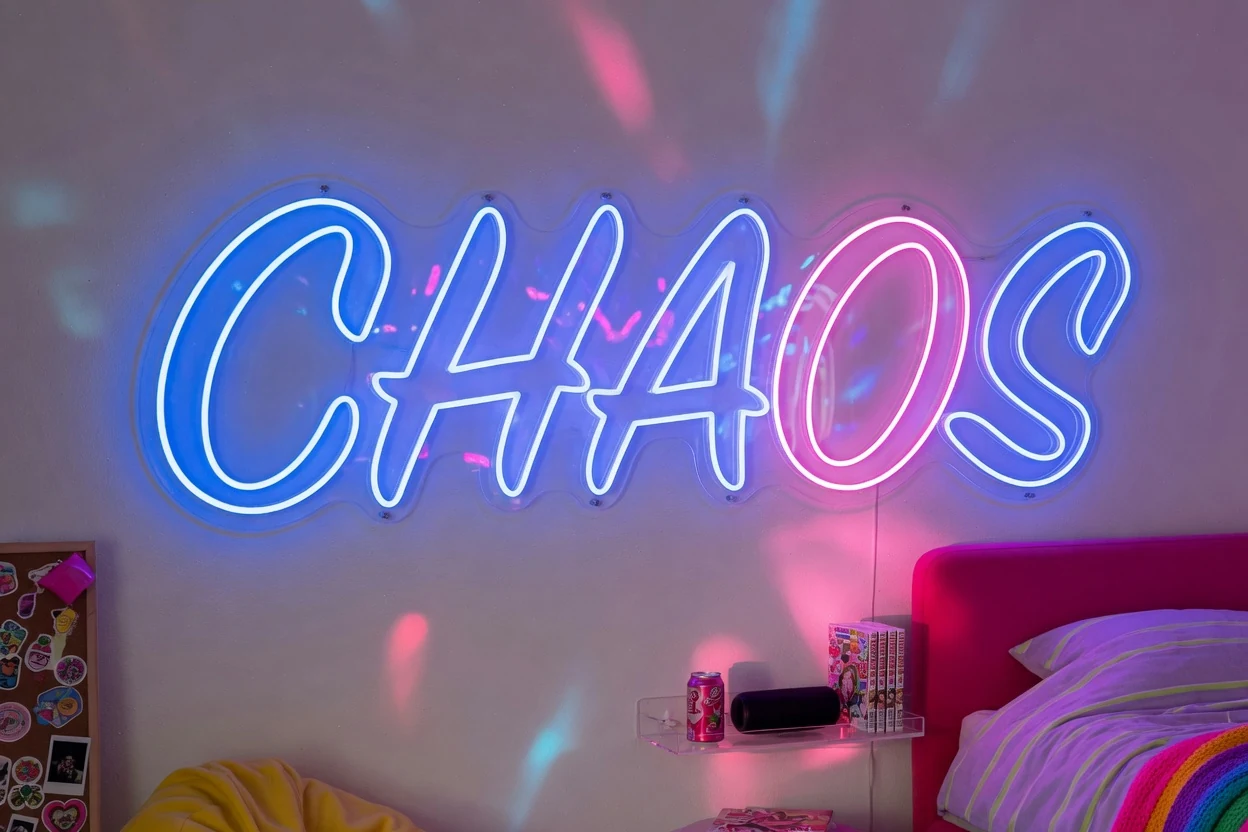
An RGB neon sign is aimed first at people who want flexible decor: gamers, teens, content creators and anyone hosting parties. Being able to change colour in one tap fits those lively spaces. RGB reshapes a room by moment and mood.
The gaming setup is still the flagship use, because RGB can match the rest of the gear. For a calmer bedroom, a fixed warm white can be enough. We cover those moods in our guides to teen bedroom decor ideas and neon colour meaning and psychology.
- Gaming setup: colours synced with the game vibe
- Teen bedroom: personalization that follows changing tastes
- Parties and events: dynamic modes that set the pace
- Content creation: modular coloured backdrops for video
RGB neon sign or monochrome: which to choose?
Choosing between an RGB neon sign and a monochrome neon comes down to a simple tradeoff between versatility and colour purity. RGB gives you every shade but a less crisp white, while monochrome locks in one calibrated colour that often looks more intense. RGB also costs a bit more because of the controller.
Our field advice is practical. For brand lettering or a logo with a signature colour, monochrome still wins on sharpness. For personal decor that needs to evolve, RGB is the clear pick. The real question is the use case, not the tech itself.
- Choose RGB: when you want to vary mood and colours
- Choose monochrome: for a precise brand colour and pure white
- Budget: RGB adds the cost of the controller and remote
- Install: the same 12V plug and play setup either way
Frequently asked questions about RGB LED neon
How does an RGB neon sign work?
An RGB neon sign works with LEDs that each hold three colour chips: red, green and blue. A controller between the 12V power supply and the tube metres each chip to rebuild more than sixteen million shades. You pick the colour or an effect with an infrared remote, a radio remote or a mobile app. The controller then adjusts the light in real time. That built in electronics is what sets RGB apart from monochrome neon, which outputs one fixed colour for its full lifespan.
Can you get a true white with an RGB neon?
A classic RGB neon builds white by mixing red, green and blue, but that white is slightly less pure than a dedicated white LED. For a clean, warm white, choose an RGBW model, which adds a separate white chip. RGBW then combines full colour range with genuine white light quality. If white is your top priority, a warm white monochrome neon remains the benchmark for sharpness and brightness.
How do you change the colour on an RGB LED neon?
You change the colour on an RGB LED neon from the included remote or a mobile app. Select a shade in the palette, tweak brightness, or turn on a dynamic mode such as fade or flash. An infrared remote needs line of sight to the receiver, while a radio frequency model works through walls at around 100 feet. More advanced controllers store your last setting when you power back on, so you do not have to set the colour again every time.
Does an RGB neon use more power than a standard neon?
An RGB LED neon draws slightly more than an equivalent monochrome, because it powers three chips plus a controller, but the gap is small. You are talking a few extra watts, with no real impact on the bill. Consumption depends mainly on sign size, chosen brightness and how long it stays on. Like any LED neon, RGB stays very efficient next to glass tube neon. Dim the intensity and you cut daily use even further.
Is an RGB LED neon a good fit for a bedroom?
Yes, an RGB LED neon works very well in a bedroom, especially for a teen or any space that needs to change. You can go from bright colour to a soft glow depending on the time of day. Set on warm white or a gentle tone at night, it builds a calm atmosphere for rest. Its 12V low voltage and lack of heat make it safe to leave on. It is a strong way to personalize a room without locking it into one look.
The RGB neon sign opens a level of personalization monochrome cannot match, as long as you match it to the right use. To design yours with the right controller and technology, start your project on our contact page for a free neon sign quote and get a free 3D mockup within 24 hours.
Your custom neon, designed for free in 24 h
- Describe your ideaA text, a logo or a simple sketch. It takes one minute.
- Get your mockup and priceWithin 24 h by email, no commitment.
- Approve, we make itFree express delivery in 7 to 10 days, set up in 3 minutes.
- Mockup and price within 24 h, no commitment
- Free express delivery, received in 7 to 10 days
- 3-year warranty, set up in 3 minutes
Get your free mockup

Guillaume Schlupp
Founder of Helioneon
Over 10 years of entrepreneurship in premium interior design. 500+ LED neons delivered across 13 countries under Helioneon and Light Genius. Leads product strategy, design and professional accounts.