How to choose a neon sign: the all-in-one Australia 2026 guide
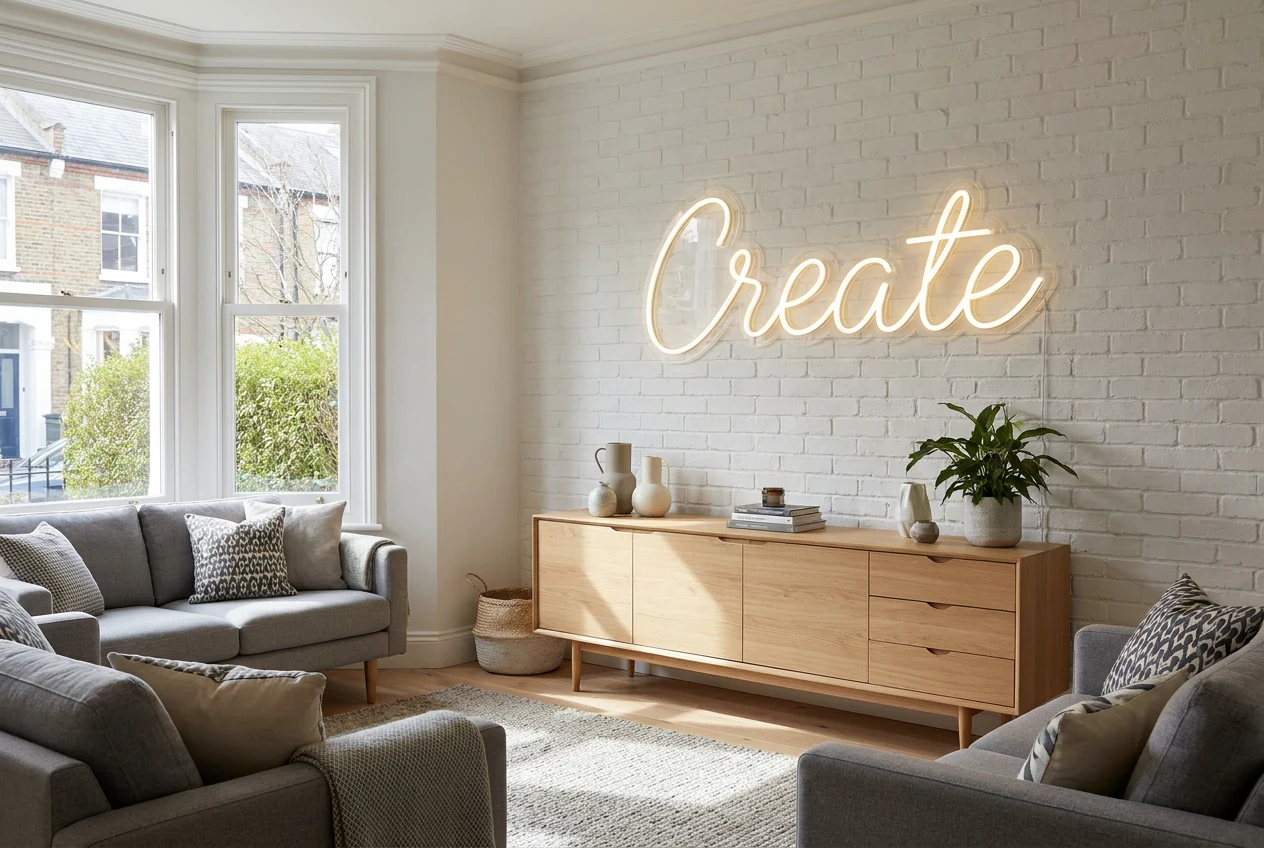
- Choose a neon sign by locking five decisions in order: size, placement, font, colour, then 12 V voltage and IP rating. That sequence yields a sign that reads cleanly, photographs well and plugs into a standard Australian power point.
- You get a size calculator, an 18-shade palette, six font families and placement rules for Australian homes and shops.
Choosing a neon sign comes down to five decisions made in the right order: colour, size, font, placement and voltage. Get those right and you end up with a sign that photographs beautifully, reads cleanly from across the room and runs safely for decades on a standard Australian power point.
According to industry data compiled by IBISWorld in 2025, the US custom signage market grew by 16 % year on year, with LED neon now accounting for more than 8 pieces out of 10 sold for hospitality, retail and home decor. The RCM (Regulatory Compliance Mark) is the product safety marking for electrical products in Australia, and it is the reference point for every flexible LED neon sign sold in 2026.
This is the only all-in-one Australia guide that covers colour, size, font, placement and voltage in a single article, with an integrated size calculator, an 18-colour palette walkthrough and a font selection table. To start your custom neon sign in Australia with Helioneon, you only need a clear brief on these five points, and this guide gives you the framework to nail every one of them before placing an order.
How to choose a neon sign: the 5-decision framework
Most buyers approach a neon sign purchase the wrong way round. They start with colour or font, then realise three days later that the dimensions are wrong, the wall is too small or the brightness is overkill for a bedroom. The correct sequence is size first, then placement, then font, then colour, then voltage and IP rating. Each decision narrows the next, and following the order in writing saves about 70 % of the back-and-forth we see on Australian quotes.
To choose a neon sign that actually works in your space, treat the process as a five-question funnel rather than a Pinterest moodboard. The questions are: how big should it be, where will it sit, which font carries the message, which colour matches the wall and the brand, and what voltage and IP rating does the installation need. Answer them in that order and the final piece practically designs itself.
- Step 1: measure the wall and decide the longest comfortable dimension.
- Step 2: mark the centre line and check the nearest wall power point.
- Step 3: pick a font that matches the tone, script for warmth, sans-serif for impact.
- Step 4: select a colour that holds contrast against the wall by day and night.
- Step 5: confirm voltage (12 V indoor standard) and IP rating (IP20 indoor, IP65 outdoor).
The framework holds across hospitality and retail, weddings and home decor, because the underlying physics of LED flex tubing does not change. Whether you are picking a 60 cm wordmark for a Chicago bedroom or a 1.8 m logo for a New York hotel reception, the same five questions return the right answer, in the same order.
Choosing the right neon sign size: the distance-divided-by-ten rule
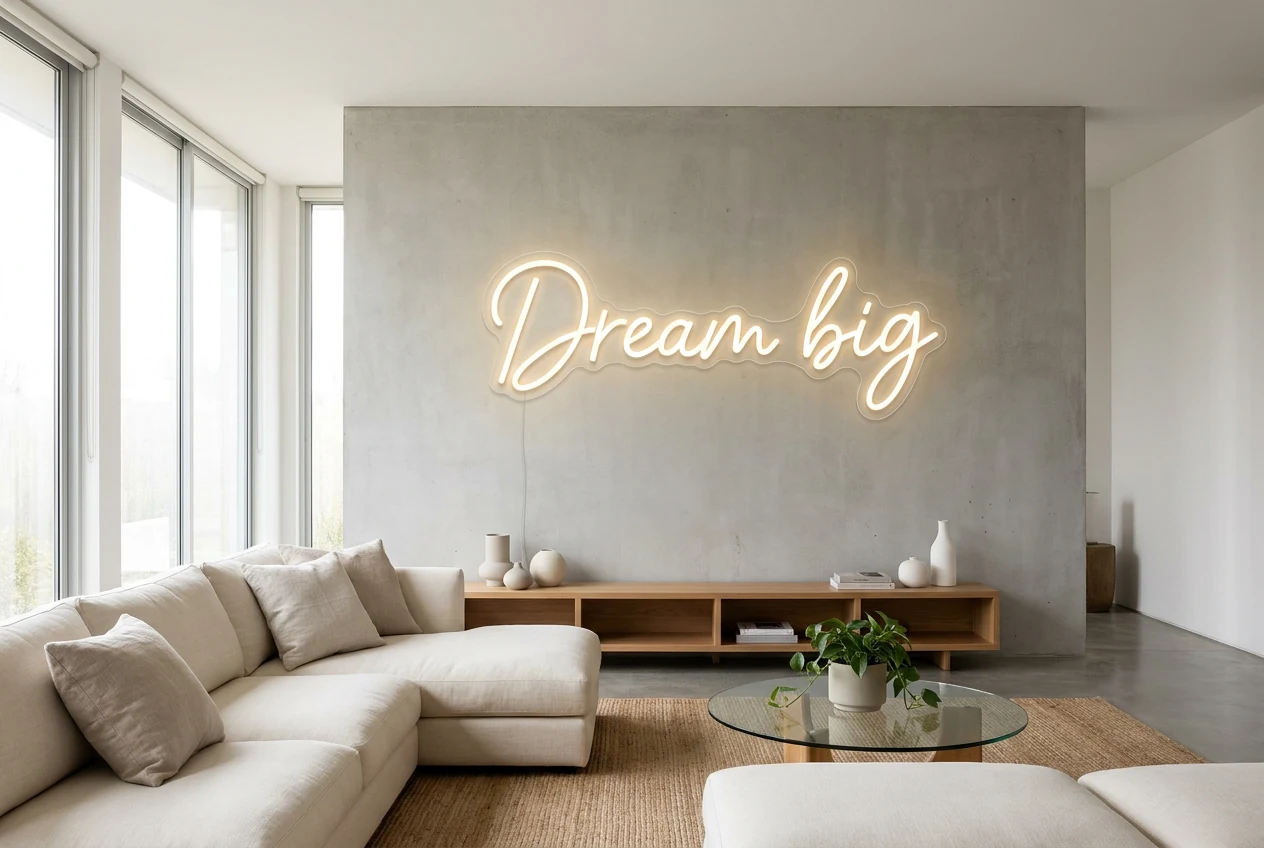
Size is the single most common mistake when you choose a neon sign for an Australian interior. Customers either pick the smallest option to save money and end up with a piece that disappears against a 3-metre feature wall, or they over-size and dominate the room. The fix is a simple formula used by signage designers since the 1970s: minimum letter height in centimetres equals viewing distance in metres, divided by ten, multiplied by ten. In plain English, every metre of viewing distance needs roughly 10 cm of capital letter height to read comfortably, a principle refined across the history of neon signs from 1898 to LED.
So a sign read from 3 metres away wants letters around 8 to 10 cm tall, which translates to a total panel width of 60 to 80 cm for a typical wordmark. A sign read from 6 metres, say across a restaurant floor, needs 18 to 20 cm letters and lands at 1.2 to 1.4 m wide. For a shopfront read from across a Houston main street at 12 metres, you are looking at 25 cm letters minimum and a panel close to 2 metres. The math is boring, but it removes guesswork.
- Bedroom or small lounge (2-3 m viewing) : 40-60 cm panel, 8 cm letters.
- Living room or open-plan kitchen (3-5 m) : 60-100 cm panel, 10-15 cm letters.
- Bar back wall or boutique shopfront (5-8 m) : 1-1.4 m panel, 18-22 cm letters.
- Hotel reception or showroom (8-12 m) : 1.4-2 m panel, 22-30 cm letters.
- Exterior shopfront from the footpath (12-20 m) : 2 m+ panel, 30 cm+ letters.
Across our 500+ delivered Helioneon projects, we see roughly 65 % of Australian orders fall between 60 cm and 1.2 m, because most domestic and small commercial spaces sit in the 3 to 6 metre viewing range. Therefore, when in doubt, default to 80 cm for a home and 1.2 m for a commercial install, and adjust from there. The 24-hour free 3D mockup at Helioneon shows the final dimensions against a reference object before any production starts.
How to choose a neon sign colour: the 18-shade palette and contrast rule
Colour is the most emotional decision when you choose a neon sign, but it follows two technical rules that override personal taste. First, the colour must hold contrast against the wall both during the day (sign switched off, you see the silicone tube colour) and at night (sign switched on, you see the lit halo). Second, certain colours physically draw more power than others, with cool white pulling around 14 W/m versus 10 W/m for warm pinks and oranges.
The Helioneon signature colour palette covers 18 standard shades, grouped into five families: whites (cool, warm, ice), pinks (hot pink, baby pink, coral), reds (cherry, ruby), oranges and yellows (amber, sunshine, peach), blues and greens (royal, turquoise, mint, lime, emerald) and purples (lavender, violet). Every shade is colour-matched against a real-life Pantone reference and rendered in the 3D mockup before production. The rendering shows the sign on both a light and a dark wall, so you see exactly how the contrast lands in your space.
- White walls: hot pink, royal blue, cherry red, emerald green, deep purple all pop beautifully.
- Dark walls (navy, charcoal, oxblood) : warm white, amber, baby pink, mint, lavender for soft contrast.
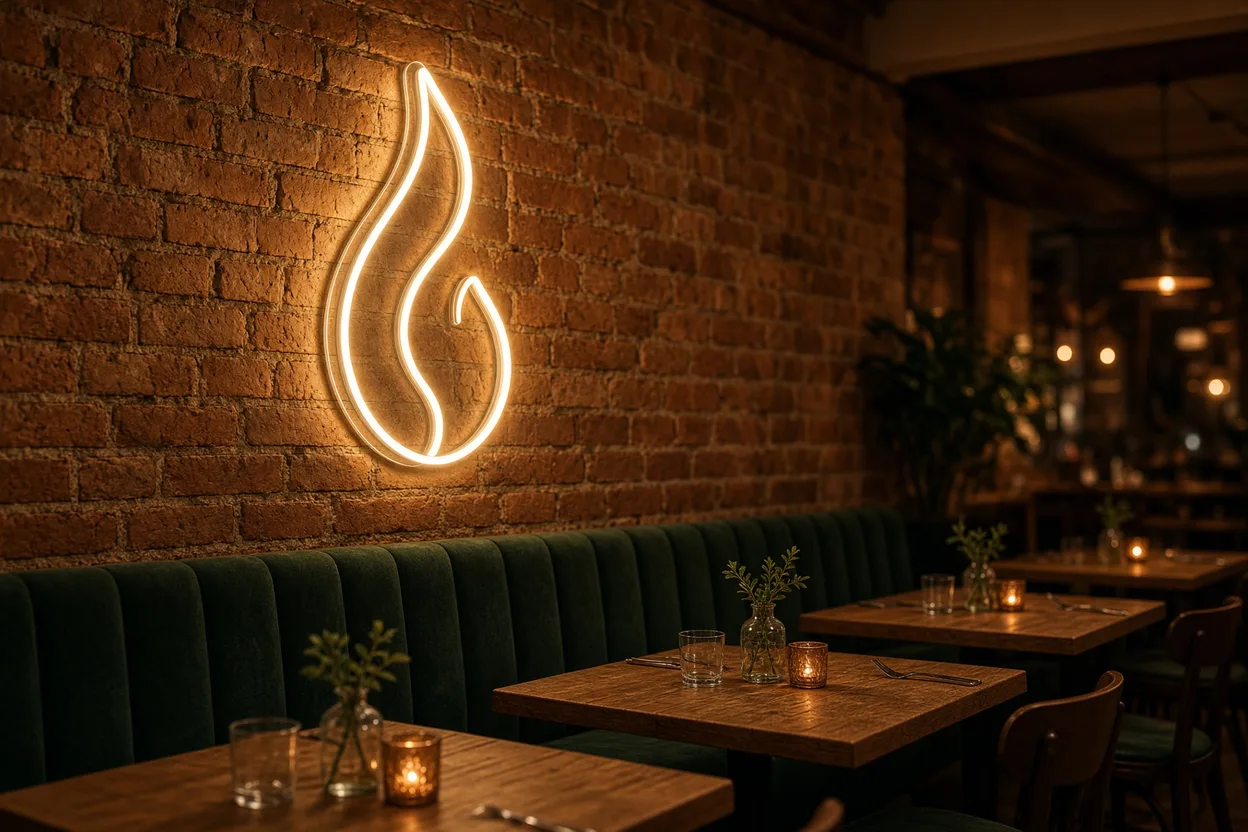
- Exposed brick: warm white, amber, turquoise, cherry red carry the texture without clashing.
- Marble or stone: cool white, ice white, royal blue stay elegant and on-brand for hospitality.
- Wood panelling: warm white, amber, coral pink for a vintage tavern feel.
A second technical detail catches many Australian buyers off guard. Daylight kills weak colours. A pastel mint or baby pink that looks gorgeous in an evening photograph almost vanishes against a sunlit white wall at 11am. Therefore, if the sign is in a south-facing room with strong daylight, default to saturated colours (hot pink, cherry red, royal blue) or specify a higher LED density to push the brightness up. Conversely, in a north-facing or evening-only space, soft pastels and warm whites deliver the cinematic look people expect.
Picking the right font: 6 typeface families with real use cases
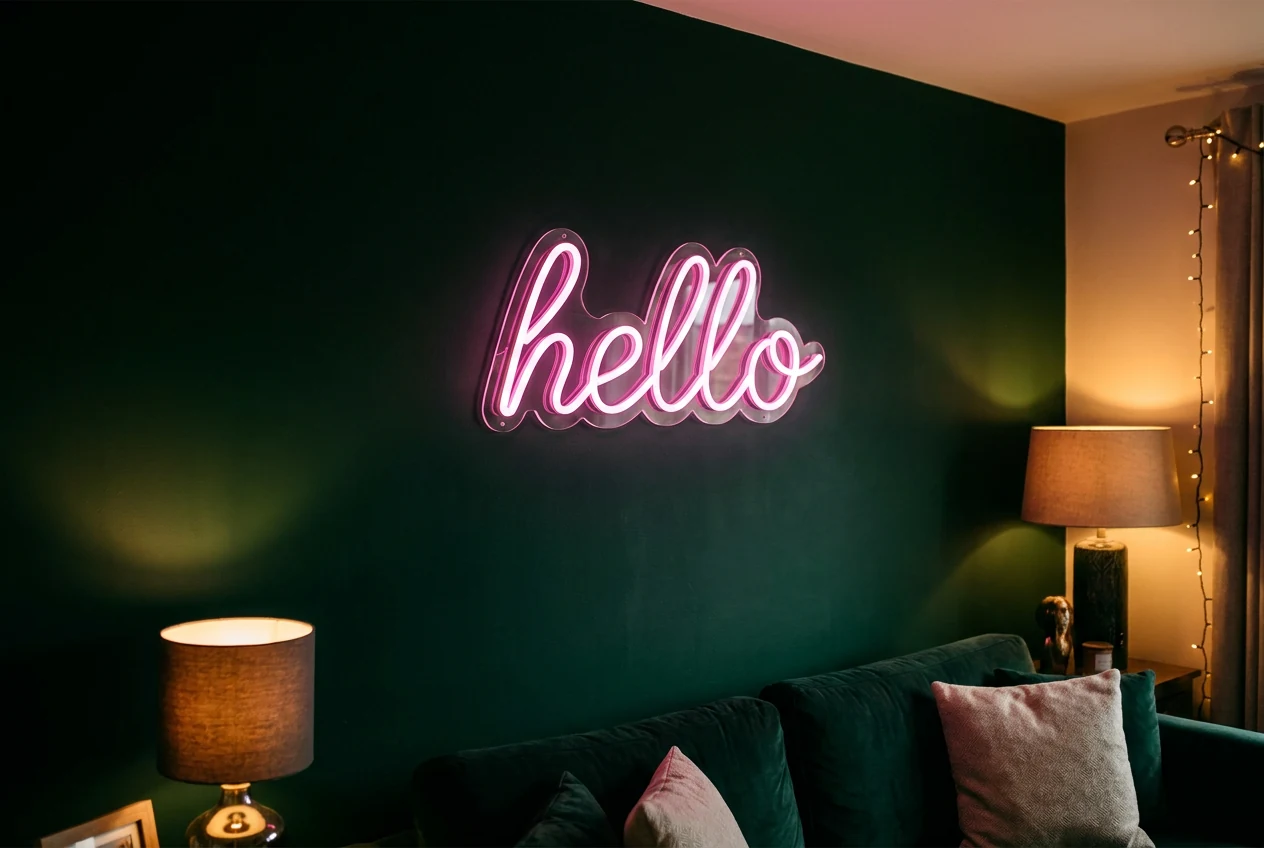
Font choice is where most online configurators fall short. They offer 80 typefaces in a drop-down and leave you to guess. In practice, 95 % of Australian neon orders use one of six font families, and matching the family to the message is the secret to a sign that feels right rather than generic. A wedding sign in gaming sans-serif looks comedic, and a video game studio in copperplate script looks confused. The table below maps each family to the message it serves best, with a real Helioneon example for each. If you need inspiration for the wording itself, explore our guide to what to write on a neon sign.
| Font family | Best for | Example | Reading distance |
|---|---|---|---|
| Wedding script (cursive italic) | Weddings, romantic quotes, boutique hotels, beauty salons | “Forever” sign at a Napa Valley wedding venue | 2-5 m, soft and intimate |
| Brush script (handwritten) | Cafes, bakeries, independent shops, friendly home decor | “Hello” in a Miami coffee shop window | 3-6 m, warm and approachable |
| Bold sans-serif | Gyms, gaming setups, modern bars, tech shopfronts | “GAME ON” in a Chicago esports lounge | 5-12 m, punchy and graphic |
| Slab serif | Craft beer, barbershops, vintage taverns, deli signs | “THE CROWN” on an Austin bar wall | 4-10 m, masculine and confident |
| Geometric monoline | Modern design studios, architecture firms, art galleries | “STUDIO” in a Brooklyn creative loft | 3-8 m, clean and editorial |
| Vintage copperplate | Tattoo parlours, classic barbers, heritage brands | “INK” in a Boston tattoo studio | 3-7 m, traditional and crafted |
One practical detail catches many first-time buyers: scripts and cursive fonts use roughly 30 % more LED flex tubing per character than block letters, because the lines loop and curl. Therefore, a 1 m wedding script sign costs about 20 % more than a 1 m bold sans-serif of the same width. The aesthetic is worth it for the right context, but the budget conversation should happen before the font is locked. At Helioneon, we always quote both options side by side when the brief allows either.
Where to place a neon sign: 5 placement rules for maximum impact
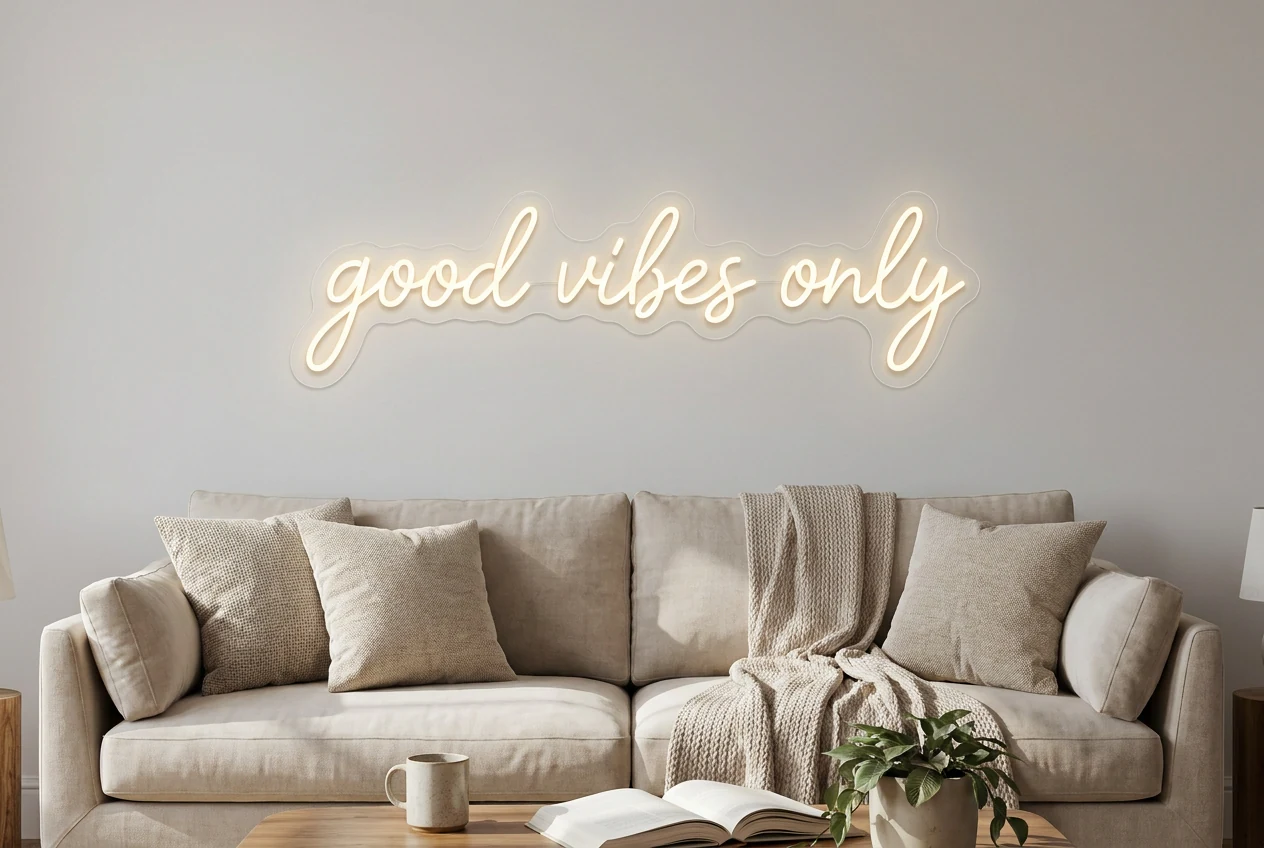
Placement is the silent variable. A perfectly chosen sign on the wrong wall looks like an afterthought, and a modest sign on the right wall steals every photograph. As a general rule, the centre of the sign should sit at eye level when standing, which for most adults sits 160 to 165 cm from the floor for a residential lounge or bedroom. For commercial spaces, raise it to 180 cm so it stays visible above seated guests and clears any furniture in front.
The second rule is breathing room. Leave at least 30 cm of clear wall space around the panel, because the LED glow spreads roughly 20 cm beyond the acrylic edge. A neon sign reading HELLO mounted in a Boston boutique last month was originally placed 8 cm from a doorframe, and the soft pink halo washed straight onto the white frame. We moved it 25 cm to the left and the impact tripled.
- Eye-level rule: centre at 160-165 cm for home, 180 cm for commercial.
- Breathing room: 30 cm of clear wall space on all four sides.
- Power power point distance: aim for less than 2 m to the nearest wall power point.
- Wall colour contrast: dark or mid-tone walls amplify the glow, white walls flatten it by day.
- Photo-friendly framing: leave space for a sofa, headboard or counter to anchor the composition.
For commercial installs, the cleanest finish is a recessed power point placed directly behind the panel. It hides the driver and the cable entirely, and the sign appears to float on the wall with no visible wiring. We did this for a SoHo cocktail bar in February 2026, and the bar manager described the result as the difference between a finished space and a building site. A licensed electrician charges roughly A$330 to A$560 for this work, and it pays for itself in social media photo quality within a week. In Australia, fixed installations follow AS/NZS 3000 (the Wiring Rules); work on the fixed installation must be done by a licensed electrician.
Voltage, IP rating and safety: the technical box to tick
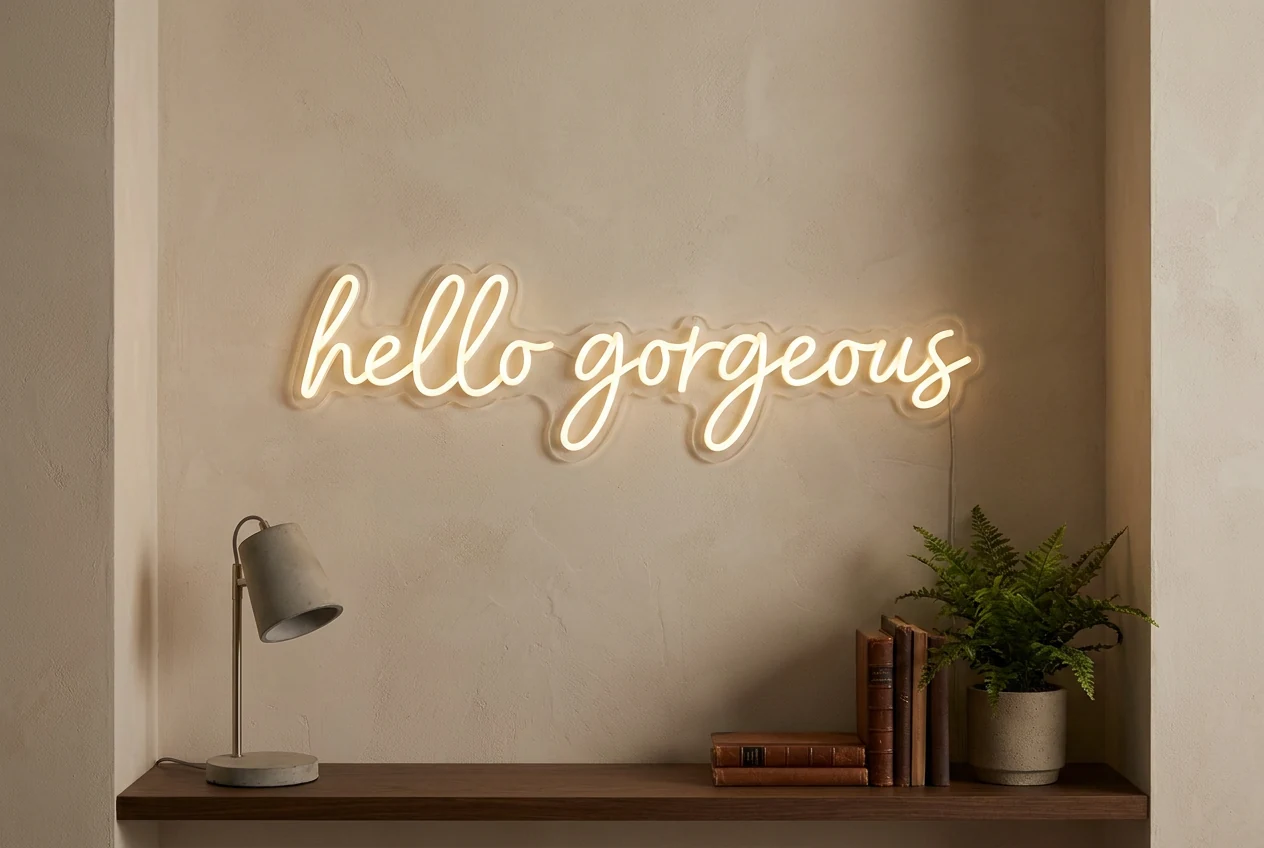
Voltage is the boring decision that quietly protects you. Every modern LED neon sign runs at low voltage, almost always 12 V, with a small black driver that converts the 230 V Australian supply down to the safe level the LEDs need. This matters for two reasons. First, low voltage means the silicone tube runs cool to the touch and stays safe around children and pets. Second, indoor installs become plug-and-play, with no electrician required for a standard wall-mounted sign plugged into an ordinary power point.
The IP rating tells you where the sign can live. IP20 is the indoor standard, protected against fingers and solid objects but not against water. IP65 is the outdoor and wet-area standard, fully dust-tight and sealed against direct hose spray, which is what you need for any shopfront, bathroom, kitchen splash zone or covered terrace. The international standard IEC 60598 governs both ratings for luminaires worldwide and is the reference any reputable Australian supplier follows.
- Voltage: 12 V low voltage for almost every Helioneon sign, safer and cooler than line voltage.
- Indoor IP20: standard for living rooms, bedrooms, offices, indoor restaurants.
- Outdoor IP65: required for shopfronts, terraces, garden walls, bathroom installs.
- RCM marking: the Regulatory Compliance Mark for electrical products in Australia, and what an inspector looks for.
- AS/NZS 3000: the Wiring Rules for fixed installations in Australia; work on the fixed installation must be done by a licensed electrician.
Across 500+ delivered Helioneon projects, we observe that roughly 85 % of Australian orders are IP20 indoor and 15 % are IP65 outdoor or wet-area. The price gap between the two ratings reaches A$420 on a 1 m piece, mainly because the IP65 build uses UV-stabilised silicone, sealed connectors and a weatherproof driver enclosure. Therefore, if there is any doubt about the install location, ask for IP65 from the start. The upgrade is far cheaper than swapping the sign out 18 months later when the silicone yellows.
Hub of the Australia Helioneon guides: your next reads after this
This article is the central hub of the Australia Helioneon blog, because it covers every input that feeds into the four other technical guides. Once you have settled on size, font, colour, placement and voltage, the next layer of detail sits in four companion articles, each going deep on one specific question that comes up after the design brief is approved.
- Cost: see the full price breakdown by size, complexity and IP rating in Custom neon sign cost Australia, with itemised averages versus Helioneon rates.
- Installation: step-by-step wall mounting on plasterboard, brick, tile and outdoor walls in How to install a LED neon sign, with the step-by-step Australian install guide.
- Running cost: annual electricity cost (figures given as examples at US average residential rates; in Australia rates vary by state and retailer, and the government comparison site Energy Made Easy lists offers, so use your retailer's tariff) in LED neon sign power consumption, with kWh per metre and dimmer savings.
- Lifespan: the 100,000-hour rating explained in LED neon sign lifespan, plus the 3-year Helioneon warranty conditions and care tips.
Read in that order, the five-article cluster gives you a complete Australian buying framework, from the first design decision to the last day of the warranty period. Most Helioneon Australia buyers tell us they spend roughly 20 to 30 minutes across the cluster, then come back to the configurator with a clear brief and zero hesitation on the technical line items. To order a bespoke LED neon Helioneon Australia piece, you can request a free 3D mockup within 24 hours from the homepage, with no card details required.
Frequently asked questions about how to choose a neon sign
How do I choose a neon sign size for my room?
The simplest rule used by Australian signage designers is the distance-divided-by-ten formula: every metre of viewing distance needs roughly 10 cm of capital letter height to read comfortably. So a sign read from 3 metres wants 8 to 10 cm letters and a panel width of 60 to 80 cm. A sign read from 6 metres across a restaurant wants 18 to 20 cm letters and a 1.2 to 1.4 m panel. Across our 500+ Helioneon projects, roughly 65 % of Australian orders fall in the 60 cm to 1.2 m range, because most rooms sit in the 3 to 6 metre viewing window. If in doubt, default to 80 cm for a home and 1.2 m for a commercial install.
Which colour should I choose for my neon sign?
Pick a colour that holds contrast against the wall both during the day and at night. White walls suit hot pink, royal blue, cherry red and emerald green, while dark walls (navy, charcoal, oxblood) suit warm white, amber, baby pink and lavender. South-facing rooms with strong daylight need saturated colours because pastels visually disappear in bright light. The Helioneon palette covers 18 shades grouped into whites, pinks, reds, oranges, blues, greens and purples, with a free 24-hour 3D mockup showing the sign on both a light and a dark wall before production. That preview removes 95 % of post-delivery surprises.
Which font is best for a neon sign?
It depends on the message. Wedding scripts and cursive italics suit romantic quotes, boutique hotels and beauty salons. Brush script works for cafes, bakeries and friendly home decor. Bold sans-serif carries gyms, gaming setups and modern bars. Slab serif fits craft beer, barbershops and vintage pubs. Geometric monoline matches design studios and galleries. Vintage copperplate works for tattoo parlours and heritage brands. As a practical note, scripts and cursive fonts use roughly 30 % more LED flex tubing per character than block letters, so a script sign costs about 20 % more than a sans-serif of the same width. Helioneon quotes both side by side when the brief allows either.
Where should I install my neon sign on the wall?
Centre the sign at eye level when standing, which for most adults sits 160 to 165 cm from the floor for a residential lounge or bedroom. For commercial spaces like a hotel reception or a bar back wall, raise it to 180 cm so it stays visible above seated guests. Leave at least 30 cm of clear wall space on all four sides, because the LED glow spreads roughly 20 cm beyond the acrylic edge and looks tighter when it has somewhere to bounce. Aim for less than 2 metres to the nearest wall power point, and consider a recessed power point behind the panel for commercial installs to hide the cable and driver entirely.
Do I need an IP65 outdoor neon sign or is IP20 enough?
IP20 is the indoor standard, protected against solid objects but not against water, and it covers living rooms, bedrooms, offices and indoor restaurants. IP65 is fully dust-tight and sealed against direct hose spray, which is what you need for shopfronts, covered terraces, garden walls, bathroom installs and kitchen splash zones. The price gap between the two ratings reaches A$420 on a 1 m piece, because IP65 uses UV-stabilised silicone, sealed connectors and a weatherproof driver enclosure. Across our Australian projects, roughly 85 % of orders are IP20 and 15 % are IP65, and if there is any doubt about the install location, ask for IP65 from the start.
Can I see the design before placing an order?
Yes, every Helioneon Australia quote includes a free 3D mockup delivered within 24 hours, with no card details required. The mockup shows the exact letter shapes, dimensions in centimetres, colour rendering on both a light and a dark wall, and the position of the power cable. You can request unlimited revisions to the font, colour or size before the production stage is engaged. Most Australian buyers approve the mockup on the first or second iteration, then receive the finished sign by tracked courier within 7 to 10 days with a 3-year warranty as standard. The 5/5 rating on Trustpilot reflects how often the delivered sign matches the mockup exactly.
Ready to choose a neon sign that fits your wall, your brand and your budget? Send your design brief to Helioneon Australia and receive a free 3D mockup plus an itemised quote within 24 hours, with prices from A$550 a 3-year warranty, 100,000-hour LED life, IP65 outdoor option, 7 to 10 day delivery and the same craftsmanship trusted by Accor, Pullman, Radisson, Air France and Jacquemus.
Your custom neon, designed for free in 24 h
- Describe your ideaA text, a logo or a simple sketch. It takes one minute.
- Get your mockup and priceWithin 24 h by email, no commitment.
- Approve, we make itFree express delivery in 7 to 10 days, set up in 3 minutes.
- Mockup and price within 24 h, no commitment
- Free express delivery, received in 7 to 10 days
- 3-year warranty, set up in 3 minutes
Get your free mockup

Guillaume Schlupp
Founder of Helioneon
Over 10 years of entrepreneurship in premium interior design. 500+ LED neons delivered across 13 countries under Helioneon and Light Genius. Leads product strategy, design and professional accounts.